(Money Today) The Pension Issue That Shook France’s Streets and Germany’s Cabinet — The 70-Year “Generational Contract” Is Breaking Down (November 8, 2026)
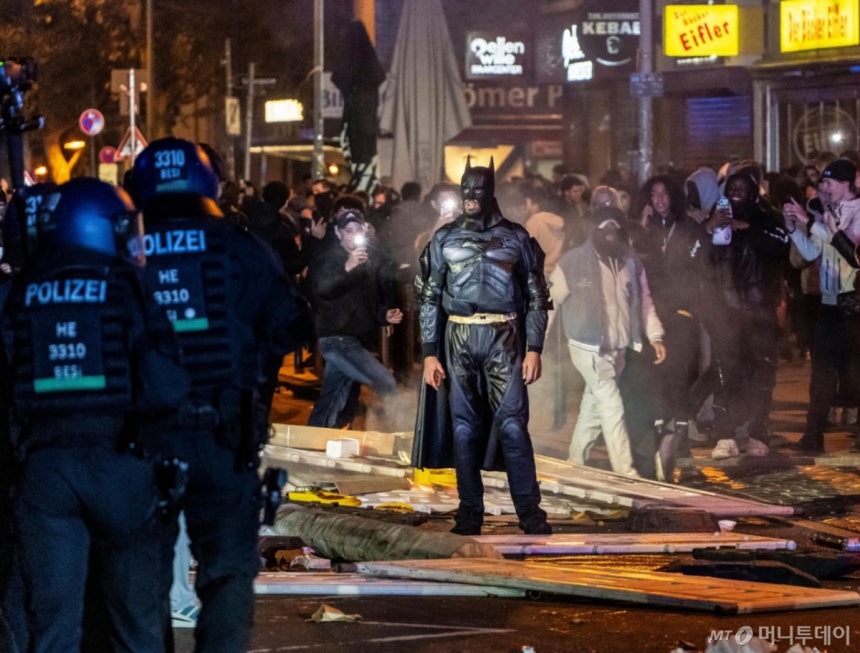
[Frankfurt=AP/Newsis] On the 31st of last month (local time), a person dressed as Batman faces off against riot police in Frankfurt, Germany. That day, a youth group called “GenZ regelt” (Gen Z Will Sort It Out) held nationwide rallies under the slogan “Our future is in our hands.” 2026.11.01. /Photo=Min Kyung-chan
[Sunday Morning Insight]
Europe’s Bill for “From the Cradle to the Grave” —
Pensions Are Swallowing National Budgets
[Editor’s Note]
Uncertainty in global society has grown with the launch of the second Trump administration, the advance of AI, climate change, and more.
Every Sunday morning, “Sunday Morning Insight”
delivers the wisdom to navigate a world of growing uncertainty, with in-depth perspectives and sharp analysis.
Europe’s pension crisis has become not a future demographic problem but a present fiscal one. As retirees increase and the working generation that pays contributions shrinks, high interest rates have even driven up the cost to governments of covering the shortfall with government bonds. Europe’s pay-as-you-go pensions, in which the working generation and the national treasury support the pensions of the retired generation, have now gone beyond being a welfare system and turned into a variable that shakes budgets, government bond markets, and the stability of governments.
From the 9th, the French Senate will deliberate the 2027 Social Security Financing Bill in the government’s original version. When the lower house rejected the revenue section on the 23rd of last month, the bill as a whole was rejected, and the pension provisions were never even taken up in the lower house. The constitutional deadline for parliamentary deliberation (50 days) expires on the 26th of this month. The point of contention is pensions. The government bill provides for fully reflecting price increases in small pensions of 1,260 euros or less a month, while capping the increase for pensions above that level.
France has already experienced one political retreat. In March 2023, President Emmanuel Macron pushed through a reform raising the statutory retirement age from 62 to 64 without a vote in the lower house, using Article 49.3 of the Constitution. The price was months of street protests. Subsequently, the 2026 Social Security Financing Act suspended this increase until January 2028. As a result, according to France’s Pensions Advisory Council (COR), retirement at 64 will apply from those born in 1969 rather than, as originally planned, those born in 1968. The pension burden is also spilling over into generational conflict.

View original [Paris= AP/Newsis] On the 5th (local time), protesters demanding wage increases and a larger education budget climb a monument and wave the French flag in Paris, France. 2026.11.06. /Photo=Min Kyung-chan
Germany is no different. In June, the government’s Old-Age Security Commission recommended linking the retirement age to life expectancy and abolishing the so-called “pension at 63,” an early pension without reductions for those with 45 years of contributions. The coalition of the Christian Democratic Union and Christian Social Union (CDU/CSU) and the Social Democratic Party (SPD) announced in early July that it would implement the recommendations comprehensively, but in August internal disagreements over abolishing the “pension at 63” broke out into the open. In the Politbarometer survey conducted by the German public broadcaster ZDF on the 20th–22nd of last month, 74% opposed abolishing the “pension at 63” and 21% supported it.
The political timetable has also become tangled. Labor Minister Bärbel Bas, who had been in charge of the bill, resigned on the 12th of last month. The government bill had not been finalized by then. The successor, Minister Alexander Schweitzer, has long opposed abolishing the “pension at 63.” In effect, the key to the reform has ended up in the hands of an opponent. Immediately after taking office, Minister Schweitzer pledged to seek a compromise on the “pension at 63,” and within the CDU/CSU parliamentary group, too, a compromise that keeps the scheme but changes its eligibility requirements is being floated. Chancellor Friedrich Merz has publicly pledged to pass the reform within the year, but it has become increasingly likely that deliberation in the Bundestag and the Bundesrat will slip into the first quarter of 2027.
In this [Sunday Morning Insight],
we traced the roots of the pension conflicts shaking France and Germany, examining how Europe’s pay-as-you-go pensions were built, why they have now become a bill that shakes national finances and governments, and how Denmark, the Netherlands, and Sweden sidestepped that shock.
◇The Toxic Provisions Are Built into the System
The reason the pension debates in France and Germany explode again and again is not a simple shortage of funds. It is that political promises that are hard to reverse have piled up, layer upon layer, inside the systems themselves.

View original Photo=OECD 'Pensions at a Glance 2025' data book table, AI-translated into Korean
The French civil servants’ pension pays up to 75% of basic pay over the last six months. The basis is not lifetime average earnings but pay at the end of a career. Pension schemes, divided by occupation, number as many as 42. Attempts to unify them have been thwarted time and again. In 1995, Prime Minister Alain Juppé withdrew the reform plan under pressure from massive strikes. The universal points-based system that the Macron administration pursued in 2019 was halted by the COVID-19 crisis in 2020.
The political landscape is even worse. The first round of France’s 2027 presidential election is scheduled for April. Former Prime Minister Gabriel Attal has called for resuming the increase to 64, while the National Rally (RN) is pledging a return to 62. Within the RN, however, there are differences in tone between Deputy Marine Le Pen and party President Jordan Bardella. In France’s 2027 presidential election, pensions have shifted from being a welfare pledge to a core issue that will decide the sustainability of the nation’s finances.
Germany’s toxic provisions are the “pension at 63,” introduced in 2014, and the mothers’ pension. The “pension at 63” lets those with 45 years of contributions draw a pension early without reductions. The eligibility age has risen in stages and now stands at 64 years and 6 months, but the name has remained unchanged. Mothers’ Pension I (2014) and II (2019), which credit child-rearing periods as pension contribution periods, cost 13.5 billion euros a year. The special provisions have grown rather than shrunk. The pension package passed last December added Mothers’ Pension III from January next year, at a cost of roughly another 5 billion euros a year. On top of this, the 48% floor on the statutory pension’s income replacement rate was extended to 2031. The sustainability factor introduced in 2004 is a mechanism that automatically lowers pension increases when the old-age dependency ratio rises. But the 48% floor has effectively sealed off this automatic mechanism’s room to operate.
Other countries are caught in the same structural trap. Italy is still paying the cost of its “baby pensions,” which from 1973 to 1992 allowed female civil servants with children to receive a pension after working only 14 years and 6 months. According to Italy’s National Social Security Institute (INPS), the cumulative number of recipients is about 256,000, and even now 2.9 billion euros a year is paid out on 185,000 pensions. In 2021, Spain abolished, before it had even taken effect, a sustainability factor designed to cut new pensions automatically as life expectancy rose, and replaced it with an “Intergenerational Equity Mechanism (MEI)” that collects more in contributions.
Britain’s “triple lock” raises pensions by the highest of the inflation rate, the wage growth rate, and 2.5%. When prices jump, pensions follow prices; when wages rise faster, they follow wages; and even if both are low, they rise by at least 2.5%. But there is no adjustment in the opposite direction. Even after prices and wages stabilize again, the pension amount raised in the previous year is not cut and becomes the starting point for the next year’s increase. As a result, temporary inflation or a wage surge does not end as a one-year cost but becomes a permanent baseline that raises pension spending in every subsequent year. It is called the “ratchet effect,” in the sense that a cog, once raised, does not slip back.
◇Bismarck’s System Was Funded
European pensions have two roots. One is the contribution-based, earnings-related type created in 1889 by German Chancellor Otto von Bismarck. The other is the flat-rate, basic-protection type proposed in Britain’s 1942 Beveridge Report.
Bismarck’s pension was originally a funded system. Germany moved to pay-as-you-go, under which retirees’ benefits are paid from the contributions of the working population, with Chancellor Konrad Adenauer’s reform in 1957. That came after two world wars and hyperinflation had wiped out the reserves. Postwar high growth and the baby boom made this transition possible. While the labor force grew and wages rose, pay-as-you-go looked like the welfare state’s most efficient fiscal technique.
Today Europe’s public pension systems fall into three groups. France, Italy, Spain, and Greece are high-benefit, high-burden pay-as-you-go countries. They maintain a structure in which the pensions of the retired generation are paid from contributions made by the working generation, yet their benefit levels are high. According to the OECD’s “Pensions at a Glance 2025,” the net income replacement rate for average earners is 70% in France, 79% in Italy, 86% in Spain, and 89% in Greece, above the OECD average of 63%. Contribution rates also reach 27% in France and 33% in Italy. The problem is that the faster population aging proceeds, the more contributions and fiscal injections this structure demands.
Denmark, the Netherlands, and Sweden layered occupational and individual funded pillars on top of the basic pension and attached mechanisms that automatically adjust benefits or eligibility ages according to life expectancy, wages, and the like. It is an approach that spreads the fiscal burden through rules within the system rather than through political decisions.
Germany and Britain lie in between. Germany maintains a pay-as-you-go public pension but reflects demographic change in its benefit formula through the sustainability factor. Britain keeps a low flat-rate state pension as its base and, in 2012, introduced automatic enrollment in workplace pensions, raising participation in private pensions. Both countries follow a hybrid model that seeks sustainability through system adjustments and a strengthened private pillar rather than guaranteeing old-age income through public pensions alone.
◇“Pension Depletion” Arrives as a Treasury Deficit

View original Photo=BCG Henderson Institute graphic, AI-translated into Korean
In pay-as-you-go countries, large reserves holding decades’ worth of benefits, like those of Korea’s National Pension, are not the norm. So rather than a “fund depletion year” arriving, the shortfall is covered every year by the treasury and government bonds. It is a structure in which a pension crisis is at once a fiscal crisis. High interest rates have magnified that cost. According to the French think tank iFRAP, French general government interest costs in the second quarter of this year rose 17.4% from a year earlier.
In its report “Old Continent, New Growth,” released in January, the Boston Consulting Group (BCG) Henderson Institute found that, counting contribution revenue alone, the public pensions of the four countries Germany, France, Italy, and Spain already fall short of their expenditures by 2–6% of GDP. That is as of 2024. Taxes fill this gap. The deficits announced by each country’s pension authorities look much smaller than this because state subsidies and earmarked taxes are already booked as revenue.
In its annual report in June, France’s COR said French pensions ran a deficit of 5.1 billion euros last year, about 0.2% of gross domestic product (GDP). The deficit ratio stays at this level until 2030 and then widens to 0.9% in 2045 and 2.4% in 2070. Pension spending rises from 14.1% of GDP to 15.3%.
According to the German Pension Insurance (DRV), the statutory pension’s buffer fund stood at 41.3 billion euros at the end of last year, equal to just 1.38 months of payments. By the end of 2027 it will shrink to 0.36 months’ worth. Filling the gap would require raising the contribution rate from 18.6% to 19.9% in 2028.
◇Why the Retirement Age, of All Things?
Governments cling to the retirement age because its fiscal effect is the largest. The payout period shrinks and the contribution period lengthens.
The French Court of Audit estimated that raising the retirement age to 65 would improve the pension balance by 8.4 billion euros in 2035, while returning it to 62 would worsen it by 10.4 billion euros. The COR judged that balancing the books through the retirement age alone would require the average retirement age to reach 64.4 in 2030, 65.8 in 2045, and 67.6 in 2070. Raising the retirement age becomes fiscal reform, however, only when the labor market absorbs it. According to France’s National Institute of Statistics and Economic Studies (INSEE), the employment rate for those aged 60–64 rose from 42.4% in 2024 to 44.4% last year, after the 2023 reform took effect, but it is still lower than in Europe’s major economies. If people who delay retirement cannot find jobs, the cost merely moves from the pension account to the unemployment-benefit and disability-benefit accounts.
On the 1st, The Wall Street Journal (WSJ) featured the case of Marie Caron, a 61-year-old French jobseeker. After losing a job in finance last December, Caron went through seven interviews this year and was turned down every time. Yet a pension is still far off. Caron can begin drawing it only at 63, and must hold out until 66 to receive a full pension. The government says people “must work longer,” but the case shows the reality that companies rarely hire jobseekers in their 60s. Behind the numbers of pension reform lies this kind of gap: a period in which retirement has been pushed back but jobs are not guaranteed.
Because the retirement age is the most visible reform tool, it also meets the strongest resistance. In 1993, France passed, without much conflict, a reform that lengthened the reference period for calculating pensions and indexed pensions to prices. But the 2023 reform, which touched the age directly, provoked the largest protests. The burden falls more heavily on low-income and manual workers, whose life expectancy is shorter. This is why Germany’s Old-Age Security Commission, together with abolishing the “pension at 63,” proposed as an alternative a “protection pension” for workers who retire early for health reasons.
◇Butterfly Effect: Pensions Erode Education, Policing, and Care Budgets
The pension bill crowds out other budgets. According to the “Report on Civil Service Pensions,” which the French government released for the first time on the 13th of last month as an annex to the 2027 budget bill, 28.5 billion euros (32%) of the Ministry of Education’s 89.1 billion-euro budget goes to fund civil servants’ pensions. Thirty percent of the Interior Ministry’s (policing) budget, and 13% on average across all ministries, goes out as pensions for retired civil servants. The report pointed out that from 2000 to 2023, while pension spending rose by 2.5 percentage points of GDP, education spending fell by 0.5 percentage points.

View original Photo/French Pensions Advisory Council (COR) graphic, AI-translated
In its 2027 budget bill, the French government increased the Ministry of Education’s budget by 1.1 billion euros, but the financial strain in schools was not relieved. This is also where the youth protests erupted. The protest on the 6th against “underfunded schools” drew 256,000 participants by the Interior Ministry’s estimate and 450,000 by the organizers’. The government’s 54 billion-euro austerity plan even includes a freeze on civil servants’ pay.
Germany puts 29% of federal tax revenue, about 127.4 billion euros, into subsidies for pension insurance. The DRV has warned that if the government cuts the 2027 subsidy by 4 billion euros, the timing of the contribution increase will be brought forward. In Britain, Prime Minister Andy Burnham said at the Labour Party conference on September 29 that from April 2030 the triple lock would be revised and the resulting funds used to create a free National Care Service. The idea is to switch to a “double lock,” raising pensions by the higher of inflation or 2.5% while maintaining their value relative to wages over the long term. Pension and care budgets have begun to collide head-on.
According to the OECD, Italy and Greece spend 28.7% and 28.5%, respectively, of total government expenditure on pensions. That means more than a quarter of government spending goes to pensions. The welfare state’s problem is no longer only the size of spending. The crux is which generation’s spending is displacing that of another.
◇Implications for Korea: Make the Rules While the Fund Still Exists
The lesson Europe’s pension crisis holds for Korea is not simply to raise contribution rates further. The key lies in the rules by which promises already made will be revised.
The National Pension is not pay-as-you-go but a partially funded system that has built up a fund. According to the National Pension Service, as of the end of June 2026 the fund’s reserves stood at 1,866 trillion won, and the money-weighted rate of return for the first half was provisionally tallied at 27.22%. Last year, too, it earned 231.6 trillion won. While the fund is ample, European-style conflicts over contribution increases and treasury injections are not felt right away. That very fact could become the first trap.
While the fund remains, the crisis is hard to see. But the moment the fund loses its buffering role, Korea too will be directly exposed to the debates over contribution rates and treasury burdens that continental European countries face. The Fifth National Pension Financial Projection of 2023 found that if the system were left as it is, the pay-as-you-go cost rate would reach 35.0% in 2078. That means paying pensions from that year’s contributions alone, without a fund, would require collecting 35% of workers’ incomes. That is higher than in France (27%) and Italy (33%). Last year’s parametric reform pushed the fund depletion date back to 2064. But projections show that applying the reform (a 13% contribution rate and a 43% income replacement rate) would actually raise the pay-as-you-go cost rate in 2078 to 37.5%. Having decided to pay more, Korea also faces a larger bill after fund depletion. That cost rate is almost three times the reform’s final target contribution rate (13%) for 2033.

View original Photo=BCG Henderson Institute graphic, AI-translated into Korean
The “fund depletion year” is not the end but the beginning of European-style treasury deficits. Fund returns do not always trend upward, either. The sharp market drop this past July showed another face of the fund. The larger the fund, the bigger the swings that market shocks cause in its book valuation. At the time, the valuation of the National Pension Fund fell by about 181 trillion won in a single month.
The second trap is that an ample fund may actually weaken the momentum for reform. The higher the fund’s returns and the larger its reserves, the greater the incentive for the political sphere to regard structural reform as less urgent. That is why critics say that relying on a stock market boom for the sustainability of pension finances is a matter not of system design but of depending on luck.
Germany’s experience shows that buffer funds can be used to finance political special provisions. The 2013 grand coalition diverted about 30 billion euros in reserves accumulated in pension insurance to fund the “pension at 63” and the mothers’ pension. It also froze the contribution rate at 18.9%, which by law should have been lowered, to pay for the special provisions. The automatic mechanism introduced in 2004 was subsequently sealed off by the floor and the special provisions. In June, the Korean government left structural reform plans out of its work report to the National Assembly Special Committee on Pension Reform. At a press briefing marking the first anniversary of taking office, President Lee Jae-myung said of structural reform that “it has become something we will not need to do for quite some time.” Optimism that leans on a stock market boom resembles the very scene that Germany left behind as a cautionary example.
The third is the design of an automatic adjustment mechanism. In Korea, the automatic adjustment mechanism is the issue on which the ruling and opposition parties are most sharply opposed, because it is read as a device that automatically cuts benefits according to fertility and life expectancy. Sweden’s answer was symmetry and consensus. It wrote into law both a “brake” that cuts increases when there is a deficit and an “accelerator pedal” that distributes surpluses when they accumulate. Changing the system requires the consent of every member of the cross-party Pension Group. The key is not so much introducing the mechanism as ensuring that it cannot be breached by special provisions even when governments change.
Fourth, the retirement age and employment must be considered together. In Korea, mandatory National Pension coverage ends at age 59, but the pension eligibility age is being pushed back to 65 by 2033. That is why proposals have emerged to raise the mandatory coverage age to 64. But if only the age is raised, without jobs for older people and an overhaul of the wage system, the problem may simply shift from pension finances to unemployment and welfare spending. Pension reform cannot be sustained merely by demanding that people pay longer and receive later. It must be designed together with a labor market in which people can work longer.
In the end, Europe’s lesson is not to miss the moment for reform. Because France failed to institutionalize sufficiently the social-consensus rules for adjusting pension promises, it has repeated clashes in the streets with every reform. Germany introduced an automatic adjustment mechanism in the form of the sustainability factor, but as the floor on the income replacement rate and political special provisions piled up, the mechanism’s room to operate narrowed. Korea still has a buffer in the National Pension Fund. But the moment this buffer becomes a pretext for postponing reform, the fund becomes not a safety valve but an illusion of fiscal stability. The rules for adjusting pension promises must be made while the fund still remains. Once older voters have become the political majority, the political cost of making those rules will be far greater.
Reporter Kim Ha-nui ([email protected])