(Seoul Economic Daily) [Direct Opinion] “The First Step Must Be an Unvarnished Fact Report on How Grave the Pension Situation Is” (October 25, 2023)
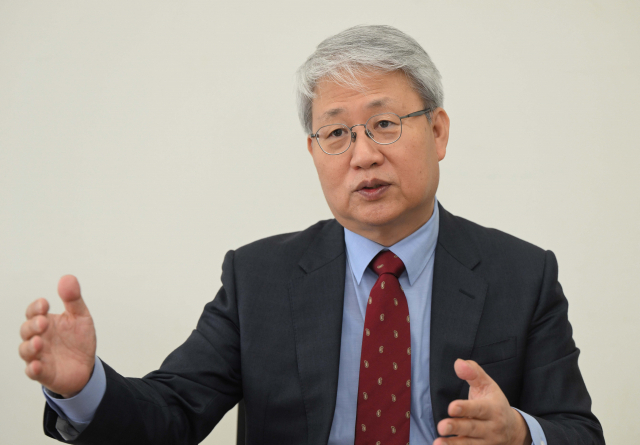
Yun Suk-myung, Research Fellow Emeritus at the Korea Institute for Health and Social Affairs (KIHASA), on October 25, in an interview with the Seoul Economic Daily,
argues that “the unfunded pension liability—the pensions promised to National Pension contributors minus the 1,000 trillion won in the accumulated fund—will reach 1,825 trillion won at the end of this year, exceeding 80% of gross domestic product (GDP),” stressing the need for a “
pay more and receive later” reform. Reporter Lee Ho-jae
◆Yun Suk-myung, Research Fellow Emeritus, Korea Institute for Health and Social Affairs
(Including the Government Employees Pension and the Private School Teachers Pension…
even bringing the gravity of the situation into public deliberation would be a success
Unfunded pension liability promised
to National Pension contributors amounts to 80% of GDP
Japan has accumulated 100 years’ worth of pension reserves, Canada 150 years’ worth,
Korea only 32 years’ worth
If reform fails, an ordeal harsher than Greece’s “50% pension cut”
will strike)
[Seoul Economic Daily]
Concerns are growing that the National Pension reform pursued by the Yoon Suk-yeol administration could instead go backward.
This is because the National Pension Financial Estimation Committee submitted to the government a final pension reform report containing 24 scenarios in department-store fashion, and the government, too, is expected to unveil on the 27th a plan that contains only the direction of reform, without specific figures.
If pension reform falls through, the burden on future generations will snowball.
In an interview with the Seoul Economic Daily on the 25th, Yun Suk-myung, Research Fellow Emeritus at the Korea Institute for Health and Social Affairs,
stressed that “the Yoon Suk-yeol administration must first issue an unvarnished fact report on how serious a situation all the pensions are in—not only the National Pension but also the Government Employees Pension, the Private School Teachers Pension, and the others.”
He warned that “if pension reform fails, we could be forced from outside to undergo an ordeal even harsher than that of Greece, which had 50% of its pensions cut.”
Original
-With the National Pension Financial Estimation Committee’s final report including even a proposal to raise the income replacement rate so as to “receive more,” concerns are being raised that pension reform could go backward.
△I have taken part in every Financial Estimation Committee, which meets every five years, from the first through the fifth, but the committee has never made such an irresponsible proposal. The members agreed on raising contributions, but on the income replacement rate they were split between keeping it and raising it, clashed, and failed to narrow their differences.
-How bad is the National Pension’s financial outlook?
△The projected pension amount promised to National Pension contributors stands at 2,825 trillion won as of the end of 2023. Excluding the 1,000 trillion won in the accumulated fund, the unfunded liability is 1,825 trillion won, more than 80% of this year’s projected gross domestic product (GDP). With about 22 million contributors, that means each contributor is already carrying a debt of 85 million won. By 2050, 27 years from now, contributors will fall to 15 million, but the unfunded liability will grow to about 5,538 trillion won, raising the debt per person to 360 million won. The Private School Teachers Pension has 330,000 contributors, and its unfunded liability as of the end of 2022 was 176 trillion won, which means each contributor is carrying a debt of more than 500 million won.
-Which pension is in the most serious financial condition?
△The Private School Teachers Pension is the worst, and reform is urgent in the order of the Government Employees Pension, the Military Pension, and the National Pension. For the Military Pension, some exception should be made, since those responsible for national defense are not numerous. The Government Employees Pension has serious problems, but a provision for a state guarantee of benefit payment has at least been put in place. The Private School Teachers Pension, however, has nothing of the kind.
-Does that mean they intend, in the end, to cover even the Private School Teachers Pension fund’s shortfall with taxes?
△I wonder whether they are counting on the powerful hospital labor unions and on the influential Seoul National University professors who moved from the Government Employees Pension to the Private School Teachers Pension when the university was incorporated. I am concerned that, instead of thinking about fixing the system, they may try to solve the problem through a state guarantee of benefit payment, as with the Government Employees Pension.
-If the state guarantees payment for all the pensions, can public finances hold up?
△That amounts to saying, let us ruin all the pension schemes together. To pay Private School Teachers Pension benefits, contributions would have to rise to 30% of income around 2043, when the fund is projected to be depleted, and to 46% by 2093. National Pension contributions are estimated to need to rise to 35% of income. The tax-funded deficit subsidy for the Government Employees Pension is also projected to surge from 4.4 trillion won last year to 6.1 trillion won this year.
-Some point out that if pension reform is left unattended, Korea could follow in the footsteps of Greece, which received a bailout from the International Monetary Fund (IMF) and others.
△In Greece, pension reform was carried out by outside hands amid an economic and fiscal crisis, and the pensions of high-income beneficiaries were cut by 50% at a stroke. Pensions for low-income people were raised instead. Our pension finances are in more serious shape than Greece’s. If reform is imposed from outside, we could be hit even harder. Japan has set aside, and manages as a fund, the money to pay pensions 100 years from now, and Canada 150 years from now.
-How many years’ worth does our National Pension hold?
△Our National Pension Fund is expected to be depleted in 2055, so it holds only 32 years’ worth. The target period for National Pension financial projections and for drawing up supplementary measures is 100 years in Japan and, in Canada, officially 77 years (to 2100) and in practice 150 years, whereas ours is short, at 70 years, and that has a large effect. Canada carries out such financial projections every three years, while we do so every five years.

View original Yun Suk-myung, Research Fellow Emeritus, Korea Institute for Health and Social Affairs. Reporter Lee Ho-jae
-What are the main causes of the deterioration in the fund’s financial outlook?
△Average life expectancy has risen, lengthening the period over which pensions are received, while the economic growth rate has fallen. The rise in the inflation rate to which pension benefits are indexed and the decline in the fertility rate have also had a large effect. We should have carried out a reform that raises the contribution rate and lowers the income replacement rate while delaying the age at which pensions are received, but we failed to do so properly.
-The National Pension contribution rate has remained unchanged for 25 years since it was set at 9% in 1998. Many point out that the political sphere has neglected reform even as fund depletion approaches.
△Pension contributors in major advanced countries currently bear contributions more than twice as high as ours. German contributors have, over the past 50 to 60 years, paid as much as six times more in contributions than we do. Japan’s contribution rate, at 18.3%, is also double ours. In particular, 70% of the member countries of the Organisation for Economic Co-operation and Development (OECD), anticipating the difficulty of political agreement, have even introduced automatic adjustment mechanisms. They feed indicators such as the birth rate, average life expectancy, and the economic growth rate into a pension sustainability factor, so that pensions are cut automatically when the pension system becomes unsustainable. With populism running rampant in the political sphere and the median age that shapes voting (currently 45) rising, introducing an automatic adjustment mechanism is urgent.
-What advice would you give the Yoon Suk-yeol administration on pension reform?
△With a minority ruling party facing an opposition-controlled National Assembly, I will not demand that it complete pension reform. But it is important to issue a “fact report” that shows, from a neutral standpoint and without exaggeration, understatement, or concealment, just how serious a situation our National Pension is really in. Simply bringing into proper public deliberation how serious all the pensions are, including the Government Employees Pension and the Private School Teachers Pension, would have historic significance. For pension reform to succeed, three things must be made public: the minutes of the National Assembly Special Committee on Pension Reform and of the government’s Financial Estimation Committee, the unfunded liability, and the cumulative deficit. The fertility rate has fallen very low, and the economic situation is also very poor. It can be said that the golden opportunity for pension reform has already been missed.
-What is the concept of the cumulative deficit?
△When the National Pension Fund is depleted in 2055, that is not the end; the deficits keep growing. The cumulative deficit is these accumulating deficits converted into present value. If, as the opposition argues, the income replacement rate is raised by 10 percentage points to 50% and contributions are raised in stages from 9% to 12%, fund depletion is delayed by three years, from 2055 to 2058. But the deficit that begins in 2058 and accumulates through 2093 reaches 9,100 trillion won in present value. By the Financial Estimation Committee’s estimate, that is a staggering 95% of GDP in 2093. This does not even include the cumulative deficits of the Private School Teachers Pension and the Government Employees Pension or the Basic Pension budget. If it were covered with taxes, the ratio of national debt to GDP would soar.
-Some argue that the pension system should be changed to an earnings-related pension.
△Korea’s average income replacement rate is low because the income redistribution function is built in, so the income replacement rate for high-income earners comes out low. After achieving a “pay more and receive later” reform, the ceiling on the income on which contributions are levied should be made realistic, together with the introduction of an automatic adjustment mechanism. Among OECD member countries, apart from the United States and a few others, almost none maintain an income redistribution function in their pension systems.
-Would that not lead to pension polarization?
△The Basic Pension should be strengthened instead. For people newly reaching old age, it should be reformed so that it is paid not to the bottom 70% by income but only to those below median income, with more paid to low-income older people. With the funds saved, a 50% income replacement rate could also be guaranteed to low-income people who have faithfully contributed to the National Pension for 20 years or more. Those who are reasonably well off would prepare for old age on their own, while those who could not join the National Pension, or joined only briefly and so could not properly prepare for old age, would be guaranteed a minimum standard of living in old age through taxes. Earnings-related pensions and automatic adjustment mechanisms form the mainstream of the pension systems of the OECD and other advanced countries with long pension histories.
-The retirement age is 60, but the age at which National Pension benefits begin is being pushed back to 65, so people cannot receive a pension for a considerable period after retiring.
△Hardly any country has such an “eligibility age gap” between the time of retirement and the time National Pension benefits begin. To remedy this, the Research Group on Continued Employment in a Super-Aged Society under the presidential Economic, Social and Labor Council is considering introducing a “reemployment after retirement” policy. It is a system under which workers are reemployed after retirement until 65, at pay of about 70% of their previous monthly wage. In Japan, too, 80% of retired workers are working until 65 through this system.
-Is there anything you would like to emphasize in closing?
△Pension reform is difficult because forces seeking to protect their vested interests control information so as not to lose them. It is worth making public the minutes of the bodies involved in pension reform and even considering live internet broadcasts. The Government Employees Pension financial projection reports should also be made public, as they used to be.
◆He is···
Born in 1961 in Yangyang, Gangwon Province, he graduated from the Department of English Language and Literature at Korea University and received a Ph.D. in Economics from Texas A&M University in the United States with a dissertation on social security. He then served at the Korea Institute for Health and Social Affairs as, among other posts, head of its Social Security Research Division. He has served as a member of the first through fifth National Pension Financial Estimation and System Development Committees and of the Government Employees Pension Financial Estimation Committee, as chair of the Basic Old-Age Pension Financial Projection Committee, and as president of the Korean Pension Association. He currently serves as an advisory committee member of the National Assembly Special Committee on Pension Reform and as a Research Fellow Emeritus at the Korea Institute for Health and Social Affairs.
Oh Hyeon-hwan, Editorial Writer ([email protected])