(Seoul Economic Daily) [Direct Opinion] “Problems That Belong to Labor and Welfare Policy Must Not Be Solved Through the National Pension” (May 31, 2019)
'Pay a little more and receive more’—the plan to improve the National Pension system is drawing fierce criticism.
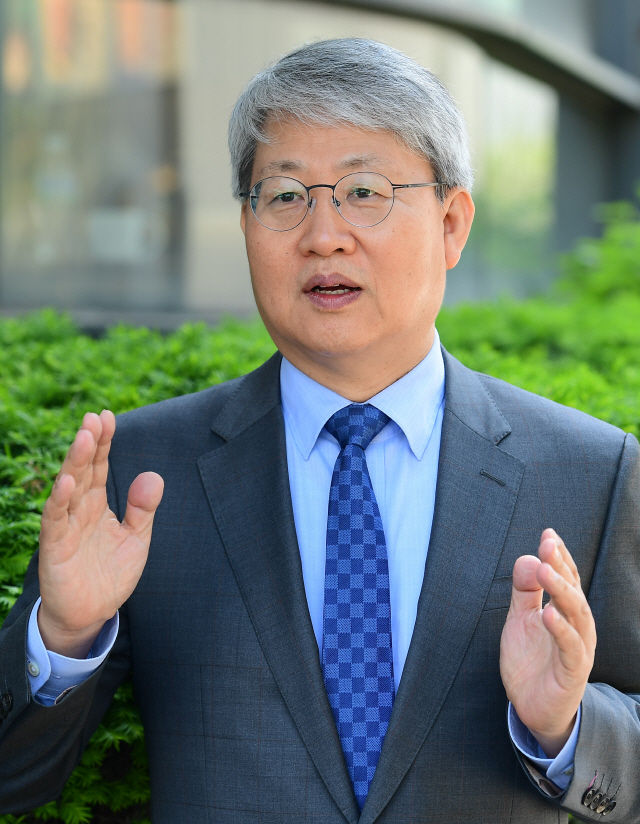
Yun Suk-myung, Research Fellow at the Korea Institute for Health and Social Affairs, stressed that “to make the National Pension system more sustainable and reduce the burden on later generations, reform must be pursued in the direction of paying more and receiving the same or less.” /Reporter Kwon Wook

Yun Suk-myung
Research Fellow, Korea Institute for Health and Social Affairs
Germany pays contributions of around 19%
and receives 48% of income over the contribution period,
while Korea pays 9% and is guaranteed 44.5%
The contribution rate needs to rise to 13.5%
The Basic Pension goes to 70% of older people,
but only the fiscal burden grows while the poverty rate stays the same
Coverage should be narrowed and more given to the vulnerable
[Seoul Economic Daily]
“Under the Canada Pension Plan, people currently pay 9.9% in contributions and receive 24% of their average income over the contribution period (the income replacement rate) as a pension. In response to public opinion that the income replacement rate was low, Canada reached a social consensus to raise it to 33.3% and to raise the contribution rate to 11.9% in a single step.
Of course, it also attached the proviso that contributions could be raised further. Korea, by contrast, is set up to have people pay 9% and receive 44.5% of their average income (for 40-year contributors, falling to 40% in 2028).
Because it is a structure in which people pay less than in Canada and receive about twice as much, it is not sustainable even now.
Yet the government, under the banner of ‘strengthening old-age income security,’ is pursuing a plan that sets the income replacement rate at 45% and raises the contribution rate to 10% in 2021, 11% in 2026, and 12% in 2031.
In other words, it would collect the same level of contributions as Canada only ten years later, yet pay out 1.36 times more in pensions.”
Yun Suk-myung, Research Fellow at the Korea Institute for Health and Social Affairs, said that “the current National Pension system and the government’s overhaul plan merely shift an enormous pension payment burden onto later generations,”
and criticized it, saying that “pushing to raise the income replacement rate in the name of strengthening old-age income security amounts to dumping onto the National Pension problems that should be solved through employment, labor, and welfare policy”.
Research Fellow Yun stressed the need to raise contributions in a way that takes into account the sustainability of the National Pension system and its acceptability to contributors and others.
He said that “it is a misunderstanding that the National Pension System Development Committee recommended raising the pension contribution rate to 17.2%,”
explaining that “we recommended to the government a plan to treat 13.5% as the upper limit to which contributions can be raised and to raise them in stages over ten years.”
-How did the talk of raising the contribution rate to 17.2% come about?
△To avoid placing a burden on later generations, it would need to be raised to 17.2%, but
in consideration of its acceptability to contributors and others, the idea was to raise it only to 13.5% and
to deal with the remaining 3.7 percentage points by introducing a mechanism that cuts monthly pensions in step with increases in the public’s average life expectancy and in the pension receipt period, thereby pursuing the National Pension’s financial stability—
an “automatic adjustment mechanism”—but there was some misunderstanding.
Such mechanisms are already in place in Sweden, Finland, Germany, Japan, and elsewhere. Because a large increase in contributions is difficult, we too need to keep pace with this international trend.
-What is an automatic adjustment mechanism?
△It can differ slightly from country to country, but in Finland, as the public’s average life expectancy rises, the monthly pension amount is multiplied by a life expectancy coefficient and so reduced by a certain percentage.
This is combined with raising the pensionable age (66 years and 2 months for those born in 1975, and 68 years and 1 month for those born in 2000).
With the life expectancy coefficient, the pension actually received is the amount payable under the existing system multiplied by 0.972 in 2015, 0.909 in 2030, 0.860 in 2065, and 0.848 in 2085.
There is also a floor on the life expectancy coefficient so that pension amounts do not fall too far.
Those who live as long as the average life expectancy do not see any reduction in the total pension they receive until death.
By contrast, in Korea’s National Pension, Government Employees Pension, and other schemes, the monthly pension amount is unaffected whether beneficiaries as a whole live five or ten years longer than originally expected.
The longer average life expectancy and the pension receipt period become, the more beneficiaries gain, but this places an enormous burden on the pension fund’s finances.
-What is the income replacement rate of national pensions in the member countries of the Organisation for Economic Co-operation and Development (OECD)?
△About 41% on average.
Korea’s is 44.5% this year on the basis of a 40-year contributor. That is similar to the income replacement rate of 48% (in the low 40s by 2030) in Germany, where contributions are around 19%.
Korea’s contribution rate is less than half of Germany’s, but its income replacement rate is similar to Germany’s.
Of course, because the share of non-regular workers and of those who retire before the retirement age is high, and the National Pension’s history and average contribution period are short, the effective income replacement rate and the average pension amount are low.
In Germany, many people contribute for around 40 years, so the gap between the nominal and effective income replacement rates is small. Even so, the average pension amount is about 1.2 million won a month in Korean currency.
It is an illusion that Germany and other advanced countries pay generous pensions. The sense of relative deprivation caused by the excessively large pensions drawn under the Government Employees, Military, and Private School Teachers pensions is also great.
-There is criticism that the Fourth Financial Projection, released last August by the Ministry of Health and Welfare and the National Pension Financial Estimation Committee, is based on an overly optimistic outlook.
△It was based on a rosy projection of the total fertility rate (1.32 in 2030 and 1.38 in 2060).
But last year the total fertility rate fell to 0.98. The projection period, at 70 years, is also shorter than Japan’s 100 years or the United States’ 75 years. The United Nations and the International Labour Organization (ILO) recommend setting the financial projection period at a span long enough to assess an individual’s entire life. The Fourth National Pension Financial Projection assumed an average life expectancy of 93 in 2088. Financial projections should therefore look at least 90 years ahead. The government says long-term financial projections are difficult, but that is an excuse. Because the projection period is short, even if the fertility rate falls to 0.86, the projected date of National Pension Fund depletion hardly changes.
-The Fourth Financial Projection was based on Statistics Korea’s 2016 population projections. In March this year, Statistics Korea released new “Special Population Projections: 2017–2067,” in which the pace of population aging has accelerated, and this appears likely to have a significant negative impact on National Pension finances.
△Total population will begin to decline in 2029, three years earlier than in the previous projection, and the point at which the share of the older population, which determines the number of pension beneficiaries, approaches 40% has also moved seven years earlier, to 2051. The working-age population aged 15 to 64 will shrink to about half its current level in 50 years, so the old-age dependency ratio—the number of older people that every 100 working-age people must support—will jump 5.5 times, from 18.8 in 2017 to 102.4 in 2067. If the number of people working and paying contributions shrinks while the number who must receive pensions surges, there is a strong likelihood that the National Pension Fund will run dry sooner, or that the contribution rate future generations must bear once the system switches to pay-as-you-go after depletion (26.8% in 2060 and 28.8% in 2088 under the Fourth Financial Projection) will exceed 30%.-The government plan raises both National Pension contributions and the income replacement rate, so it has almost no effect in stabilizing the pension fund’s finances. There is also criticism that it is likely to deepen the polarization of old-age income.
△According to the OECD, as of 2015 the National Pension take-up rate for regular workers in Korea was 97.6%, but for non-regular workers it was only 48.2%. A National Pension contribution increase of the size needed to raise the income replacement rate would concentrate the benefits on workers with high incomes and stable jobs, and is likely to shift onto later generations the fiscal burden on the pension fund caused by an insufficient contribution increase. It could also result in the polarization of earned income carrying over into the polarization of old-age income.
-What should be done to reduce National Pension coverage gaps and lengthen the average contribution period.
△To get more vulnerable people enrolled in the National Pension, contribution support should be extended beyond the current low-income workplace-based insured to special-type workers and low-income self-employed people, who bear their full contributions themselves. The government should take the lead in reforming the wage system around job-based pay so that people can work and pay contributions until the retirement age of 60, and beyond that until 65.
-When contributions are raised, the benefit-to-contribution ratio—“the ratio of total pension benefits to the contributions paid by contributors with middle incomes or above”—inevitably falls.
△That is why the earnings-related character of the National Pension needs to be strengthened. At present, the monthly pension amount is calculated by averaging “the person’s own average income over the contribution period (the A value) + the average income of all contributors (the B value).” The earnings-related element and the income redistribution element affect the pension amount 50:50. This should be changed to 75:25 to strengthen its character as an earnings-related pension.
-Korea pays the Basic Pension out of taxes to 70% of older people aged 65 and over. What about advanced countries?
△Systems vary from country to country, but in Finland about 43% of older people aged 65 and over (7% at the full amount) receive the basic pension. As recently as 1993, 93% received the full basic pension, but it was changed to a method of reducing it according to the amount of national pension benefits received.
-The Basic Pension overhaul plan, too, focuses on an across-the-board increase.
△Paying the same amount to the bottom 70% by income only increases the government’s fiscal burden and makes it hard to resolve the polarization of older people’s incomes and poverty. The OECD, too, has issued a policy recommendation to reduce the number of Basic Pension recipients and to pay larger benefits to vulnerable groups. To achieve the original purpose of strengthening old-age income security, more vulnerable people must join the National Pension and receive its benefits.
-Voices are growing that the criteria for calculating the poverty rate of older people aged 65 and over should be changed, given the reality in Korea that real estate makes up a large share of wealth.
△The government currently uses “the share of older households with less than 50% of median income (the income in the very middle when incomes are lined up in order)” as the standard for the elderly poverty rate.
This rate, at 46.5%, is the highest among OECD member countries.
But since real estate makes up a high share of assets, calculating the elderly poverty rate by looking only at public pensions, earned income, and the like can create an illusion.
There is also a research finding that the poverty rate would fall to 29.3% if older households were assumed to receive housing or farmland pensions secured by the homes, farmland, and other property they own.
Of older people aged 65 and over, 77% own a home.
It is necessary to consider a plan to pay more Basic Pension to older people who are actually poor, identified through systematic surveys. /
[email protected]
He is···
Born in 1961 in Yangyang, Gangwon Province, he graduated from Korea University with a bachelor’s degree in English Language and Literature and a master’s degree in Economics, and received a Ph.D. in Economics from Texas A&M University in the United States. He has researched the National Pension, the Basic Pension, and other schemes at the National Pension Research Institute and the Korea Institute for Health and Social Affairs. He serves as vice chair of the National Pension Deliberation Committee of the Ministry of Health and Welfare and as a member of the National Pension System Development Committee, among other posts. He has served as Director of the Social Insurance Division and Director of the Pension Research Center at the Korea Institute for Health and Social Affairs, and is currently a Research Fellow at its Public Pension Research Center and its Center for Work-Linked Welfare Research.