(Seoul Sinmun Interview) “The ‘Pay More, Receive More’ Plan Only Swells the Pension Deficit — Botched Reform Will Burden the Younger Generation” [Choi Kwang-suk’s Inside] (November 27, 2023)
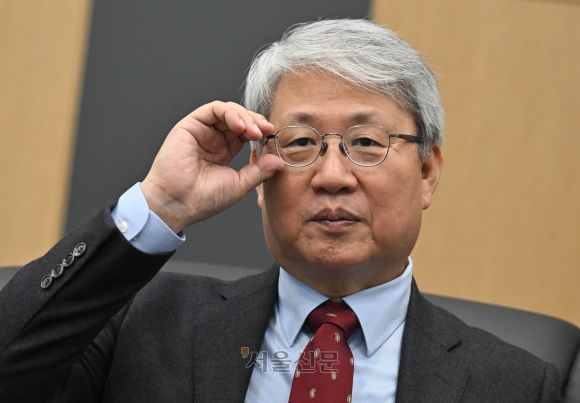
Yun Suk-myung, Research Fellow Emeritus, Korea Institute for Health and Social Affairs
The International Monetary Fund (IMF) recently took the unusual step of calling on Korea to carry out a forceful pension reform, but the pension reform the Yoon Suk-yeol administration is pursuing has failed to gather speed. The government announced a “watered-down” pension reform plan with no specific figures for the contribution rate (what you pay) or the income replacement rate (what you receive) and then passed the ball to the National Assembly, and the National Assembly is dragging its feet just as much. With the general election coming in April next year, critics say both the government and the National Assembly are merely going through the motions of reform. On the 20th, Seoul Sinmun met pension expert Yun Suk-myung, Research Fellow Emeritus at the Korea Institute for Health and Social Affairs, and asked him about the direction of a pension reform that has become hopelessly tangled.
View original In an interview at the Seoul Sinmun building in Gwanghwamun on the 20th, Yun Suk-myung, Research Fellow Emeritus at the Korea Institute for Health and Social Affairs, said, “Even if the National Pension keeps its income replacement rate at 40%, raises the contribution rate to 15%, and raises the pension eligibility age from 65 to 68, the deficit will balloon to the point that paying pensions becomes difficult in the future,” stressing that “a scheme of receiving more than now would wreck reform.” Reporter Hong Yun-gi
● Paying more is unavoidable to improve the finances
-The IMF recently released a shocking report on Korea’s pension reform.
“It projected that if Korea does not reform its pensions, national debt will rise to about 200% of gross domestic product (GDP) by 2070, 50 years from now. That is a strong warning that we will fall into a swamp of low growth and high debt. For 25 years we have failed to raise the contribution rate by even a single percentage point, and because we kept comparing ourselves with the countries that pay the most generous pensions, reform ran into trouble every time. Reform must not be put off any longer.”
-How does the National Pension contribution rate compare with other countries?
“Among the member countries of the Organisation for Economic Co-operation and Development (OECD), the only country with a lower contribution rate than Korea (9%) is Lithuania (8.7%).
-You have long argued for raising the contribution rate.
“Because I stressed that people must pay more in contributions to improve pension finances, I was even called a ‘champion of fear marketing’ for supposedly stoking public anxiety. This IMF report also said the contribution rate must rise by a further 13.8 percentage points (9% + 13.8% = 22.8%) to avoid increasing national debt, so is the IMF doing fear marketing too?”
-There are so many pension committees in the government and the National Assembly that it is confusing to follow how the debate is proceeding.
“That seems to be because the government and the National Assembly each set up their own advisory committees and put forward plans. Last month the government submitted to the National Assembly a vague reform plan of ‘gradual contribution-rate increases,’ stripped of every figure for the contribution rate and the income replacement rate. The National Assembly has its Special Committee on Pension Reform, which has a Private Advisory Committee under it and decides with reference to the plans that committee produces. From here, the Special Committee on Pension Reform will draw up a final plan based on the Private Advisory Committee’s report and the government’s draft Comprehensive National Pension Management Plan, and then go through the procedure of amending the law.”
(Pension reform the IMF has also warned about
Without reform, national debt at twice GDP in 2070
Contribution rate not raised by even 1 percentage point in 25 years
Only one OECD country pays less than Korea
The Special Committee’s reform plans
“13% contribution rate”: a pay-more, receive-more plan
Depletion delayed only seven years, deficit up by 702 trillion won
Do not obscure the essence; tell the public
Grading the Yoon administration’s pension reform
A “watered-down” plan despite a rare consensus
Adjusting pensions to economic trends is positive
Too many considerations; unlikely before the general election)
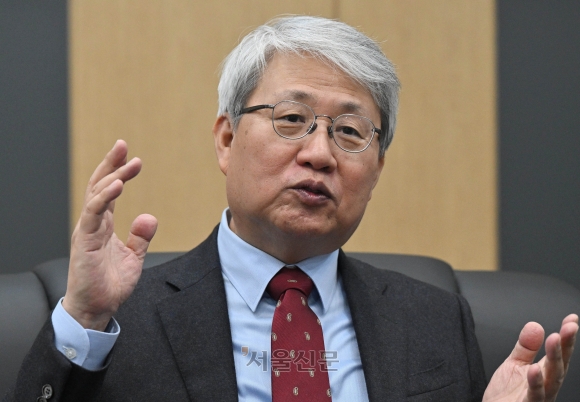
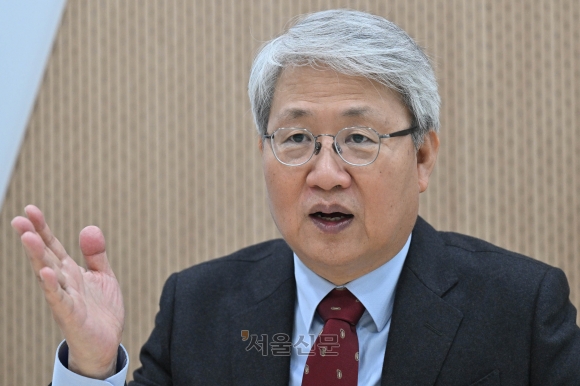
View original In an interview at the Seoul Sinmun building in Gwanghwamun on the 20th, Yun Suk-myung, Research Fellow Emeritus at the Korea Institute for Health and Social Affairs, said, “Ours is a structure in which people pay absurdly little in pension contributions and receive a lot,” adding, “The longer pension reform is delayed, the heavier the burden on the younger generation becomes.” Reporter Hong Yun-gi
● As things stand, a cumulative deficit of 14,000 trillion won by 2093
-The Private Advisory Committee of the National Assembly’s Special Committee on Pension Reform recently put forward two plans.
“Plan 1 is a ‘pay more, receive more’ plan that raises the National Pension income replacement rate by 10 percentage points from the current 40% (to 50%) and raises the contribution rate by 4 percentage points from 9% (to 13%). Plan 2 is a ‘pay more, receive the same’ plan that keeps the income replacement rate at 40% but raises the contribution rate by 6 percentage points (to 15%).”
-How do you assess the two plans?
“Plan 1 delays the fund depletion date by seven years beyond the current 2055, and Plan 2 has the effect of delaying it by 16 years. But Plan 1 is deeply problematic, because sustainability would fall even further than now. Plan 2 is an unavoidable direction, since we have been paying absurdly low contributions. Yet the pension finances are so rotten that even adopting Plan 2 and raising the pension eligibility age from 65 to 68 would not stabilize them.”
-I hear you argued in the National Pension Financial Estimation Committee that the cumulative deficit under each alternative should be stated explicitly.
“In the Financial Estimation Committee I argued that the cumulative deficit figures up to 2093 should be disclosed, but that was not accepted. The cumulative deficit is an important figure that acts as a decisive factor in determining the direction of pension reform.”
-If the fund depletion date is pushed back, should the cumulative deficit not shrink as well?
“If the income replacement rate is kept at 40%, then according to an estimate by Professor Jeon Young-jun of Hanyang University, the cumulative deficit through 2093 is expected to reach 14,000 trillion won. Under Plan 1, however, the fund depletion date is delayed by seven years, but the cumulative deficit grows even larger. The public does not know this.”
-The contribution rate was raised and the fund depletion date pushed back, so why does the deficit grow?
“Raising the contribution rate creates an optical illusion. At first the pension finances seem to improve, but because the income replacement rate has also been raised, the negative effect appears in the long run. If the contribution rate is raised to 13%, the fund depletion date is pushed back, but according to data that the office of Representative Ahn Cheol-soo obtained from the National Assembly Budget Office, the cumulative deficit through 2093 actually increases by as much as 702.4 trillion won. That means 702.4 trillion won is added to Professor Jeon’s estimate of 14,000 trillion won.”
-Could the “pay more, receive more” plan, which meets less public resistance, not be adopted?
“It cannot be reform. Paying more and receiving more may be good politically, but it deceives the public. If the cumulative deficit grows larger, the burden on the younger generation becomes heavier. One must not obscure the essence by claiming that concerns about fund depletion are easing merely because the depletion date is pushed back a few years.”
-The government wavered back and forth and in the end passed the ball of pension reform to the National Assembly.
“The government at first said it would carry out ‘parametric reform,’ adjusting the contribution rate and the income replacement rate, and then changed its position to say that ‘structural reform’ changing the entire framework of public pensions, including the National Pension and the Basic Pension, must be carried out. But for structural reform to be done properly, parametric reform must come first.”
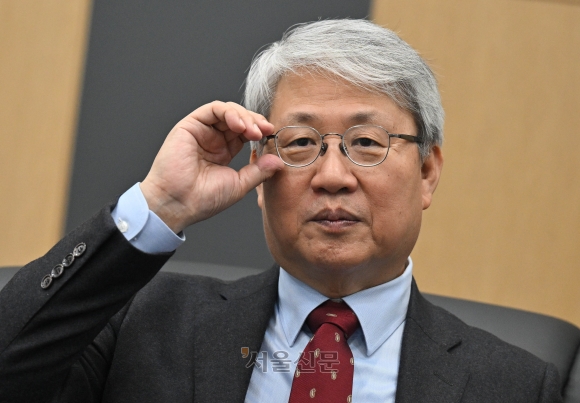
View original In an interview at the Seoul Sinmun building in Gwanghwamun on the 20th, Yun Suk-myung, Research Fellow Emeritus at the Korea Institute for Health and Social Affairs, said, “Regardless of whether its reform succeeds, the Yoon Suk-yeol administration could earn a good verdict from history just by revealing, without embellishment, how serious the pension deficit is, for instance by disclosing the cumulative deficit.” Reporter Hong Yun-gi
● Rates must rise before 6.8 million baby boomers retire
-What matters most in parametric reform?
“It is urgent to raise the contribution rate before the roughly 6.8 million second-wave baby boomers (born 1968–74) leave the labor market. Even if structural pension reform is carried out, the fiscal imbalance must first be reduced to some degree.”
-What if the timing for pension reform is missed?
“The longer pension reform is delayed, the greater the burden on the younger generation becomes. If the reform is imposed by outside forces, it will have to be carried out with brutal severity. In Greece, the pensions of those receiving large pensions were cut by 50% in an instant. The longer reform is delayed, the more dire the situation that may unfold.”
-If you were to grade the Yoon Suk-yeol administration’s pension reform?
“If things stay as they are, it could draw even more criticism than the Moon Jae-in administration, which failed to reform pensions but did present four plans. Since it came up with a ‘watered-down’ reform plan even though a consensus on pension reform had finally formed, it gets an F. But because it is considering raising the contribution rate and an ‘automatic adjustment mechanism’ that adjusts pension amounts according to future economic trends and other factors, it could be given a D. The government must tell the public, without embellishment, just how difficult pension finances are.”
-The government does seem to be making some effort.
“If the government and ruling party’s position that structural reform must be carried out, such as improving the elderly poverty rate through a Basic Pension overhaul and securing the income-security function of retirement pensions, is put into practice, that would be an A. Though it has limits, the fact that Statistics Korea released comprehensive pension statistics for the first time also deserves high marks.”
● The even more rotten Private School Teachers and Government Employees Pensions must also be fixed
-National Pension reform is urgent, but the Private School Teachers Pension is in the worst shape, so why start with the National Pension?
“The National Pension comes up first because it covers the entire population. But the Private School Teachers and Government Employees Pensions have an even more extreme ‘low-contribution, high-benefit’ structure, so they are far more rotten financially. The debt is so large that each of the 330,000 current Private School Teachers Pension members carries more than 500 million won of it. And this debt is growing rapidly every year.”
-Can pension reform be wrapped up before the general election in April next year?
“It looks difficult. With the election ahead, there will be many considerations. The fact that a proper pension reform is bound to be painful will also play a part. Some suggest that the ruling and opposition parties agree on a reform plan and then pass it next May, after the general election and just before the 22nd National Assembly convenes, since that would carry no political burden.”
●Who is Committee Member Yun Suk-myung?
With a Ph.D. in economics from Texas A&M University in the United States, he is a leading pension expert who advocates fiscal stability. He has taken part in the pension reform work of every administration for 25 years. He is a man of conviction who holds that no reform is better than a botched one. Mild-mannered as a rule, he becomes passionate whenever pensions come up, which has earned him the nicknames “Yeon-mi-nam” (a man crazy about pensions) and “the star pension instructor” who answers any question with ease. He currently serves as an advisory committee member of the National Assembly’s Special Committee on Pension Reform and as Research Fellow Emeritus at the Korea Institute for Health and Social Affairs.
Senior Journalist Choi Kwang-suk