(Chosun Ilbo) ‘Profligate Spending’ France… Stuck in a Quagmire with No Exit as Pension Reform Drifts (November 6, 2026)

[Issue Focus] Interviews with Three Bond Experts
“If Italy’s debt is ‘yesterday’s debt,’ France’s debt is ‘tomorrow’s debt’” (Masahiko Loo, Senior Fixed Income Strategist, State Street Investment Management)
“The fundamentals of Southern European countries are better than France’s” (Shinji Kunibe, Lead Portfolio Manager for Global Bonds, Sumitomo Mitsui DS Asset Management)
“With no majority in parliament, agreement on the pension issue is a distant prospect” (Evelyne Gomez-Liechti, Multi-Asset Strategist, Mizuho International)
The Quality of the Debt Is the Problem
If Italy’s Debt Is ‘Yesterday’s Debt,’ France’s Is ‘Tomorrow’s Debt’
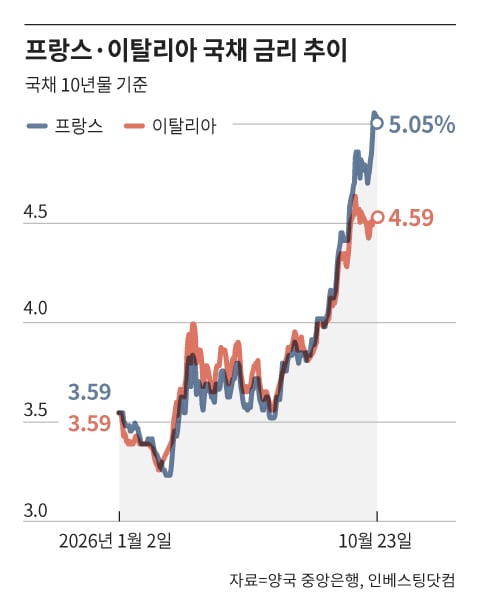
The French government has to pay more interest than Italy to borrow the same money. At the start of this year, French and Italian 10-year government bond yields both began at around 3.59%, but recently the French yield has been 0.46 percentage points higher. Although France’s ratio of national debt to gross domestic product (GDP), at 119.1% as of the second quarter, was lower than Italy’s 139.9%, France has to borrow on less favorable terms. Global bond experts, in a series of interviews with WEEKLY BIZ, predicted that France, where political division makes it hard to put fiscal savings measures into practice, will not find it easy to escape its ‘government bond crisis.’
/Graphic: Kim Eui-kyun
French Finances Worse Than Southern Europe’s
Government bond investors around the world see France as worse off than the Southern European countries, such as Italy and Spain, that went through fiscal crises in the past. “The trajectory of debt matters more than its absolute level,” Loo said. France has not recorded a fiscal surplus since 1974. Italy carries a heavier debt burden than France, but for most of the past 30 years it has run a primary balance surplus (the fiscal balance calculated excluding interest payments on government debt). “The bond market will tolerate heavy debt, as in Italy, as long as it is stable,” Loo said, adding that “bond investors fear that France’s fiscal deficit, especially its primary deficit, is becoming entrenched.”
Political stability matters too. Pointing to Italian Prime Minister Giorgia Meloni’s long hold on power, Kunibe said Italy “has the edge over France in terms of political stability.” French politics, by contrast, is going through deep division, so deep that some 30 politicians have declared their intention to run in next year’s presidential election or are considering a run.
“French Parliament Has Lost the Ability to Rein In Profligate Spending”
The experts saw reining in the French government’s profligate spending as the first priority. “‘Fiscal savings’ that cut government spending (rather than increasing tax revenue) come closer to a solution,” Gomez-Liechti said, adding that “tackling the pension issue, or the immigration cuts advocated by Marine Le Pen (a far-right presidential contender), could deliver savings.”
/Graphic: Kim Eui-kyun
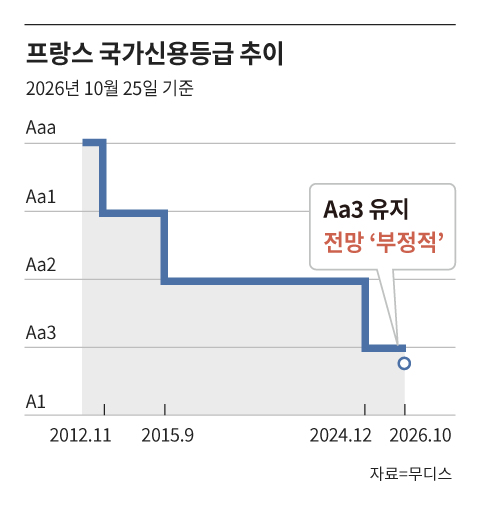
The problem is that the French parliament is failing to join forces on pension reform, its top priority. On the 23rd, the international credit rating agency Moody’s kept France’s credit rating at Aa3 with a ‘negative’ outlook, noting that “the continued fragmentation of the political landscape has raised the risk of impairing the functioning of the legislature” and that “political instability risks undermining the government’s ability to address key policy challenges such as high fiscal deficits, a rising debt burden, and persistently rising borrowing costs.” Gomez-Liechti likewise said, “Those who place relatively more weight on fiscal soundness believe the retirement age (the age at which pension benefits begin) should be raised, but other parties do not accept this because of voters who do not want the pension eligibility age to rise,” adding, “With no majority in parliament, any agreement is hard to reach.”
In 2023, French President Emmanuel Macron pushed through a pension reform that raises the age at which people begin receiving a pension from 62 to 64 in stages. Because of political backlash, however, the reform has been suspended until January 2028, after next year’s presidential election. There is also a strong chance that the reform will effectively be nullified, because leading presidential contender Le Pen has vowed to “bring the pension eligibility age back to 62,” and some on the left are arguing that “it should be lowered to 60.”
No Solution in Sight
With No Majority in Parliament, Agreement on Pensions Is a Distant Prospect
Doubts About the Country’s Fundamentals
Kunibe recently cut the share of French government bonds in some of the funds that the portfolio manager runs and raised the share of safer assets such as German government bonds, because the French government has offered no message on ‘fiscal discipline.’ “The world is returning to a ‘higher-for-longer’ regime in which inflation stays structurally more entrenched,” Loo said, adding, “The bond market is now increasingly reluctant to fund, at ‘yesterday’s prices,’ countries that run large deficits or have weak fundamentals.”
“Unlikely to Spread into a Eurozone Crisis”
Experts believe a French fiscal crisis is unlikely to spread into a crisis for the eurozone as a whole. Some worry that as ‘yen carry trade’ money, which had been invested in overseas bonds and stocks on the back of Japan’s low interest rates, flows back to Japan, the French government bond crisis could spread into a eurozone-wide crisis. “It is true that Japan is stepping back from its position as the ‘marginal buyer’ of global bonds,” Loo said, “but fears of a resulting financial Armageddon are overblown.”
Other experts also said Japanese investors are not dumping French government bonds on the market on a large scale. “Japanese investors’ aggressive selling of French government bonds mostly took place in 2022–2024,” Gomez-Liechti said, adding, “With the political situation in France now so chaotic, it will be hard to see cautious Japanese investors buying French government bonds (on a large scale) again.” Kunibe also said, “For Japanese domestic investors, holding French government bonds remains attractive in terms of ‘carry trade returns,’ such as the interest income earned over the holding period,” adding, “The likelihood that Japanese investors’ sales of French government bonds will lead directly to a eurozone crisis is extremely limited.”
Reporter Hong Joon-ki [email protected]