(Cheonji Ilbo, Report on the Pension Future Forum Statement) Pension Future Forum: “Basic Pension Debate Co-Hosted by the Government and Civic Groups Is Biased” — Calls for a Fair Social Discussion (November 6, 2026)
Criticized as a “Testimony Forum That Does Not Represent Citizens”
Neutrality Questioned as a Government Committee Co-Hosts
At Issue: A Fiscal Burden of Tens of Trillions of Won and Intergenerational Equity
Expert Verification and Balanced Stakeholder Participation Needed
After Citizen Deliberation, the Government and the National Assembly Bear Final Responsibility
[Cheonji Ilbo=Reporter Lee Mun-seong]
Questions of representativeness and fairness in the process of gathering citizens’ views have been raised over the overhaul of the Basic Pension, into which tens of trillions of won of state funds go every year.
Because the policy ties together the alleviation of elderly poverty and the tax burden on future generations, observers point out that it needs a structure of social discussion that goes beyond debates centered on particular organizations and combines expert verification, the participation of stakeholders from each generation, and citizen deliberation.
In a statement issued on the 6th,
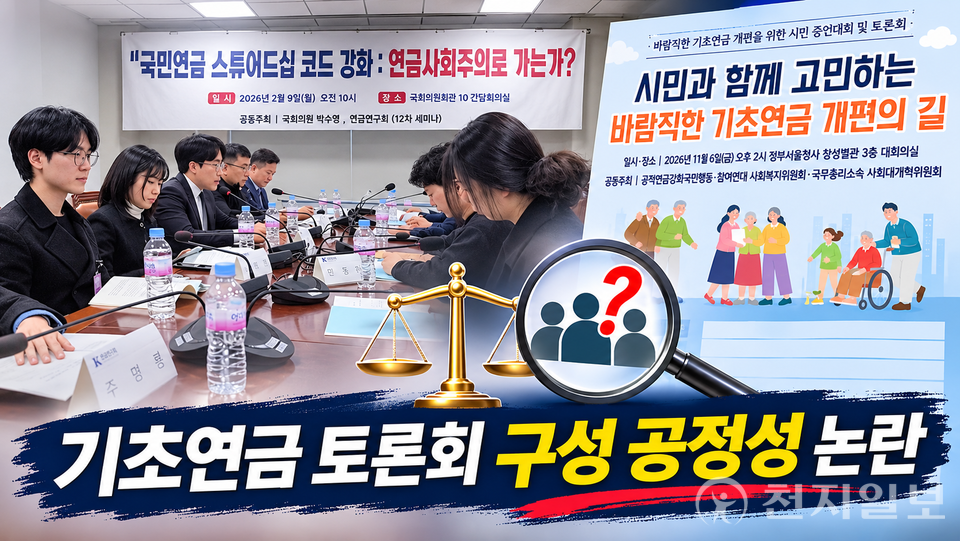
the Pension Future Forum criticized the makeup and operation of the citizens’ testimony forum and debate “Thinking It Through with Citizens: The Right Way to Overhaul the Basic Pension,” co-hosted at 2:00 p.m. the same day by the Public Pension Strengthening People’s Action, the Social Welfare Committee of People’s Solidarity for Participatory Democracy, and the Committee for Grand Social Reform under the Prime Minister.
The Forum titled its statement “Do Not Put Citizens Out Front—Speak in Your Own Name” and asked in return, “Who gave them the authority to represent ‘citizens’?”
Going beyond the policy debate over whether to expand the Basic Pension, the objection focuses on how fairly a forum for public deliberation in which the government is involved reflects diverse interests.
◆“The Same Camp from the Witness Stand to the Moderator’s Chair”—Criticism of Participant Selection
What the Pension Future Forum took issue with first was the makeup of the event’s participants.
According to the Forum, of the four citizen witnesses, the only one taking part without an organizational title is a Basic Pension beneficiary.
The others are the vice chair of the National Senior Workers’ Union of the Federation of Korean Trade Unions (FKTU), an official of the Retirees’ Branch of the Korean Public Service and Transport Workers’ Union of the Korean Confederation of Trade Unions (KCTU), and the head of the Welfare State Youth Network.
The Forum pointed out that the organization taking part as the youth representative likewise has a policy orientation toward a universalist welfare state.
The moderator is a subcommittee head of the co-organizing Committee for Grand Social Reform, and the presenter is the policy committee chair of the organizing group.
According to the Forum, the discussion table includes an official of People’s Solidarity for Participatory Democracy, figures from the labor movement, and a scholar who, on the nomination of the Democratic Party of Korea, co-chaired the Private Advisory Committee of the National Assembly Special Committee on Pension Reform.
Of this arrangement, the Forum said that “the side that set up the stage is moderating, presenting, and even filling the witness stand,” and demanded that the criteria for selecting participants be made public.
It is not in itself a problem for officials of labor unions or civic groups to take part in a policy debate. They, too, have the right to voice their views as stakeholders.
But observers point out that if an event was built around officials of organizations that support a particular policy direction, there are limits to interpreting its outcome as the view of citizens as a whole or as a social consensus.
◆Co-Hosted by a Government Committee—Questions of Public Neutrality
Another key issue in the statement is the role of the Committee for Grand Social Reform under the Prime Minister.
The Pension Future Forum took issue with an arrangement in which a government committee takes part as a co-host, the event is held at the Government Complex Seoul, and a subcommittee head of that committee serves as moderator.
Criticizing this as a way of “borrowing the government’s name and space to put ‘citizens’ out front,” the Forum raised the suspicion that a government committee had lent public authority to an event held by organizations with a particular policy line.
In particular, the Forum argued that while the organizers criticize the government’s Basic Pension overhaul plan for lacking a democratic decision-making process, experts and stakeholders with opposing views have not been adequately included in the very event they themselves are holding.
Holding a debate in support of a particular policy falls within private organizations’ freedom of expression. But when a government committee takes part as a co-host, the nature of the event, the procedure for selecting participants, and whether there was an opportunity to gather diverse views need to be explained more clearly.
A government committee’s co-hosting does not in itself mean a breach of fairness. Whether it was actually appropriate must be judged by examining the committee’s internal approval procedures, how the event was planned, and the criteria for selecting participants.
◆The Era of a 25-Trillion-Won Basic Pension—Old-Age Security and the Burden on Future Generations Must Be Weighed Together
Procedural fairness matters in the debate over overhauling the Basic Pension because of the program’s fiscal scale and the intergenerational interests at stake.
According to the Pension Future Forum’s statement, the organizers projected that in 2027 the Basic Pension will have about 8 million beneficiaries and require a budget of 25.7 trillion won.
Unlike the National Pension, the Basic Pension is financed by taxes rather than by accumulated contributions.
Changes in benefit levels and eligibility affect not only the income security of today’s older people but also future state finances and the tax burden on the working generation.
Particularly as the elderly population grows, whether to expand the Basic Pension, whom it should cover, and its relationship with the National Pension are questions whose long-term fiscal effects must be examined.
The Pension Future Forum criticized the organizers for demanding that the government present a medium-term fiscal outlook while putting forward no long-term financial projection for the strengthening of the collective system of support they themselves advocate.
Saying that “they must first put forward projections of the expected costs for 2040, 2050, and beyond,” the Forum called for the same verification standard to be applied to every policy alternative.
Overhauling the Basic Pension is a task that must weigh the alleviation of elderly poverty, fiscal sustainability, and intergenerational equity together.
Because a discussion centered on the interests of only one side makes it difficult to secure social consensus, objective verification of the fiscal grounds and policy effects is important.
◆Expert Verification, Stakeholder Participation, and Citizen Deliberation Must Be Combined
The controversy also raises the question of how future discussions on overhauling the Basic Pension should be structured to earn public trust.
To build a rational structure for discussion, experts in pensions, public finance, and social welfare first need to verify the effects of each policy alternative.
This would mean analyzing different alternatives—such as expanding benefits, targeted support, and overhauling the link with the National Pension—by the same standard for their effect on elderly poverty and their long-term fiscal burden.
Next, a consultation procedure could be set up in which not only Basic Pension beneficiaries and older people’s organizations but also a range of stakeholders, including young people, workers, taxpayers, and vulnerable groups, take part.
In this process, rather than selecting only people who hold posts in particular organizations as citizen representatives, a combination of open recruitment, nominations, and screening for conflicts of interest could be considered.
Where a formal social consensus is sought, a deliberative procedure for ordinary citizens is also needed.
This would mean providing a citizens’ panel formed through random sampling with opposing policy alternatives and balanced learning materials, and gathering its views after sufficient discussion.
This would also institutionally remedy the shortcomings the Pension Future Forum pointed out in its statement, such as the lack of random sampling, of equal footing for opposing views, and of balanced learning materials.
Such procedures are not necessarily required of an ordinary policy debate. But to present an event’s outcome as the view of citizens as a whole or as a social consensus, it must be backed by commensurate representativeness and a deliberative process.
◆Responsibility for Policy Decisions Matters More Than “the Will of the Citizens”
Equally important, even with expert verification and citizen deliberation, the final decision on the Basic Pension overhaul, and responsibility for it, must rest with the government and the National Assembly.
This is because citizen participation is a means of raising the legitimacy and acceptance of a policy, but it cannot be grounds for passing responsibility for state finances and legislation on to citizens.
The Pension Future Forum likewise stressed in its statement that “projections and verification should be left to the domain of experts, and the choice among the alternatives presented, and the consequences of that choice, must ultimately rest with the government and the National Assembly.”
The Forum demanded that the Public Pension Strengthening People’s Action and People’s Solidarity for Participatory Democracy make clear that the event is their own policy debate, not a citizens’ testimony forum.
It urged the Committee for Grand Social Reform to explain how it came to co-host an event with particular organizations and allow the use of a government complex, and to apologize.
The Forum said, “We speak in the name of the Pension Future Forum, and we simply take responsibility for the grounds and consequences of what we say,” adding, “What genuine pension reform requires is not the name of mobilized citizens, but verifiable numbers and the responsibility one must bear with one’s own name on the line.”
In the end, the controversy goes beyond support for or opposition to the direction of the Basic Pension overhaul and asks how far the government can act as a fair arbiter.
Observers point out that the more a policy bears on both the livelihoods of today’s older people and the burden on future generations, the more the diversity of participants, procedural legitimacy, and objective fiscal verification can serve as the starting point for social consensus.