(Newspim) [Ah! KOSPI] ⑩ To Dream of KOSPI 10,000 Again — Structural Improvement, Not a Short-Term Index Boost (October 29, 2026)
Rather than a short-term boost, the government
should emphasize corporate growth and market autonomy
In the era of 500 trillion won in retirement pensions,
long-term investment and investor protection are the tasks
Government holds a large share of Fund Management Committee seats…
concerns over the administration’s sway
Minutes “disclosed four years later,”
and checks “nonexistent” as well
[Seoul=Newspim] Reporters Lee Na-young and Shin Do-kyung =
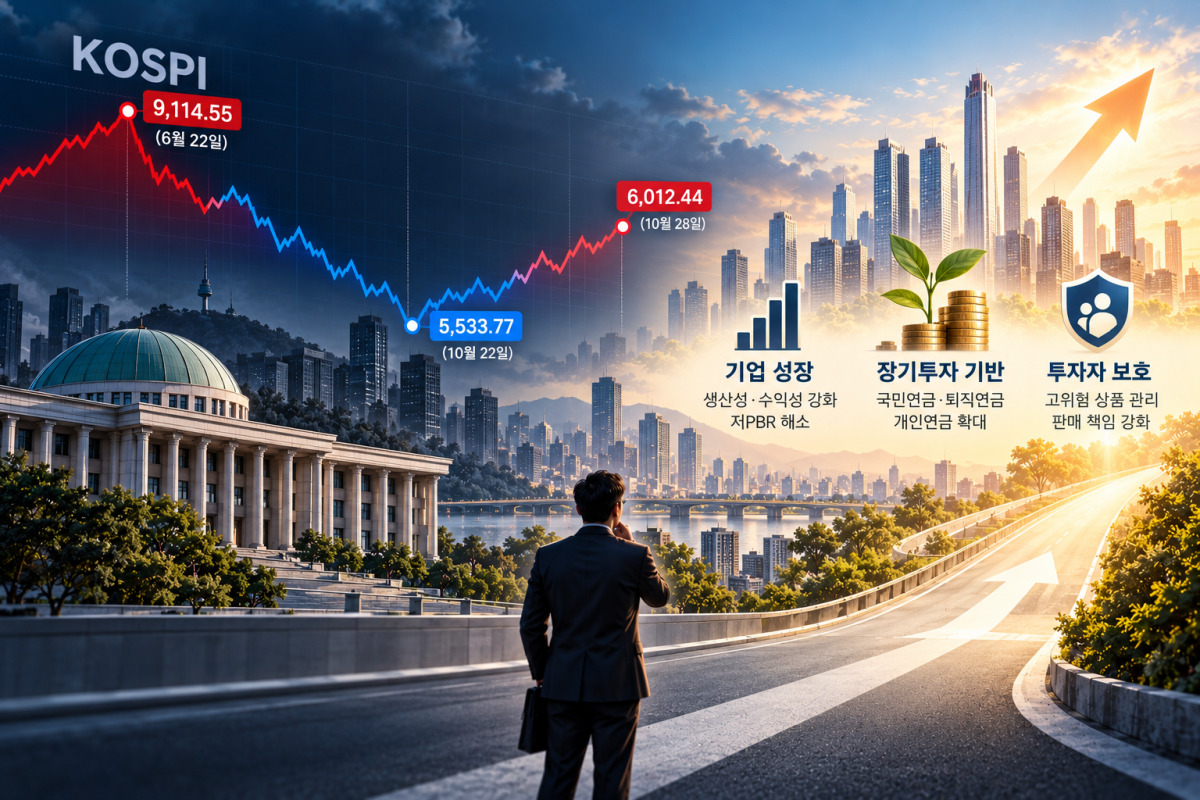
With the KOSPI having recovered the 6,000 mark after surpassing 9,000 and then falling into the 5,000 range, debate continues over the government’s stock market stimulus policies and the scope of its market intervention.
The point being made is that, rather than concentrating on a short-term boost to the index, the government should address the market’s structural problems, for instance by strengthening the foundations of corporate growth and expanding long-term investment capital.
In particular, as controversy erupted this year over the National Pension’s adjustment of its domestic equity allocation and its deferral of rebalancing amid the market’s steep swings, calls are also growing to strengthen the independence and expertise of pension fund management.
Experts stress that the government should lay the institutional groundwork for improving corporate value and protecting investors, while minimizing political intervention in the management of the National Pension and establishing an independent decision-making system.
◆ Corporate growth rather than an index boost… resolving low PBR and expanding private investment are the tasks
According to the Korea Exchange on the 29th, the KOSPI hit a record closing high of 9,114.55 on June 22 and then fell to 5,533.77 on the 22nd of this month. It has since rebounded, closing the previous day (the 28th) at 6,012.44 and recovering the 6,000 mark.
With a market structure concentrated in large semiconductor stocks and outflows of foreign capital having amplified stock market volatility, opinion in the market holds that policies to raise corporate productivity and profitability are important for sustained growth of the stock market.
Professor Kim Sang-bong of the Department of Economics at Hansung University said,
“There is no need to push up the stock market artificially,”
adding, “Share prices can rise steadily only when the economy grows as companies’ exports and productivity increase and employment expands.”
To that end, the view is that institutional groundwork must be laid to revitalize private investment and foster growth companies.
In particular, the investment environment needs to be improved so that small and medium-sized enterprises with strong technology can secure funding and expand their businesses.
Professor Kim said, “The government invests too, but it must help the private sector invest,”
and stressed, “We must invest in technology SMEs and science-and-technology SMEs and support them so that they can grow into large companies.”
Institutional improvements to resolve the undervaluation of listed companies are also important.
The view is that corporate governance and capital market rules must be overhauled so that growth in corporate earnings and expanded shareholder returns can translate into higher corporate value.
Lee Hyo-seop, Research Fellow at the Korea Capital Market Institute (KCMI), said, “Since the low price-to-book ratio (PBR) problem in the domestic stock market remains serious, a variety of policies are needed to resolve it,”
adding, “Now that the direction of the government’s policies, such as preventing the deliberate suppression of share prices, has been set out, I hope they will be implemented swiftly.”
◆ Expanding the foundation for long-term investment and managing high-risk products… strengthening protection for individual investors
Expanding the foundation for long-term investment and strengthening the system for protecting individual investors are also cited as major policy tasks for the government.
The argument is that, to ease a structure in which the stock market moves sharply on foreign trading, conditions must be created for a variety of long-term investment capital, including retirement pensions and personal pensions as well as the National Pension, to participate in the market.
According to the Ministry of Employment and Labor and the Financial Supervisory Service, Korea’s retirement pension reserves stood at 501.4 trillion won at the end of last year, up 69.7 trillion won (16.1%) from the previous year.
Reserves came to 228.9 trillion won in defined benefit (DB) plans, 141.6 trillion won in defined contribution (DC) plans and corporate IRPs, and 130.9 trillion won in individual IRPs.
It is pointed out that, as retirement pensions grow in size, institutional improvements to raise their investment performance are also needed.
According to the report “Performance and Market Share of Retirement Pension Providers,” published by the Korea Capital Market Institute, no clear relationship emerged between retirement pension providers’ long-term investment performance and their market share.
The analysis is that improvements to the default option, simpler investment products, and greater investment responsibility for providers are needed so that investment performance can translate into contributors’ choices and the movement of funds.
Tax support for long-term investment is also cited as an area for improvement. The view is that tax support measures to encourage long-term holding of financial assets should be considered.
It is also pointed out that oversight of individual investors’ investment in high-risk products must be strengthened.
Since the risks of single-stock leveraged exchange-traded funds (ETFs), margin trading, and the like came to the fore amid this year’s steep market swings, the argument is that the system for recommending products should be reviewed in light of financial companies’ responsibility as sellers and investors’ capacity to bear risk.
Research Fellow Lee said, “In Korea, high-risk investment through leveraged ETFs, margin trading, and the like is relatively easy,”
adding, “Products should be recommended primarily to investors who can sufficiently bear the investment risk.”
To strengthen the foundation for long-term investment, the management systems of institutional investors also need to be examined, along with the protection of individual investors.
In particular, improving the fund management system of the National Pension, a major institutional investor in the domestic stock market, is also an important issue.
◆ Responsibility for losses unclear… codifying the committee’s independence and adjusting the scope of minutes disclosure are “urgent”
It is also pointed out that, to escape the period of contraction and slump and enter a sustainable growth path, defining the government’s role is more urgent than anything else. The argument is that recurring political headwinds must be blocked and investment decisions made on the basis of expertise.
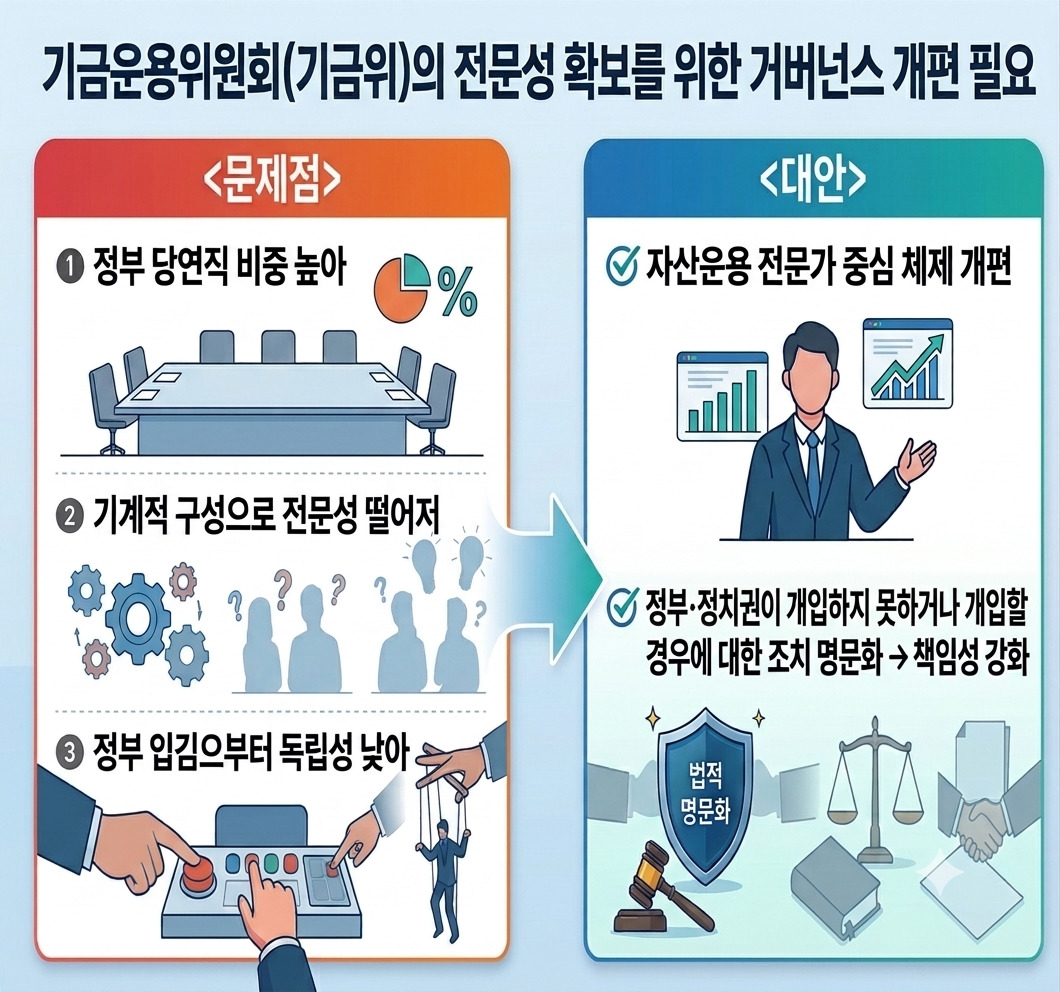
The National Assembly and experts cite, as the first thing the government “must do” for the National Pension to deliver its best performance, a governance overhaul to secure the expertise of the Fund Management Committee.
At present, the Fund Management Committee is chaired by the Minister of Health and Welfare and consists of six ex officio government members, two employer representatives, three employee representatives, five representatives of individually insured contributors,
and two relevant experts.
The image was created with generative AI to aid understanding of the article. [AI illustration = Gemini]
At the parliamentary audit of the National Pension Service on the 14th, Representative Cho Bae-sook of the People Power Party said, “The very composition of the Fund Management Committee cannot be free from the administration’s sway,”
and pointed out, “On momentous decisions such as rebalancing or raising the target allocation for domestic equities, it not only cannot be free from the government’s sway but also lacks expertise.”
Kim Sung-joo, Chairman of the National Pension Service, agreed, saying, “I once introduced a bill to reduce the number of government members and increase the number of representatives of the insured,” and adding, “The share of government members is too high.”
Mechanical composition based on representation rather than expertise is also a problem.
Yun Suk-myung, Research Fellow Emeritus at the Korea Institute for Health and Social Affairs (KIHASA), pointed out, “The president of KIHASA, for example, is an expert who has researched only health insurance; becoming president of KIHASA does not make someone an expert on the National Pension,” and “Under the way the Fund Management Committee currently operates, there are a great many points at which the government can change the direction of fund management.”
It has also long been raised as a problem that the government-centered composition of the Fund Management Committee lets the government have its way in the National Pension’s asset allocation decisions.
Indeed, in 2021 as well, the government raised the permitted exception limit for the strategic asset allocation (SAA) by 1%.
According to the “Minutes of the Third Fund Management Committee Meeting of March 2021,” released this April, concerns were raised about making an emergency change to the fund’s long-term strategic framework in the middle of the management period.
However, Kim Yong-beom, then Vice Minister of Economy and Finance, and Kim Yong-jin, then Chairman of the National Pension Service, argued for a flexible response.
In the wake of a stock market crash right after the SAA limit was raised, the National Pension’s overall rate of return in 2022 was -8.22%, its worst performance ever.
It suffered losses of about 79.6 trillion won.
Criticism is being raised that, with a decision-making structure built around government officials and stakeholders from each occupational group, it is difficult to guarantee expertise and independence in asset management in rapidly changing financial markets.
By contrast, major overseas pension funds have built governance systems that put expertise and independence first.
At Japan’s Government Pension Investment Fund (GPIF), a Board of Governors made up of the president and nine members from finance, business, and academia leads decision-making.
At the Canada Pension Plan (CPP), an investment committee consisting of a chair and 11 investment specialists is solely responsible for investment,
while Norway’s sovereign wealth fund (GPFG) entrusts its management to the central bank.
The image was created with generative AI to aid understanding of the article. [AI illustration = Gemini]
Experts suggest that the National Pension can fulfill its proper role of raising returns and stabilizing the stock market only if the Fund Management Committee is reorganized around asset management experts and political intervention is minimized.
They said that, even if the influence of the political sphere cannot be escaped 100%, responsibility should be strengthened by codifying in law that the government and the political sphere may not intervene, and the measures to be taken if they do.
The point is that the structural limitation must be remedied whereby, although government policy in 2021 affected the management of the National Pension Fund, it is difficult to determine where responsibility lies after the fact.
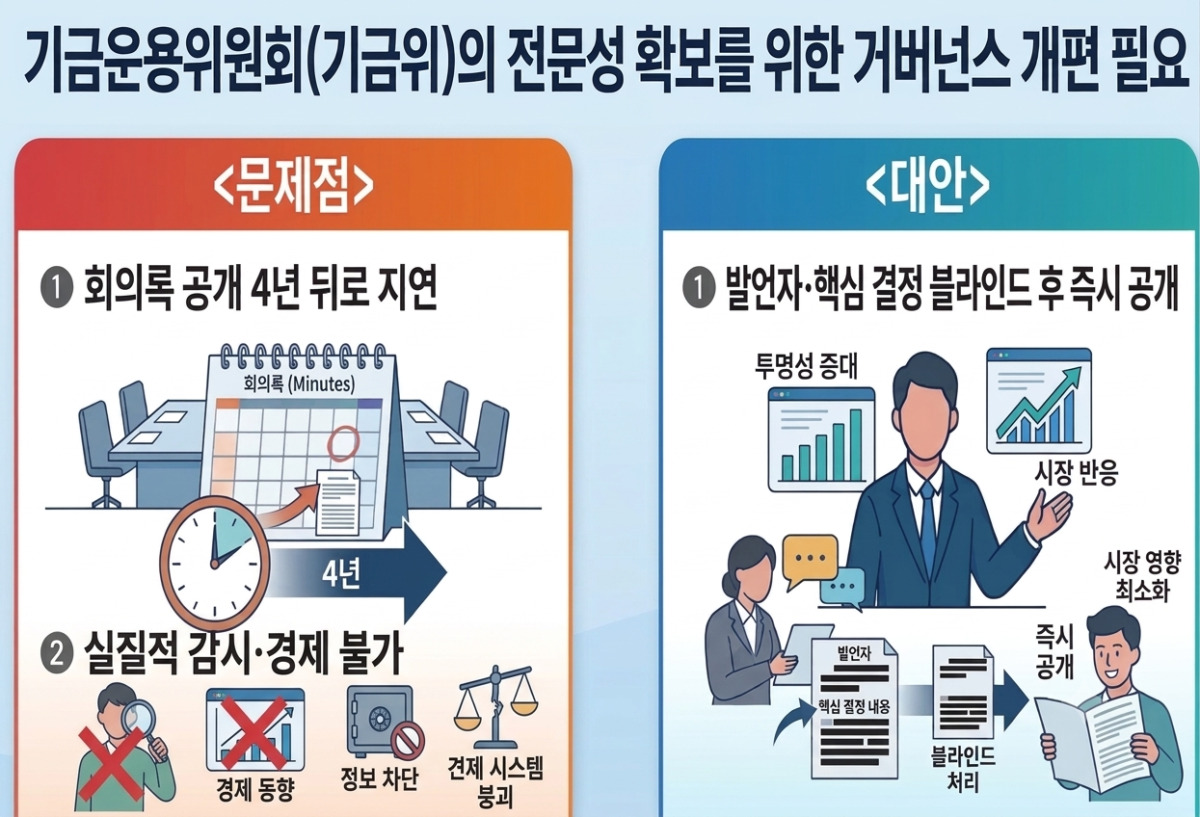
There were also recommendations that the scope of minutes disclosure be improved.
Because the Fund Management Committee’s minutes contain the National Pension’s core investment strategies and market forecasts, such as adjustments to target asset allocation weights, deferrals of selling or buying particular asset classes, and adjustments to rebalancing limits, they may be kept undisclosed for up to four years.
However, since disclosing the minutes only four years later makes real oversight and checks impossible, the argument is that they should be disclosed immediately, creating a safeguard against irrational decisions made under political headwinds from the administration and the political sphere.
Research Fellow Emeritus Yun said, “The minutes can be disclosed with the speakers themselves anonymized, along with items that can affect the market, such as raising the domestic equity allocation and deferring rebalancing,” and “They should then be disclosed under real names four years later so that the two can be compared.”
Representative Ahn Sang-hoon of the People Power Party and Representative Park Hong-bae of the Democratic Party of Korea have each sponsored a “Partial Amendment to the National Pension Act” to strengthen the independence and expertise of the Fund Management Committee.
The bill introduced by Representative Ahn includes provisions specifying legal responsibility to ensure that there is no political intervention in managing and investing the fund and that its independence is guaranteed without fail.
The bill introduced by Representative Park focuses on increasing the share of experts.
An official at the Ministry of Health and Welfare explained, “Because the composition of the Fund Management Committee requires a legal amendment, there are some parts we agree with and some parts that are difficult to reflect.”
Another official at the ministry also said, “There are views that expertise or representativeness should be strengthened, but it has to be looked at as a whole,”
adding, “A pinpoint approach is difficult; it has to be examined comprehensively through the amendment process.”
Attachments
- Screenshot_20261029_210515_Samsung Browser.jpg(477.4 KB)
- Screenshot_20261029_210523_Samsung Browser.jpg(608.5 KB)
- Screenshot_20261029_210530_Samsung Browser.jpg(971.5 KB)
- Screenshot_20261029_210542_Samsung Browser.jpg(581.9 KB)
- Screenshot_20261029_210551_Samsung Browser.jpg(650.1 KB)
- Screenshot_20261029_210600_Samsung Browser.jpg(733.0 KB)
- Screenshot_20261029_210612_Samsung Browser.jpg(931.1 KB)
- Screenshot_20261029_210623_Samsung Browser.jpg(646.1 KB)
- Screenshot_20261029_210632_Samsung Browser.jpg(829.4 KB)
- Screenshot_20261029_210649_Samsung Browser.jpg(626.1 KB)
- Screenshot_20261029_210658_Samsung Browser.jpg(615.6 KB)