(JoongAng Ilbo Report, April 25, 2024) Serious Error in Pension Reform Material — The Effect of Raising the Income Replacement Rate Was Exaggerated (October 9, 2026)

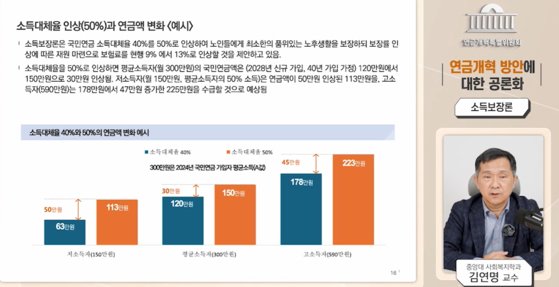
Professor Kim Yeon-myeong of Chung-Ang University, helping the Public Deliberation Committee's 500-member panel of citizen representatives under the Special Committee on Pension Reform learn, explains the effect of raising the income replacement rate. On the left of the graph, the low-income earner's income figure of 630,000 won is incorrect. The correct figure is actually 900,000 won, and the pension increase is not 500,000 won but 230,000 won. Captured from a video on the Public Deliberation Committee's website
A serious error has been found in the learning materials that the Public Deliberation Committee under the National Assembly's Special Committee on Pension Reform provided to 500 citizen representatives.
In explaining the effect of raising the income replacement rate, it used incorrect figures and, as a result, exaggerated the effect beyond its actual size.
Even so, the material was found to have been used, uncorrected, all the way through the final survey of the 500 citizen representatives.
A problem was found in the material for the income security argument (Plan 1) in the citizen representatives' learning video posted on the "Public Deliberation for Pension Reform" website. Professor Kim Yeon-myeong of the Department of Social Welfare at Chung-Ang University presents it on behalf of the income security argument.
Plan 1 raises the income replacement rate from 40% to 50% and contributions from 9% to 13%. Plan 2 embodies the fiscal stabilization argument, raising only contributions, to 12%.
In the final survey of the citizen representatives, 56% favored Plan 1 and 42.6% favored Plan 2.
In the video, Professor Kim said, "The core of the income security argument is how far to raise the level of public pensions (here referring to the National Pension) to secure old-age income. The income replacement rate (the ratio of the old-age pension to lifetime average income) is set to fall to 40% (42% this year), and the central claim of the income security argument is to raise it to 50%."
Professor Kim stressed the inevitability of raising the replacement rate by showing how old-age pensions change when the income replacement rate for a 40-year contributor rises from 40% to 50%.
The figures are broken down into low-income earners (lifetime average income of 1.5 million won), average earners (3 million won), and high-income earners (5.9 million won). A contributor earning 3 million won who pays contributions for 40 years would see the monthly pension rise by 300,000 won, from 1.2 million won to 1.5 million won.
Professor Kim went on to say, "It is designed so that low-income earners gain relatively more."
According to the video material, a low-income earner with a lifetime income of 1.5 million won would see the monthly pension rise by 500,000 won, from 630,000 won to 1.13 million won. A high-income earner's would rise by 450,000 won, from 1.78 million won to 2.23 million won. If Professor Kim were right, the low-income group would gain the most.
Professor Kim gave the explanation while displaying a graph of the change in pension amounts on the screen.
The error lies in the low-income section.
Professor Kim put the pension at 630,000 won at a 40% income replacement rate and explained that raising the rate to 50% would increase the pension by 500,000 won.
But 630,000 won is an incorrect figure.
According to the National Pension Service's table of expected pension amounts, the correct figure is 900,650 won. Contrary to Professor Kim's claim, the actual increase is only about 230,000 won.
The increase was misrepresented as more than twice the actual amount.
In reality, raising the income replacement rate increases high-income earners' pensions the most and low-income earners' the least.
Moreover, because many high-income earners are employees of large companies who pay contributions for a long time, they benefit more from a higher replacement rate.
Oh Gun-ho, Chair of the Policy Committee of Welfare State I Make, points out in his book, "Raising the income replacement rate concentrates the effect more on high-income earners."
Yet Professor Kim misleadingly suggested that the low-income group benefits more.
Before distributing this video material and three types of explanatory materials to the 500 citizen representatives, the Public Deliberation Committee conducted the first survey (March 22–25),
in which support for Plans 1 and 2 stood at 36.9% and 44.8%, respectively.
In the second survey after the materials were distributed (on the 13th), the figures reversed to 50.8% and 38.8%.
After that, the incorrect material went uncorrected through the first through fourth debates and the final survey (on the 21st).
What is more, the video material was belatedly posted on the Public Deliberation Committee's website for the general public to see only on the 17th.
Professor Kim Yeon-myeong said, "It is true that the figure was wrong. I meant to fix it but missed it." Professor Kim added, "Taken as a whole, I think it is an overinterpretation to say that a single figure on a (presentation) slide had a major effect (on the outcome)."
Welfare Specialist Reporter Shin Sung-sik