(Pension Future Forum Commentary) On-the-Scene Report from the Debate Hosted by the 22nd National Assembly Special Committee on Pension Reform (Posted September 28, 2026; Updated September 29)
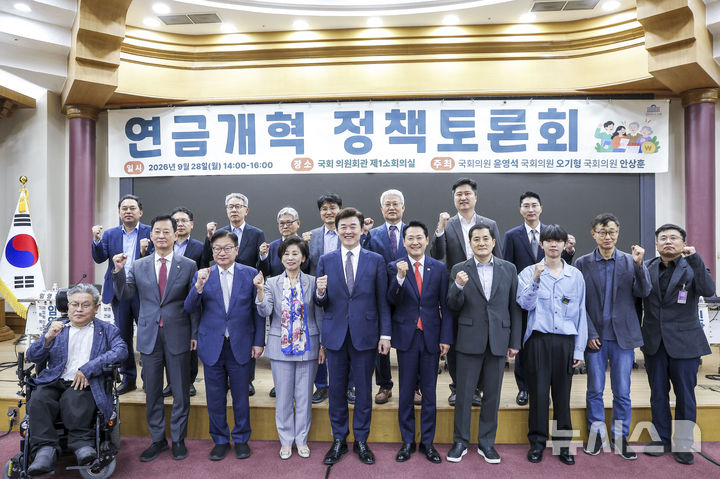
(As expected,
the majority of the media is still focusing
its reporting on the
advance injection of treasury funds—that is, taxes—into the National Pension.
Because the contents of the intense exchanges
with government ministries and other bodies on-site
are not being properly
reported in the news,
the author intends to include those details under the Commentary
section of the
Pension Future Forum's "Statements and Commentary" category.
From the remarks of Research Fellow Emeritus Yun Suk-myung, who took part as a discussant,
this summary focuses on those judged
essential to put on the record.
These remarks can be verified through the
recorded broadcast to be aired on NATV,
that is, National Assembly Broadcasting.)
a. At the debate, the moderator remarked that the discussion would be divided along the lines of "income security vs. fiscal stabilization," and this drew a strong objection. (What follows is the rebuttal made on the spot.)
A frame—that is, the label "fiscal-stability camp"—is created first, and Committee Member Yun Suk-myung is then named as the leading figure who has been making such claims.
However, the plan to "keep the income replacement rate at 40% and raise the contribution rate to 15%," which Committee Member Yun Suk-myung proposed in the Fifth National Pension Financial Estimation Committee and in the Advisory Committee to the 21st National Assembly Special Committee on Pension Reform, cannot achieve fiscal stabilization.
(Fiscal stabilization cannot be achieved even if the National Pension eligibility age is raised by three years, to 68—a measure Committee Member Yun Suk-myung did not propose.
This is why arguments for increasing the investment return of the National Pension Fund have emerged!)
Given all this, how can anyone impose a "fiscal-stability camp" frame? This is nothing more than a bad frame born of deeply malicious intent.
Let it be stressed once more, here at today's debate: the Pension Future Forum, including Committee Member Yun Suk-myung, who is often misrepresented as belonging to the "fiscal-stability camp," is simply emphasizing "enhanced intergenerational equity and the sustainable operation of the scheme."
b. Some are speaking as if most of the problems could be solved by injecting large amounts of treasury funds in advance. "Leaving the fate of the National Pension to an exogenous variable beyond our control—higher fund investment returns—is utterly irresponsible."
Before advancing the notion that fund investment returns are a cure-all, one must first examine how countries holding massive accumulated funds operate their schemes.
Norway, which holds a sovereign wealth fund that, per capita, is more than ten times the size of our National Pension's, "requires contributions of 18.1% while providing an income replacement rate of 41%." Japan "requires contributions of 18.3% while providing an income replacement rate of 32.4%." The Canada Pension Plan (CPP) "requires contributions of 11.9% while providing an income replacement rate of 33.3%."
Despite holding massive accumulated funds, these countries run their pension schemes only after first securing a balance between contributions and benefits. Before arguing for treasury injections, one must first understand how these schemes are run.
Keeping a scheme that is far from any balance between contributions and benefits while stressing only treasury injections is no different from arguing that the already entrenched pension vested interests of older generations—in Korea's case, especially those aged 50 and over—should be cemented even further.
c. While some emphasize large-scale treasury injections and higher returns through aggressive investment, the Future Generations Network, a youth organization under the Pension Future Forum, issued a statement today (September 28, 2026), the day of the debate.
"The money for treasury injections can come from only one of two sources: taxes or debt. Who will bear that burden? Who will bear the investment risk that comes with aggressive investment?
In the end, it is nothing but a word game; all these burdens and responsibilities ultimately fall on young people and future generations.
That is why we demand that, before any illusory promises or blueprints are put forward, it first be made clear where responsibility lies."
d. Committee Member Yun Suk-myung has argued that the March 20, 2025, amendment to the National Pension Act was a deterioration that saddled young people and future generations with an even heavier burden, pushing the pay-as-you-go (PAYG) cost rate, which had stood at around 36% before the overhaul, up by a further 2.8 percentage points to around 39%. The Ministry of Health and Welfare countered on-site that it had never presented any such data.
In response, Committee Member Yun Suk-myung, a discussant, showed on the spot the Ministry of Health and Welfare website that sets out these details, and stressed that when the Japanese expert Watanabe Yuichi asked for an explanation of them, a three-hour explanation was given at the Josun Hotel in Seoul.
e. One of the discussants strongly criticized the introduction of an automatic adjustment mechanism. What follows is Committee Member Yun Suk-myung's rebuttal.
"Automatic adjustment mechanisms span a very wide spectrum. For example, there could be approaches running all the way from 1 to 1,000. Among the sources of fiscal instability in our public pensions is the instability that arises when people live longer than originally expected and so draw a pension for a correspondingly longer period.
A design in which the total pension paid over a lifetime stays the same, but the monthly payment is reduced only in proportion to the lengthening of the benefit period, is precisely the quasi-automatic adjustment mechanism that applies Finland's life-expectancy coefficient.
If the National Pension's mandatory contribution age is extended by a further five years through labor market reform, pension amounts need not be cut even if a Finnish-style quasi-automatic adjustment mechanism is introduced.
Yet whenever automatic adjustment mechanisms come up, some insist that raising the subject only breeds needless distrust, claiming that the pension will turn into a hollow 'empty-can pension' or that such a mechanism is premature for us.
Anyone who wishes to criticize should first study automatic adjustment mechanisms properly."
f. Although the position taken here stresses both the need for and the urgency of introducing an automatic adjustment mechanism, the one that the government of the day announced in September 2024 was the worst design. That is because its latest possible introduction date was 30 years away, which made it a thoroughly bad design that would deepen intergenerational inequality even further through the very introduction of an automatic adjustment mechanism.
If one bears in mind that the purpose of pension reform, and of introducing an automatic adjustment mechanism, lies in enhancing intergenerational equity as well as securing the sustainability of the pension scheme, introducing an automatic adjustment mechanism as early as possible can be regarded as consistent with that purpose.
g. To properly grasp the reality facing our public pensions, the financial projection period must be extended by 30 years to 100 years, as in Japan,
and the financial projection cycle must be shortened to three years, as in Canada.
h. The accrued pension liability of the Government Employees Pension and the Military Pension is 1,345 trillion won, the unfunded pension liability of the Private School Teachers Pension is 185 trillion won (with each insured person carrying more than 500 million won in debt), and the unfunded liability of the National Pension is 2,000 trillion won;
thus, the payment shortfall of our public pensions, which are operated on a defined benefit (DB) basis, amounts to approximately 3,500 trillion won.
i. Even if the income replacement rate of the National Pension is lowered by 13 percentage points from the current 43% to 30%, and contributions are immediately increased to 12%, the National Pension Fund will be depleted in 2070 (according to the official financial projection results of the Fifth National Pension Financial Estimation Committee in 2023).
j. (Committee Member Yun Suk-myung's rebuttal to the remarks of the Director of the Pension Policy Division at the Ministry of Health and Welfare, who claimed that the unfunded liability of the National Pension is decreasing due to the amendment of the National Pension Act on March 20, 2025, and that unfunded liability is unsuitable for use because the figures can vary depending on the calculation method)
According to an estimate by Professor Jeon Young-jun of Hanyang University's School of Economics and Finance, a member of the Pension Future Forum,
even if a return of 5.5% is applied—which is 1 percentage point higher than the 4.5% fund investment return adopted by the Fifth National Pension Financial Estimation Committee—under
the "43% income replacement rate, 13% contribution rate" scenario,
by the year 2095, the unfunded liability of the National Pension relative to GDP will increase approximately 2.5 times.
Since a payment guarantee provision found in no other country in the world was introduced when the Government Employees Pension was revised in 2000,
the deficit subsidy for the Government Employees Pension has reached 10 trillion won for the year 2025 alone.
The state guarantee of benefit payment for the National Pension, which Committee Member Yun Suk-myung had opposed for 20 years, has been introduced.
It is now explicitly stated that the state also guarantees the payment of the National Pension.
If so, the government, which had previously refused to disclose the unfunded liability of the National Pension on the grounds that the state was not the employer, is now obligated to calculate and disclose the unfunded liability.
It is argued that unfunded liability is an inappropriate concept for use because the figures vary by calculation method,
but this is simply a matter of calculating the National Pension's figure in the same way as the accrued liability of the Government Employees Pension and the Military Pension.
The unfunded liability of the National Pension must be calculated and disclosed starting next year, without delay.
k. Financial projection reports for the Government Employees Pension have not been disclosed since 2015. What is the reason for not disclosing the Government Employees Pension financial projection reports despite the annual deficit subsidy reaching 10 trillion won?
l. This is Committee Member Yun Suk-myung's rebuttal to Professor Yang Jae-jin's claim that there will be no concerns about fund depletion of the Private School Teachers Pension if the contribution rate for the Private School Teachers Pension is increased from the current 18% to 22% and the fund investment return is raised.
The German Federal Government Employees Pension, which has a lower benefit rate than our Government Employees Pension and Private School Teachers Pension, pays contributions of 38% to the Bundesbank. The claim that fund depletion can be avoided with a 22% contribution rate for the Private School Teachers Pension does not appear to be valid.
m. Public pensions should be operated in an integrated manner, as recommended by the OECD since 2022. This is because it is always someone else's fault and never one's own.
Currently, among OECD member countries, Korea, Germany, France, and Belgium are the only four countries that operate public pensions separately.
Public pensions must be operated in an integrated manner so that transparent comparisons can be made.
Integrated operation here does not mean the integration of schemes, but rather overhauling the schemes so that transparent comparisons become possible in substance as well as in name.