(Chosun Ilbo, September 16) [Taepyeongno] The More I Think About It, the More Absurd the Failure of the Basic Pension Overhaul
Having himself called it "strange" and ordered an overhaul,
he ignored the interim reports
and then put on the brakes at the last minute.
The current announcement
is merely a one-year measure.
Proper discussion and overhaul must begin now
Two weeks have passed since the government scrapped the Basic Pension overhaul plan, but there are many things that remain incomprehensible.
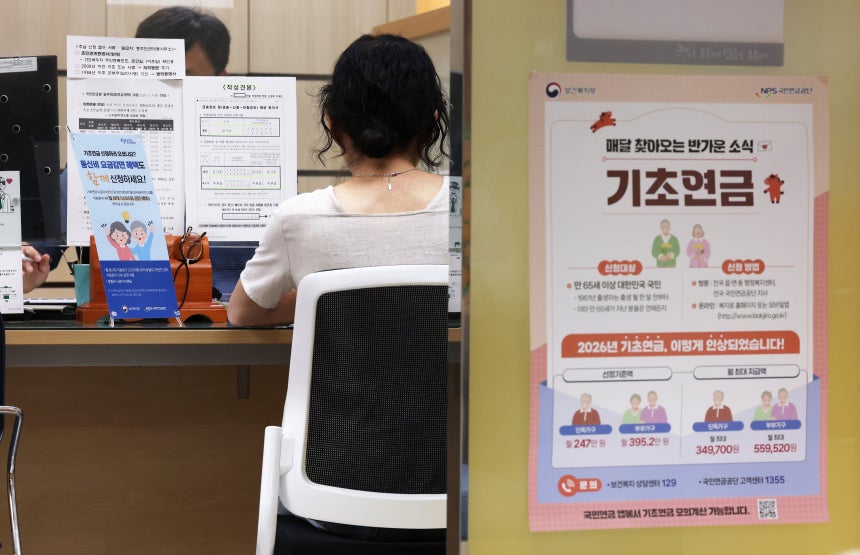
The newly released plan maintains the current eligibility criteria for receiving the Basic Pension and provides the bottom 30% by income with 30,000 won more next year than this year.
The core issue that must be fixed—the problem of providing the Basic Pension even to those with some financial leeway—was left untouched.
Until now, the words of President Lee Jae-myung and Minister of Health and Welfare Jung Eun-kyeong raised expectations that the Basic Pension overhaul would be carried out at a reasonable level.
During a Cabinet meeting on January 20, President Lee said, "It is somewhat strange that someone with a monthly income of 2.5 million won (this is recognized income, so people whose actual income is nearly double can also receive it) receives 340,000 won," adding, "The fiscal burden increases by several trillion won per year; is that correct?"
He accurately pointed out the problem of using taxes to provide the Basic Pension even to those aged 65 and over who are well-off, which occurs because benefits are given uniformly to the bottom 70% by income.
At the same time, President Lee said, "If necessary, it should be done in a 'more for the lower, less for the upper' manner." He spoke of both the eligibility criteria and the "more for the lower, less for the upper" overhaul simultaneously.
In response, during a presidential office work report on July 16 attended by President Lee, Minister Jung said, "The 'more for the lower, less for the upper' principle has been established, and we are creating an overhaul plan in the direction of changing the eligibility threshold to the standard median income."
This is also the overhaul plan suggested by many research institutions and experts, including KDI, the National Pension Research Institute, and KIHASA. President Lee did not make any particular mention of this.
Minister Jung continued to express this position several times thereafter through the National Assembly or the media.
However, it is said that even after the Ministry of Health and Welfare submitted several interim reports on the Basic Pension overhaul plan, the presidential office did not show any particular reaction.
Could it be that they lacked significant interest in the largest welfare project in the country, for which the national treasury budget alone is 25.7 trillion won next year?
The Ministry of Health and Welfare reportedly interpreted this as a positive signal regarding changing the eligibility threshold to the standard median income.
Seeing that Minister Park Hong-geun of the Ministry of Planning and Budget also stated at the end of July that the Basic Pension eligibility threshold would be changed to the standard median income, it seems that coordination between ministries had been completed.
However, the Ministry of Health and Welfare suddenly canceled the briefing on the Basic Pension overhaul plan—which had been scheduled for 2:00 p.m. on the 27th of last month—one hour before it was to begin, and the final plan released on the 1st was a proposal to maintain the eligibility threshold as is.
Ultimately, this means that the presidential office blocked it, yet there is no explanation as to why.
Unlike other issues, there had been no significant voices of opposition regarding the Basic Pension overhaul.
Speculation merely suggests that this may have been due to concerns over an erosion of support among middle-aged and older voters as President Lee's approval rating dropped to the 30% range.
It is not as if he had been pushed into promising it; I wonder if there has ever been another example where someone personally called something "strange" and ordered it to be pursued, only to let it fail so vainly.
President Macron of France, whom President Lee met a few days ago, achieved pension reform despite enduring great political burden and social backlash.
Even if President Lee had pursued the Basic Pension overhaul, it was not a situation where immediate political losses would have occurred. On the contrary, if it were an overhaul that reduced the fiscal burden and provided more generous support to those aged 65 and over who needed it, it was highly likely to be applauded.
This is not something that should have collapsed so vainly.
It is true that this plan was developed in a relatively short period following President Lee's order and that social deliberation, such as discussions with experts, was insufficient.
This Basic Pension announcement is for one year. It has not been decided how to proceed after next year.
In effect, time has been secured to discuss the matter for about a year. The direction is clear. Regardless of how the eligibility threshold is changed, it needs to be in a direction where those aged 65 and over who are well-off do not receive it.
There are plenty of ways to minimize political backlash as well as side effects, such as designing the plan so that the effects appear gradually.