
(Column 4, the Column That Most Prominently Led the Opposition to Introducing the Basic Pension. OhmyNews, November 6, 2005) Committee Member Yun Suk-myung (Posted September 8, 2026)
(As of the second half of 2026,
the most contested issue
in pension reform is
the introduction of the Basic Pension,
and what most strongly opposed it was the
November 6, 2005
column by Committee Member Yun Suk-myung
in OhmyNews.)
We Cannot Break the Backs of Future Generations Just to Live Well Now
[The National Pension, Relayed in Print — The Government’s Plan] Yun Suk-myung, Research Fellow at the Korea Institute for Health and Social Affairs (KIHASA)
OhmyNews(news)
https://www.ohmynews.com/NWS_Web/View/at_pg.aspx?CNTN_CD=A0000371371&CMPT_CD=SEARCH
The National Pension, not even 20 years old since its introduction, is facing a harsh period of trial. This is because there are considerable differences among the political world and stakeholders regarding the direction of National Pension reform.
The National Pension improvement proposals currently submitted to the National Assembly are broadly divided into three. ▲the government’s 2003 amendment to the National Pension Act, which focuses on fiscal stabilization; ▲the opposition party’s amendment bill, whose main thrust is introducing a tax-financed Basic Pension; and ▲the Uri Party’s proposal, which pursues both fiscal stability and closing coverage gaps at the same time — these are exactly what they are.
Last October, the Uri Party accepted the problem raised that “the government’s plan focuses only on fiscal stability while overlooking measures to close the coverage gaps,” and submitted a new bill.
For the fiscal stabilization of the National Pension, only the income replacement rate would be lowered by 10 percentage points, from 60% to 50%, while the contribution rate would be kept at the current 9%, with the decision on whether to raise the contribution rate to be made after 2008. The pension coverage gap was addressed by collecting taxes to pay a Basic Old-Age Pension of between 70,000 and 100,000 won a month, depending on income level, to 60% of older people aged 65 and over.
The National Pension’s Role Will Shrink 25 Years From Now

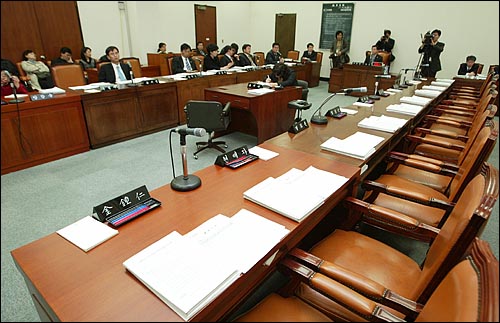
▲On the afternoon of December 27, 2004, at the National Assembly’s Health and Welfare Committee, which is taking up the amendment to the National Pension Act and other measures, only Uri Party lawmakers sit in their seats, with opposition lawmakers absent. Kwon Woo-sung
This Uri Party amendment to the Pension Act is a modified version of the National Pension amendment that the government presented this June. Compared with the overhaul plan the government originally presented in June, the Uri Party’s proposal can be summarized as a substantial retreat on fiscal stabilization measures and, on the dimension of closing the coverage gaps, a substantial expansion of the number of eligible recipients.
Although the Uri Party’s proposal is a modified version of the government’s plan, it is not suitable as a direction for pension reform aimed at coping with a super-aged society — that is the author’s judgment.
The direction of the government’s National Pension reform presented this June can be summarized as seeking stronger fiscal stabilization and a plan to close the coverage gaps that takes into account the developmental trends of the National Pension. As part of the financial projection, the amendment to the National Pension Act that the government submitted to the National Assembly in 2003 was a plan to lower the income replacement rate by 10 percentage points, from 60% to 50%, by 2008, and to raise the contribution burden from 9% to 15.9% by 2030.
After the government’s plan was submitted, two variables arose. One was that fierce criticism was raised that the plan cared only about fiscal stability and had no measures to close the coverage gaps. The other variable was that, starting in December 2005, a system converting the existing severance pay into a retirement pension was put into effect. As converting the 8.3% severance pay into a retirement pension was expected to yield an income replacement rate of around 20%, it was judged that, from a long-term perspective, room had opened up to lower the National Pension’s income replacement rate.
In terms of the burden, it was also considered that, in the long run, combining a 15.9% National Pension contribution rate with an 8.3% retirement-pension contribution rate would raise the burden level to an excessively high 24.2%.
The government’s June plan, with regard to fiscal stability, is a plan that would not lower the current 60% income replacement rate to 40%, a 20-percentage-point cut, until 2030, while keeping the contribution burden level capped at 13% or below. Given that the retirement pension system was introduced in December 2005, it was judged that, if an effective old-age income security system were built over the following 25 years, the retirement pension would establish itself as one pillar of old-age income security, thereby allowing the role of the National Pension to be reduced correspondingly.
On the other hand, based on the recognition that the problem of income-security coverage gaps among the current older population was serious, the government collected taxes and paid a Basic Old-Age Pension of 80,000 won a month to 45% of those aged 65 and older in an effort to address the problem of elderly poverty.
Even though it shares a common point with the opposition party’s tax-financed Basic Pension in that it collects taxes to pay the pension, the government’s plan differs considerably from both the ruling party’s plan and the opposition party’s plan. The government’s plan is based on research from the Korea Institute for Health and Social Affairs’ survey of the welfare needs of older people, which found that older people requiring government support would amount to about 45% of the total population aged 65 and over.
Because the National Pension’s history since its introduction is short, as of the end of 2005 National Pension beneficiaries amount to only 13.5% of older people aged 65 and over, but the longer that history grows, the more sharply the number of pension beneficiaries will rise. According to the National Pension’s long-term projection, by around 2030 National Pension beneficiaries are expected to make up more than 55% of all older people aged 65 and over, an increase of more than 40% over the present level.
The core of the government’s plan is that it has seized on the point that, while the problem of elderly poverty is serious now because National Pension beneficiaries are few, the share of older people in poverty will fall sharply once the era of full-scale National Pension receipt arrives.
Accordingly, the share of recipients of the Basic Old-Age Pension, which is to be paid to about 45% of older people, will fall to around the 25% level by 2030, in step with the rising trend in National Pension beneficiaries. This makes it possible to significantly lighten the burden on future generations in a super-aged society.

▲In 2004, at a nationwide candlelight protest held by the Korea Taxpayers Association beside the Kyobo Book Centre in Gwanghwamun to block the National Pension amendment bill to the last and to abolish the National Pension, a participating citizen places an “Abolish the National Pension” leaflet on a small child’s head. Yonhap News, Jin Sung-cheol
Why the Advanced Welfare States Are Abolishing the Tax-Financed Basic Pension
As is well known, a “tax-financed Basic Pension” is a system under which the state collects taxes and pays a pension to every citizen of the Republic of Korea from the point at which they reach a certain age (say, 65 or over).
Although there will be some difference in degree depending on the amount of pension paid, if the Basic Pension is introduced, the problem of elderly poverty will improve dramatically. It could establish itself as an effective income security system for older people who, such as the abused older people frequently appearing in the media these days, failed to prepare for their own retirement in the course of rapid industrialization.
Nevertheless, why is the government opposing the introduction of such a good system? It is because the government, which is responsible for managing the country’s finances, is taking into account the negative effects that would arise in the long run after the system’s introduction.
A tax-financed Basic Pension is a system that, for the sake of older people who have already retired, collects taxes from the present working generation and pays a pension to those retired older people. Naturally, in a society or a country where the number of older people is small and the working population is large, there is little difficulty in operating the system. Moreover, since a considerable number of OECD countries operate a tax-financed Basic Pension system, public opinion that Korea, as an OECD member, must likewise introduce a tax-financed Basic Pension is running high.
These countries, however, are distinctive in that they introduced the system in an environment favorable to introducing a tax-financed Basic Pension — high growth and high fertility, among other things. That is, they introduced the Basic Pension on the premise that, with a high annual economic growth rate and a high fertility rate for newborns as well, the economically active population that would support older people would increase rapidly.
Yet these countries too, as the surrounding environment has shifted in a direction unfavorable to maintaining the Basic Pension — low growth, low fertility, and rising life expectancy — are struggling to extricate themselves from the tax-financed Basic Pension.
Even the Nordic advanced social-welfare states such as Sweden and Finland, which we commonly take to be the very model of the welfare state, have already turned their policy direction toward abolishing or scaling back the Basic Pension.
What Pension Plan Is Sustainable Even in a Super-Aged Society?
Foreign countries aside, what is the problem in our own case that leads the government to take such a strongly opposed position on introducing a tax-financed Basic Pension? The problem, it may be said, lies in the low fertility rate and the rapid rise in life expectancy.
Korea’s fertility rate is already the lowest in the world. That means that the economically active population that must feed and support older people is shrinking just as rapidly. The older population that will become pension beneficiaries is growing at the fastest rate in the world.
A tax-financed Basic Pension, by contrast, fixes the share of pension beneficiaries at 100% or 80% of the older population, so in a super-aged society in which the older population surges, the burden on future generations cannot but increase sharply. This is because, unlike the National Pension, in which the pension is paid out of the contributions one has made oneself, a tax-financed Basic Pension covers the pension amount out of taxes collected from that year’s economically active population.
As long as the older population is small relative to the economically active population, as it is now, this will pose little problem; but in a super-aged society in which the number of older people surges while the economically active population shrinks sharply as the fertility rate falls, the burden on the economically active class cannot but reach a level beyond imagination.
Therefore, if a tax-financed Basic Pension is introduced, there will be no major problem right now, but after 2020, when the country enters a super-aged society, there is a risk that the backs of future generations will be broken by the enormous funding required. The government’s position is that we cannot break the backs of future generations just so that we can eat and live well. It is also far too irresponsible to shift the burden onto future generations who have not even been born yet without ever asking them.
Even knowing that the overwhelming majority of the public are unhappy about improving the National Pension system in a direction that would mean receiving less than now, the government is presenting a plan to cut the pension amount. Even if it is unpopular, from the standpoint of a government responsible for the nation’s long-term, hundred-year plan, it is likely an unavoidable choice.

▲Yun Suk-myung
Looking around at the reality we face, we need to think hard about whether the rosy schemes being held out to us can really remain sustainable even in a super-aged society.
A pension system is one that cannot but collapse if the money or the capacity to bear the burden runs out. Yet the common experience of the countries with mature pension systems is that, because of populism, a system once introduced is hard to fix in good time — right up until it collapses — on account of political groups with one eye on the vote. This is a moment that calls for a more dispassionate judgment on the direction of National Pension reform.
https://www.ohmynews.com/NWS_Web/View/at_pg.aspx?CNTN_CD=A0000371371&CMPT_CD=SEARCH


