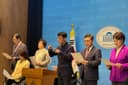
(National Assembly Member Nam In-soon and Yun Suk-myung, Head of the Pension Research Center) [2013 Head-to-Head Debate] Should National Pension Benefit Payments Be Guaranteed by Law?
- #국민연금법

(We have attached as a file the relevant provisions
of the German Social Code that prove Germany has
no provision for a state guarantee of pension payment!)
(2013
Korea Economic Daily head-to-head debate)
(A proposal has been put forward to eliminate public distrust by having the state guarantee National Pension benefit payments. At present, the obligation to pay rests with the National Pension Service. The ruling party, too, accepted it. The amendment to the National Pension Act passed the National Assembly Health and Welfare Committee. However, the Ministry of Strategy and Finance and other agencies opposed it, and deliberations were halted in the Legislation and Judiciary Committee. The objection was that a state guarantee would be counted as a latent liability and would create problems for the country's external credibility. It was also argued that it could impede reforms — such as raising the contribution rate — needed to prevent fund depletion.
In practical terms, if the National Pension Fund were depleted, the state would have no choice but to assume responsibility for benefit payments. This holds true in every country. Nevertheless, both sides maintain that writing this into statute and not writing it in are different matters. From Representative Nam Yun In-soon of the Democratic United Party and Yun Suk-myung, head of the Pension Research Center at the Korea Institute for Health and Social Affairs (KIHASA), we heard views for and against.)
For - Distrust over "fund depletion" grows — only a law can stop a "rush to withdraw" (National Assembly member Nam Yun In-soon)

Since 1998, a National Pension financial projection has been conducted every five years. This year the third financial projection was carried out. On each occasion the government has lowered the National Pension's benefit rate on the grounds that the fund will be depleted, and as a result the public worries that, if the pension fund is depleted, they will be unable to receive the pensions they have paid in. Far from instilling public confidence in the National Pension, the government has fostered distrust. According to a survey conducted by the Federation of Korean Industries in 2011, 50.8% of respondents answered that they "will not receive a pension in old age because the fund will be depleted." In a KBS opinion poll this past April as well, the share expecting that "the National Pension they receive in old age will be the same as it is now" was a mere 16.5%. Fully 83.5% answered that it would be less than it is now or that they would receive nothing at all.
In response, this Representative, together with others, introduced as lead sponsor an "Amendment to the National Pension Act" containing a "state guarantee of National Pension payment." It passed the National Assembly Health and Welfare Committee (hereafter the Health and Welfare Committee) after party-government consultations between the government and the ruling party and agreement between the Ministry of Health and Welfare and the ruling and opposition parties.
The Blue House and the Ministry of Strategy and Finance, however, put on the brakes, on the grounds that Korea is the only country that writes a guarantee of National Pension payment into statute and that specifying such a guarantee would be recorded as national debt and would adversely affect the nation's fiscal soundness. Because of this, a bill that had gone through party-government consultations and secured ruling- and opposition-party agreement has failed to clear the Legislation and Judiciary Committee and remains pending.
Pensions are not counted as liabilities — no bearing on the country's credit rating
But the Ministry's reasoning for this opposition rests on mistaken facts. The Ministry claims that Korea is the only country to write a guarantee of National Pension payment into statute, but in fact a good many countries — Germany and Japan among them — do write a guarantee of pension payment into statute. Germany, the first country to introduce social insurance, specifies in Book VI (Public Pension Insurance), Article 214 (Liquidity Guarantee) of its Social Code that the state is to provide a subsidy when the pension fund falls short, and Japan legally guarantees the state's obligation to pay pensions in its National Pension Act.
Moreover, Korea already has provisions for a state guarantee of benefit payment in the Government Employees Pension, the Military Pension, and the Private School Teachers Pension. Of these, the Government Employees Pension and the Military Pension — for which the concept of an exchange transaction holds because the state is the employer — recognize the estimated pension amount payable as an accrued pension liability in the financial statements. But because the state is not the employer in the Private School Teachers Pension or the National Pension, it is difficult to judge that an exchange transaction between national accounting entities clearly exists.
Accordingly, under Article 9 (Recognition of Pension Liabilities) of the Ministry's "Fund Accounting Rules" notification as well, the Private School Teachers Pension and the National Pension currently do not recognize the estimated pension amount payable as an accrued pension liability in the financial statements. Not all pension benefits are included within the scope of accrued pension liabilities; only the long-term benefits under Article 42 of the Government Employees Pension Act and the benefits under Article 6 of the Military Pension Act are. So even if a state guarantee of benefit payment is specified in the "National Pension Act," there is no problem in not recognizing it as an accrued pension liability, just as with the Private School Teachers Pension.
The National Pension is a partially funded and partially pay-as-you-go (PAYG) scheme. It stands midway between a fully funded system, as in Chile, in which one receives back exactly what one has paid in, and a PAYG system, as in Europe, where pension schemes have matured, in which the reserves paid in by the current working generation fund the pensions of the current older generation. Under the National Pension scheme, one does not simply receive back the very contributions one has paid. When one draws a pension 20–40 years after paying in, the pension is paid out of both one's own contributions and the contributions of the working generation of that day; the National Pension can therefore be described as a partially PAYG social insurance scheme with an enormous fund.
If the partially PAYG National Pension is regarded as a liability, then most European countries, which have no fund at all, would be carrying enormous liabilities. Germany, for example — which spends 10.8% of gross domestic product (GDP) each year on its PAYG pension and has a state guarantee of benefit payment written into its law — would in effect be carrying enormous liabilities. Yet Germany does not count this as national debt.
The Ministry argues that if a state guarantee of benefit payment is written into the National Pension Act, the national debt measured on an International Monetary Fund (IMF) basis risks snowballing. Yet under the IMF's Government Finance Statistics Manual, social security benefits are not recognized as government debt, on the grounds that in social insurance schemes no strict relationship exists between contributions and benefits, the benefit structure may be changed by policy, and no contractual obligation is created for the government. The International Public Sector Accounting Standards (IPSAS), moreover, have deferred establishing an accounting standard for public pensions, which are non-exchange in character.
Germany specifies payment of a subsidy — in Japan, too, the state guarantees it in law

Even granting the Ministry's claim in full — that specifying a state guarantee of benefit payment would be reflected in the national debt — the fear that this would affect the nation's fiscal soundness and lower the country's credit rating is groundless. In May of last year, when the government shifted the basis on which the national accounts are prepared to an accrual basis, it additionally brought 340 trillion won in Government Employees Pension and Military Pension provisions, which until then had been excluded from national debt, into national debt and announced total national debt of 720 trillion won. As a result, national debt roughly doubled from the previous year, yet the world's three major credit rating agencies in fact raised Korea's credit rating.
Unlike the personal pensions and pension savings products run by the financial sector, the National Pension is a social insurance scheme operated by the state to secure the public's old-age income. To dispel the public's fear that they will not receive the pensions they have paid in if the pension fund is depleted, and to strengthen the foundations of the National Pension scheme — the backbone of Korea's old-age income security system — and thereby make old-age income security firm for the middle class and ordinary citizens, the "Amendment to the National Pension Act" (the alternative bill) must be passed as quickly as possible.
Against -
A "stumbling block" to future pension reform — if it becomes debt, the country's external credibility falls
(Yun Suk-myung, head of the Pension Research Center at the Korea Institute for Health and Social Affairs)

The claim that the state should guarantee National Pension payment is nothing new. A related bill was introduced back in the 18th National Assembly, and in last year's presidential election it was one of the opposition's campaign pledges. The aim is to dispel the deep-rooted distrust of the National Pension.
It is true that the social environment surrounding the National Pension has changed greatly. In 1988, when the National Pension was introduced, the economic growth rate and the fertility rate were high while average life expectancy was only 70. Twenty-five years on, this is an era of low growth.
The fertility rate has fallen while average life expectancy has passed 80, and the older population is rising sharply. There are projections that the National Pension will be depleted around 2060. In such circumstances it is not beyond understanding that the public should be anxious about whether they will properly receive their National Pension benefits. If the National Pension is to take hold as an old-age income security scheme, public trust is essential.
But is a payment guarantee the solution? It is not. To begin with, in terms of practical effect, writing a payment guarantee into statute means little. In a democratic country, what government would be "brazen" enough not to pay the National Pension? Short of a very extreme situation in which the functions of the state have ceased to operate, the National Pension will be paid whether or not there is a payment guarantee provision. The practical effect of legislating it is not clear.
The state pays even without a statutory provision — every overhaul brings only a split in national opinion
On the contrary, a payment guarantee does more harm than good. First, it is highly likely to act as a stumbling block in the process of overhauling the National Pension scheme. If the state guarantees pension payment, the logic that "even if the fund runs dry, the state can simply cover it with taxes" may spread. The state would then put less effort into restoring the National Pension's finances to soundness. This is a phenomenon already appearing in the Government Employees Pension and the Military Pension, where a payment guarantee is written into statute.
The overhaul of the National Pension must be done properly and at the right time. Discussion of the overhaul is likely to proceed in the direction of increasing the public's burden. When it does, the public may invoke the payment guarantee provision to object that "the government is not keeping its original promise." The payment guarantee could become the trigger for a split in national opinion and a waste of national energy. The pension overhaul becomes all the harder.
Looking back at the past makes this clearer still. The 2003 amendment to the National Pension Act, based on the results of the first National Pension financial projection, was intended to overhaul the National Pension scheme to fit the changed environment. It proposed changing the existing "pay less, receive more" scheme into a "pay more, receive less" scheme.
The public pushed back. Cutting National Pension benefits on the pretext of fiscal stabilization meant failing to keep the original promise, and voices calling for those who had taken part in designing the National Pension to be held to account grew loud. There was also criticism that the government had deliberately put forward pessimistic assumptions in order to overhaul the National Pension in the direction it wanted. The controversy ran on for four years, but in the end a half-measure reform in which one "only receives less" was carried through.
And six years have passed. The National Pension's fiscal instability has worsened that much further. What is needed now to dispel the distrust is something else: overhauling the scheme as quickly as possible so that the National Pension can be sustainable. Even so, there is little interest in raising the pension's sustainability through a contribution increase. In a situation where it is not easy to build a consensus on the direction of the overhaul, writing a payment guarantee into statute could instead become an obstacle to the responsible management of the National Pension.
Some cite equity as the ground for a National Pension payment guarantee. The special occupational pension schemes — the Government Employees Pension and the Military Pension among them — already specify a payment guarantee, they say. They therefore argue that the same provision should be introduced for the National Pension. But this does not fit the reality.
As the sustainability of the special occupational pension schemes has become a problem, calls for their reform are growing louder. In such circumstances, for the National Pension to follow the special occupational schemes' payment guarantee provisions is a problem. The right direction is to keep revising both the Government Employees Pension and the National Pension toward sustainability.
The claim that in other countries the state guarantees pension payment is also at odds with the facts. That is the case with Germany, which is cited as an example of a payment guarantee. Germany pays a subsidy toward pension costs (Social Code, Article 213(1)) and has a provision under which the federal government may provide support when liquidity is short. But it also specifies that this is to be returned once the liquidity problem is resolved (Social Code, Article 214(1)). It is hard to find a case abroad specifying that the state directly guarantees payment of a national pension.
Pension latent liabilities of 423 trillion won — the fallout from a payment guarantee reaches the national economy

If a payment guarantee is written into statute, yet another side effect is to be expected: the problem that follows from counting the National Pension's latent liabilities as national debt in full. The latent liabilities arising from the National Pension came to 423 trillion won as of 2011. If it is specified that the state guarantees payment of these, they could be added to national debt in full.
The country's external credibility would then fall, funding rates would rise, and international competitiveness could be adversely affected as well. That is to say, the repercussions of specifying a payment guarantee could appear across the national economy.
Specifying a guarantee of National Pension payment calls for caution. However good the intent, if legislating it carries this many negative effects, it must be reconsidered.
Since the legislative process is already under way in the National Assembly, some argue that the relevant provision must be included. If so, softening the content of the provision would also be an alternative. It could be replaced, for example, with language requiring the state, as a prudent manager, to do its utmost to guarantee pension payment. This is a way to ease the public's anxiety without increasing national debt.
Yun Suk-myung < Head of the Pension Research Center, KIHASA >