
(JoongAng Ilbo — Pension Future Forum Coverage, Print Edition) Basic Pension 'More for the Lower, Less for the Upper' Half-Measure Overhaul — Only the Bottom 30% Get an Extra 30,000 Won a Month (September 2, 2026)
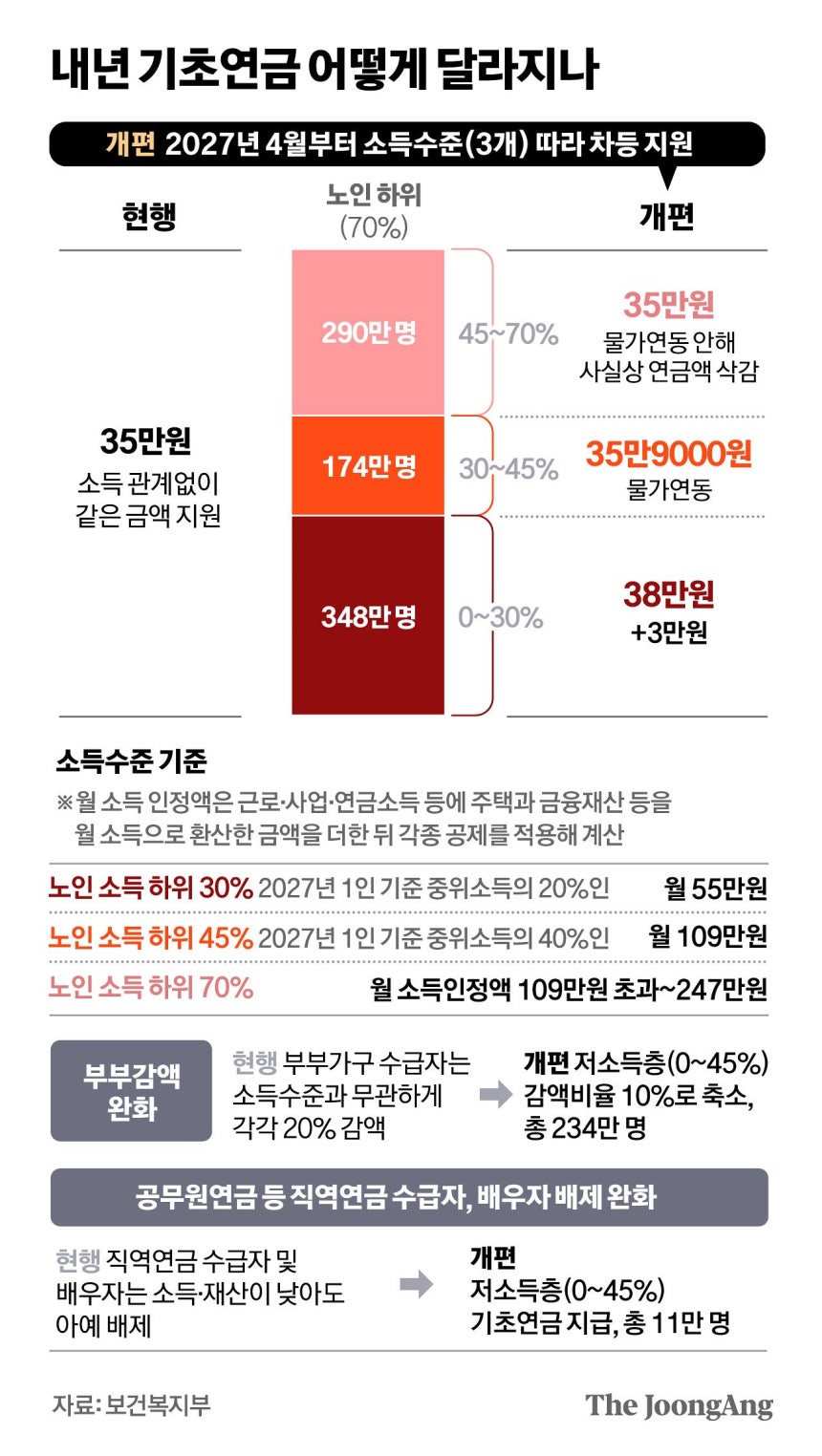
The structural overhaul of the Basic Pension that the government had pursued at President Lee Jae-myung's direction for 'more for the lower, less for the upper' has been shelved.
Next year, only a limited differentiated payment will be implemented: low-income recipients will get an extra 30,000 won a month, while the pensions of relatively higher-income beneficiaries will be frozen. Because measures such as changing the Basic Pension eligibility threshold were not implemented, some observers see the overhaul plan as having been effectively shelved.
On September 1, the 2027 budget bill containing these details was passed at the Cabinet meeting.
Earlier, President Lee said, “An older person with a monthly income of several million won and an older person with zero income receive the same amount of Basic Pension,” adding, “One way forward would be to apply 'more for the lower, less for the upper' only to future increases.” In response, the government has been reviewing an overhaul plan that would link the current target take-up rate — set at '70% of those aged 65 and over' — to the standard median income.
Starting in 2027, the eligibility threshold would have been changed from the bottom 70% by income among older people to 90% of the standard median income, then lowered in stages to 86.6% in 2028, 83.3% in 2029, and 80% in 2030. Existing beneficiaries above the new threshold would have been given a five-year protection period, during which their payments would be reduced in stages before they were removed from the program.
Son Ho-jun, Director-General for Pension Policy at the Ministry of Health and Welfare, said, “There is a need to shift to the standard-median-income standard, but it must go through further discussion in the National Assembly and society.”
The retreat from the Basic Pension overhaul plan appears to reflect concern over the fallout from cutting or disqualifying existing beneficiaries.
The recent decline in President Lee's job approval rating in opinion polls is also seen as part of the background.
As a result, the structure under which older people with high income and assets also receive the Basic Pension will continue next year as well. The 'less for the upper' portion contained in this budget bill amounted to nothing more than freezing the pensions of 2.9 million older people whose recognized income exceeds 1.09 million won a month.
They will keep receiving the same 350,000 won a month as this year; under the current price-indexation method, the amount should rise to 359,000 won next year, but they will not receive the 9,000-won increase. That amounts to 35.7% of the 8.12 million beneficiaries overall.
The 'more for the lower' portion is not large, either. The pensions of 3.48 million older people whose recognized income is 550,000 won a month or less will rise by 30,000 won to 380,000 won. The 1.74 million people with a recognized income between 550,000 and 1.09 million won a month will receive 359,000 won, reflecting the inflation rate.
Cho Yong-beom, Vice Minister of the Ministry of Planning and Budget, said, “This is not a case of pulling the top stone out to prop up the bottom one; rather, it leaves the top stone in place while reinforcing the bottom stone.”
Dr. Oh Gun-ho, co-chair of Welfare State I Make, criticized this, saying, “Excluding the inflation-indexed portion, the additional amount given to the bottom 30% is only 21,000 won — can that really be called 'more for the lower'?” and “The goal of improving elderly poverty has disappeared.”
The Pension Future Forum's Future Generations Network pointed out in a statement, “They abandoned the structural reform needed to help the poorest older people properly, while passing on only the cost to the next generation.”
![(연금연구회 성명서 보도. 노컷뉴스) [칼럼] 연기금 카지노 책임론?…'쉬운길' 선택의 결과일 수 있다 (2026.10.20.)](/_next/image?url=%2Fuploads%2Feditor%2F2026%2F10%2Fc6f13b0799b440d0874a9f72413c6f58-0004200449_003_20261020063615439-1.jpg&w=128&q=75)
![(연금연구회 성명서 보도. 중앙일보) [취재일기] 국민 노후보다 코스피를 지킨 국민연금 (2026.10.19. )](/_next/image?url=%2Fuploads%2Feditor%2F2026%2F10%2F7e92f70b0ec843bbb869a4cf46b01f72-0003558751_001_20261019052229249.jpg&w=128&q=75)