Is There a Young Person Who Would Nod at “The Law Guarantees Pensions, So Do Not Worry”? (2026. 08.29.)
(Published one day before the amendment
to the National Pension Act passed
on March 20, 2025 —
that is, on March 19, 2025 —
this is a contributed article by Yun Suk-myung,
Research Fellow Emeritus at the Korea Institute for Health and Social Affairs,
in Shin Dong-A, the Dong-A Ilbo group’s monthly magazine.
The opposition party mentioned in this piece
is the Democratic Party.
We are posting this piece
on the Pension Future Forum website
because the pension act amendment
passed on March 20, 2025 —
the legislative change the Pension Future Forum
defined as a “change for the worse” —
was the product
of political coercion by the then-opposition
Democratic Party, which insisted
it would pass the bill
even single-handedly.
That is the point
we wish to emphasize.
When they were in opposition
they forced the bill through
with such coercion,
and yet,
having taken power,
they cannot reform even the Basic Pension
properly, while
“meddling in every conceivable way
in the management of the National Pension Fund.”
Against this two-faced conduct on the part
of the government and the ruling party
we issue a warning in the name of the people,
and above all
on behalf of the young,
whose anger
has reached its peak.
The supermajority opposition must,
rather than doing nothing but electoral vote calculations,
bring at least a minimum
sense of responsibility
to the governing of the country.
That is our demand.)
[Pension Reform Proposal] The Opposition Takes “a 43% Income Replacement Rate” and Puts Forward “Writing a Payment Guarantee into Law”
● The opposition concedes on the income replacement rate, attaching three conditions
● Even if the “People Power Party proposal” is accepted, unfunded pension liability in 2050 will reach 6,159 trillion won
● It is “the existence of the fund,” not “a phrase in the statute,” that guarantees the National Pension
● “Pension reform without an automatic adjustment mechanism is a transparent sham”
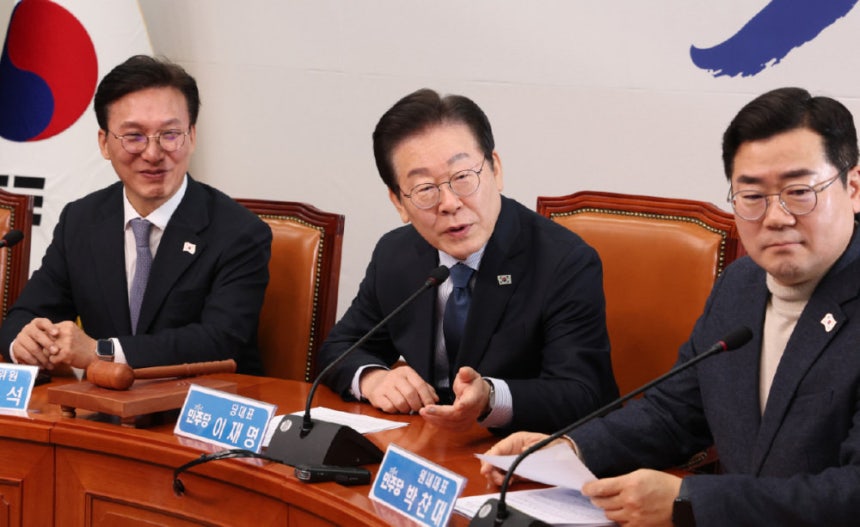
Debate on pension reform, which had lapsed into a lull in the aftermath of the December 3 emergency martial law, has resurfaced as a hot potato at the initiative of Lee Jae-myung, leader of the Democratic Party of Korea.
At the ruling party–opposition–government consultative council on state affairs on February 20, party leader Lee is understood to have said, in effect, that “if agreement fails, we will have no choice but to force the bill through.”
Four days later, at a Democratic Party Supreme Council meeting, he stressed that “to cope with low birth rates and population aging, the National Pension system must be overhauled without fail,” adding, “I expect it to be dealt with as quickly as possible.”
Korea is the country with the worst conditions for operating a pension system among the member states of the Organisation for Economic Co-operation and Development (OECD). The three elements that underpin the operation of a pension system — the birth rate, life expectancy, and the share of the older population — are all developing unfavorably for pension provision. On March 5 the OECD published a booklet titled “Korea’s Unborn Future,” which carried the warning that “Korea’s total fertility rate in 2023 was 0.72, the lowest in the world, and if this situation continues, those aged 65 and over will account for around 58% of the total population by 2082.” In other words, the population receiving the National Pension will come to exceed the population paying into it. This is, of course, an unsustainable structure. Korea needs more forceful pension reform than any other country.
A one-percentage-point difference widens to 299 trillion won in 25 years
Both the ruling and opposition parties agreed that “National Pension reform is necessary.” They also agreed on raising the contribution rate from the current 9% to 13%. But as views diverged over how far to raise the income replacement rate — the “money received” — the National Pension reform bill drifted in the National Assembly for a long time. The People Power Party argued that the income replacement rate should be raised to 43%, while the Democratic Party held out for 44%. The current income replacement rate is 41.5%, and it was designed to fall by 0.5 percentage point a year until it reaches 40% in 2028.
As the pension reform debate has spun its wheels for years, public frustration has grown. Some have even said, “There is only a one-percentage-point difference, so why does one side not simply give way?” The situation is not so simple, however. That is because a one-percentage-point difference in the income replacement rate can arrive later as a bill no one expected.
According to an analysis by the Pension Future Forum, to which the author belongs, if the current framework continues, the National Pension’s unfunded pension liability is estimated to reach 6,332 trillion won as of 2050. Unfunded pension liability is “the shortfall against benefits promised to the insured” — in substance a bill charged to future generations. If the National Pension were overhauled along the lines of the People Power Party proposal, the unfunded pension liability in 2050 would fall by 173 trillion won from that level, to 6,159 trillion won. Under the Democratic Party proposal, by contrast, it would rise by 126 trillion won relative to the current path. A one-percentage-point difference in the income replacement rate thus widens into a difference of 299 trillion won 25 years later.
Now that the Democratic Party has signaled a willingness to concede on the income replacement rate, the debate looks set to enter its second act. On March 14, Jin Sung-joon, chair of the Democratic Party’s Policy Committee, said that “if the People Power Party finally accepts three items — writing a state guarantee of benefit payment into law, expanding the childbirth and military service credits, and expanding contribution subsidies for low-income insured persons — the Democratic Party will accept an income replacement rate of 43%.” Conditional though it was, this signaled a willingness to concede on the income replacement rate. Kim Sang-hoon, chair of the People Power Party’s Policy Committee, responded that “we accept this positively and welcome it.” The two parties plan to handle the related matters in the standing committee and then discuss whether to write the phrase “handled by agreement between the ruling and opposition parties” into the plan for constituting the Special Committee on Pension Reform (the pension committee).
The problem lies in the three conditions Jin has set out. Of particular concern is “stipulating a guarantee of National Pension payment in the National Pension Act.” Guaranteeing payment of pensions may sound self-evident at first, but the reality is not so simple. Even if the two parties agree to raise the contribution rate and the income replacement rate to 13% and 43% respectively, that does not solve the problem of an unfunded pension liability set to surge to 6,159 trillion won in 2050 (119.2% of GDP) and 42,032 trillion won in 2095 (311.4% of GDP). On the contrary, there is a considerable chance that the statutory provision will later be invoked to stall any further pension reform debate — along the lines of “the law guarantees it, so what is the problem?”
How many young people would nod at being told, “The law promises to guarantee payment, so do not worry”? Later generations can receive pensions only if there is money — a fund. There is also a considerable chance that pension reform will be taken up only once conditions have deteriorated down the line. By then the unfunded pension liability will in all likelihood have worsened beyond recovery.
The reason the younger generation is anxious about the National Pension system is not that the law fails to guarantee payment. It is that they believe “fund depletion is inevitable as low birth rates and population aging deepen.” Writing a payment guarantee into the National Pension Act will not make the unfunded pension liability disappear. During the global financial crisis of 2008, Greece could not meet the cost and cut the pensions of high-benefit recipients by 50% at a stroke. It is the existence of the fund, not a phrase in the statute, that guarantees payment of pensions.
The citizen representatives chose to “pay a little more and receive a lot more”
Korea’s “history of pension reform” has been an arena of conflict between the interests of generations. A similar pattern appeared last year in the deliberations of the citizen representatives of the Public Deliberation Committee, established under the pension committee at the National Assembly’s initiative. The idea was that “since a political decision on pension reform is hard to come by, let us explain the issues to citizen representatives and then decide the direction of reform.” The intention may have been good, but the outcome was not: the citizen representatives chose a proposal to raise the contribution rate from 9% to 13% and the income replacement rate from 40% to 50%. They threw their weight behind what became known as the “pay a little more and receive a lot more” proposal — an outcome that ran counter to the original purpose of pension reform.
The citizen representatives’ decision generated much controversy, and in the end the proposal did not clear the National Assembly. Park Myung-ho, Professor in the School of Economics at Hongik University and a member of the Pension Future Forum, pointed out that “when the 500 citizen representatives were selected during the public deliberation process, a baseline survey of 10,000 people was used,” and that “because people in their thirties to fifties formed the core, the younger generation was under-represented, and decisions favored by a particular generation could be reached.” The population structure, in other words, worked against the younger generation in the pension reform debate. There is no guarantee that something similar will not happen again. As low birth rates and population aging deepen, the share of the younger generation is set to shrink further. Pension reform for the younger generation thus becomes ever harder to achieve.
The mechanism created to prevent this problem is the “automatic adjustment mechanism.” Beginning with Sweden in 1999, it has been introduced in Germany, Japan, and elsewhere. It is a method of readjusting the pension system to reflect the effects on pensions of changes in the three factors that bear on it — the birth rate, life expectancy, and the economic growth rate. Twenty-four of the OECD’s 38 member countries have adopted an automatic adjustment mechanism. These countries are judged to have achieved “the depoliticization of pensions” thanks to it.
Automatic adjustment mechanisms are operated differently from country to country. Sweden runs its pension on a pure defined contribution (DC) basis: one receives only what one has paid in. If pension liabilities exceed contribution revenue and the fund, a “balance index” is applied to adjust pension amounts. Germany and Japan apply a defined benefit (DB) approach, running their pensions by setting a certain level of payment in advance and operating an automatic adjustment mechanism alongside it. Germany has introduced a “sustainability factor,” under which pension amounts for contributors and beneficiaries are changed if the pension system is judged to be unsustainable. Japan likewise adjusts pension amounts when the birth rate, life expectancy, and the economic growth rate diverge from initial expectations.
Of these approaches, Sweden’s secures the highest level of sustainability. Given Korea’s realities, however, an overhaul along those lines looks all but impossible. When even a single-digit increase in the contribution rate provokes endless conflict, a wholesale overhaul could effectively sound like saying, “Let us not do pension reform at all.”
In present circumstances, an overhaul along the lines of “the Finnish model,” which has introduced a quasi-automatic adjustment mechanism, appears to be the best option. In Finland, when longer life expectancy increases the total pension paid out, the increase is deducted from the pension amount. As a result the total pension an individual receives until death remains the same, while the average monthly payment falls. Finland is also supplementing its pension system on several dimensions, for instance by restructuring society so that people can work longer. By lengthening contribution periods it has secured adequate pension amounts while addressing the problem of fund depletion.
The Democratic Party is in effect opposed to introducing an automatic adjustment mechanism. On March 14, policy chief Jin Sung-joon stressed that “labor and civil-society experts have expressed opposition to introducing [an automatic adjustment mechanism],” and that “the Democratic Party has consistently maintained a clear position that we must be cautious about introducing one.” Labor groups and others opposed it on the grounds that “introducing an automatic adjustment mechanism could lead to ‘pension cuts’ down the line.”
Introducing an automatic adjustment mechanism is not a choice but a reality
Opposition to an automatic adjustment mechanism is itself proof that the current overhaul plan is unsustainable. Introducing one is not a choice but a reality. As of 2025 the National Pension’s unfunded pension liability already amounts to 2,060 trillion won. If the income replacement rate is raised to 43%, the contribution rate would have to be raised to 21.2% immediately for the unfunded pension liability not to grow. According to the fifth National Pension financial projection of 2023, even adopting a “30% income replacement rate, 12% contribution rate” option would see the fund depleted in 2070.
According to that study, financial stability is hard to achieve even if the income replacement rate is held at its current level and the contribution rate alone is raised to 17%. The “43% income replacement rate, 13% contribution rate” option under discussion in the National Assembly cannot secure sustainability.
Joo Ho-young, Deputy Speaker of the National Assembly and former chair of the pension committee in the 21st National Assembly, told a press briefing at the Assembly on February 26 that “whether the income replacement rate is 43% or 44%, pension reform without an automatic adjustment mechanism is a transparent sham, a stopgap that only makes things worse.”
Deputy Speaker Joo said that “raising the income replacement rate to 43–44% while adding military service and childbirth credits in the name of pension reform is like plugging a leak in a jar and then boring another small hole beside it,”
adding that “those who take their pensions and leave are in effect ‘grabbing the money and running,’ and from the standpoint of the younger generation it amounts to ‘plunder.’”
The problem, in short, is adding only credit policies and the like without introducing an automatic adjustment mechanism.
Can it be called pension “reform” when the older generation receives more and the younger generation bears more?
Will young people be reassured by voices saying, “The law guarantees payment, so there is no need to worry”?
A statutory payment guarantee meant to address the younger generation’s anxieties is, on the contrary, more likely to make life harder for them.
The French economic thinker Claude-Frédéric Bastiat gave the name “legal plunder” to the seizure of other people’s property with the help of law or politics.
The present approach, which swells the unfunded pension liability, risks degenerating into the legal plunder of later generations in the name of a pension.
This is why the pension overhaul draws the criticism that it is “a device for preserving the pension vested interests of the 586 generation” (Koreans born in the 1960s who attended university in the 1980s and are now in their fifties).
A statutory payment guarantee meant to ease the anxieties of future generations may instead make life harder for them, and the National Pension could deteriorate beyond recovery.
For “the ship of state” to stay afloat, an automatic adjustment mechanism of the kind used in OECD member countries must be introduced so that every generation shares the cost.
Yun Suk-myung, Research Fellow Emeritus, Korea Institute for Health and Social Affairs