
629 Trillion Won of State Funds Must Be Poured into the Government Employees Pension over 40 Years… the Private School Teachers Pension Depleted in 16 Years (2026.08.27.)
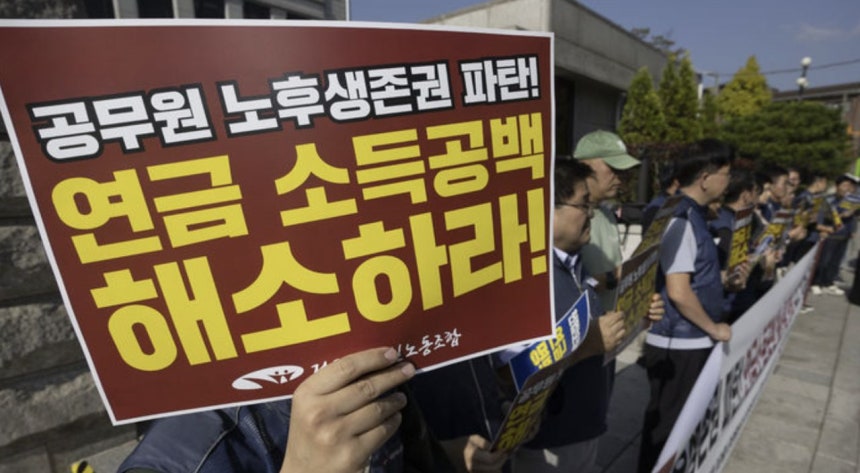
(The financial projection report of the Government Employees Pension,
which is run on the public’s taxes —
what is the reason for not disclosing it!
A report that was disclosed as a matter of course before 2010
is not being disclosed; the reason for this
we demand that the Ministry of Personnel Management
and the Government Employees Pension Service
set out, at the earliest possible date,
before the public.
As taxpayers,
this is what the public demands.)
With the Government Employees Pension’s deficit growing by the day, a projection has emerged that 629 trillion won of state funds must be injected over the next 40 years.
The Private School Teachers Pension (hereafter the Private School Pension), moreover, is projected to turn to deficit in 2028 and to have its fund depleted in 2042.
Ten years have passed since the two pensions were reformed in 2015, yet the financial crisis has hardly been resolved. Last December the Private School Pension’s Financial Re-Estimation Committee (the sixth) recommended that “a financial stabilization plan must be prepared without delay,” but there has been no movement since.
The Government Employees Pension began running deficits in 1993 and has been covering them from state funds for 25 years, since 2001. In 2015 a reform was carried out that raised contributions and lowered the pension accrual rate.
At the time it was projected that, thanks to the reform, state subsidies for 2016–2025 would be halved to 34 trillion won (39 trillion won allowing for inflation). The money actually spent, however, comes to 41 trillion won. In particular the subsidy, which had been in the 2–3 trillion won range, surged after 2022 to 8.3173 trillion won last year, a 2.6-fold jump in four years. Before the reform, 27% of Government Employees Pension expenditure depended on state subsidy; last year the figure rose to 36% (National Assembly Budget Office data).
629 Trillion Won of State Funds over 40 Years to Cover the Government Employees Pension Deficit
When Yoon Young-seok, Chairman of the National Assembly’s Special Committee on Pension Reform, estimated the state funds required to cover the Government Employees Pension deficit for 2026–2065 on the basis of materials submitted by the Ministry of Personnel Management, the figure came to 629 trillion won (at 2024 prices).
It rises into the 10 trillion won range in 2030 and into the 20 trillion won range in the late 2050s.
Choi Jae-sik, former Chairman of the Government Employees Pension Service, said, “The Government Employees Pension deficit grows every year, and 10 trillion won of the public’s taxes is spent to cover it. The Private School Pension faces depletion right before its eyes,” adding, “Even so, nobody steps forward.”
The number of Government Employees Pension members has grown by about 200,000 (an 18% increase) over the past decade, owing in part to the Moon Jae-in government’s increases in civil service and firefighting posts. More members helps the finances in the short run.
The reason the deficit grows nonetheless is that the number of beneficiaries is rising far faster. It grew by about 300,000 (a 70% increase) between 2016 and 2025.
The National Assembly Budget Office (the Budget Office) expects expenditure growth for 2026–2029 (5.5% a year on average) to outpace revenue growth (4.3%). According to the Ministry of Personnel Management, the shortfall against pensions to be paid (the provision liability) grew from 905 trillion won in 2021 to 1,076 trillion won last year.
A crisis is approaching for the Private School Pension as well.
In 2022 pension payments already exceeded contribution revenue for the first time (by 221.8 billion won), and last year the gap grew 5.7-fold, to 1.2619 trillion won.
Between 2021 and 2025, while contribution revenue
grew by an annual average of 1.9%, payments rose by 8.9%.
Thanks to investment returns it holds out for six years, turning to an annual deficit in 2028, and then eats through the fund, which is expected to be depleted in 2042, 14 years later (Budget Office estimate).
The number of Private School Pension members rose by about 40,000 in 2016 when national university hospital staff were newly brought in (Ministry of Education tally), but this cannot keep pace with the increase in beneficiaries.
The National, Government Employees and Private School pensions re-estimate their finances every five years.
The Government Employees Pension does not disclose the results.
The Private School Pension’s sixth financial re-estimation report, published last December, projected that members would peak in 2040 and begin to decline while beneficiaries continued to increase.
In particular, the number of beneficiaries drawing a linked pension in conjunction with the National Pension increases sharply. The report estimated the point of fund depletion at 2047.
That is two years earlier than at the fifth re-estimation five years ago. It is five years later than the National Assembly Budget Office’s estimate (2042). The Private School Pension explains that the variables used in the estimates differ.
The Financial Re-Estimation Committee estimated that, if matters are left as they are, the contribution rate (the PAYG cost rate) required to pay that year’s pensions would have to be 26.1% in 2050 and 34.3% in 2095.
A third of income would have to be paid in contributions. The current contribution rate is 18%. The Budget Office expressed concern that “as the school-age population falls, private school staff will decrease in future (fewer members and less revenue), so the scheme will be affected by demographic change.”
What is the reason the crisis of the Government Employees and Private School pensions continues?
Yun Suk-myung, Research Fellow Emeritus at the Korea Institute for Health and Social Affairs, said it is “because the 2015 reform was not done properly.” At the time, the weakest of several reform proposals was adopted.
There were proposals to cut the annual pension accrual rate from 1.9% to 1.3% or 1.6%, but 1.7% was decided in the end. Yun pointed out that “increasing the number of civil servants and bringing national university hospital staff into the Private School Pension helps the finances in the short run, but when these people come to draw their pensions it will act as a heavy burden.”
Kim Ki-tae, 36, an office worker, said, “I do not understand why, while we worry about the National Pension being depleted and are told to pay more and receive less, the Government Employees Pension deficit has been covered with taxes for 25 years,” and
“putting off reform and passing hundreds of trillions of won of debt on to our children’s generation is plainly unfair.” Kim added, “The government and politicians should stop worrying about whom they might offend and operate properly, right now, to the public’s standards.”
![(Report on the Pension Future Forum Statement, Nocut News) [Column] Holding the 'Pension Fund Casino' to Account?… It May Be the Result of Choosing the 'Easy Way' (October 20, 2026)](/_next/image?url=%2Fuploads%2Feditor%2F2026%2F10%2Fc6f13b0799b440d0874a9f72413c6f58-0004200449_003_20261020063615439-1.jpg&w=128&q=75)
![(Report on the Pension Future Forum Statement, JoongAng Ilbo) [Reporting Diary] The National Pension Protected the KOSPI Rather Than the Public's Retirement (October 19, 2026)](/_next/image?url=%2Fuploads%2Feditor%2F2026%2F10%2F7e92f70b0ec843bbb869a4cf46b01f72-0003558751_001_20261019052229249.jpg&w=128&q=75)