
Basic Pension Reform Announcement Imminent… the “Standard Median Income Linkage Ratio” Is the Issue (August 25, 2026)
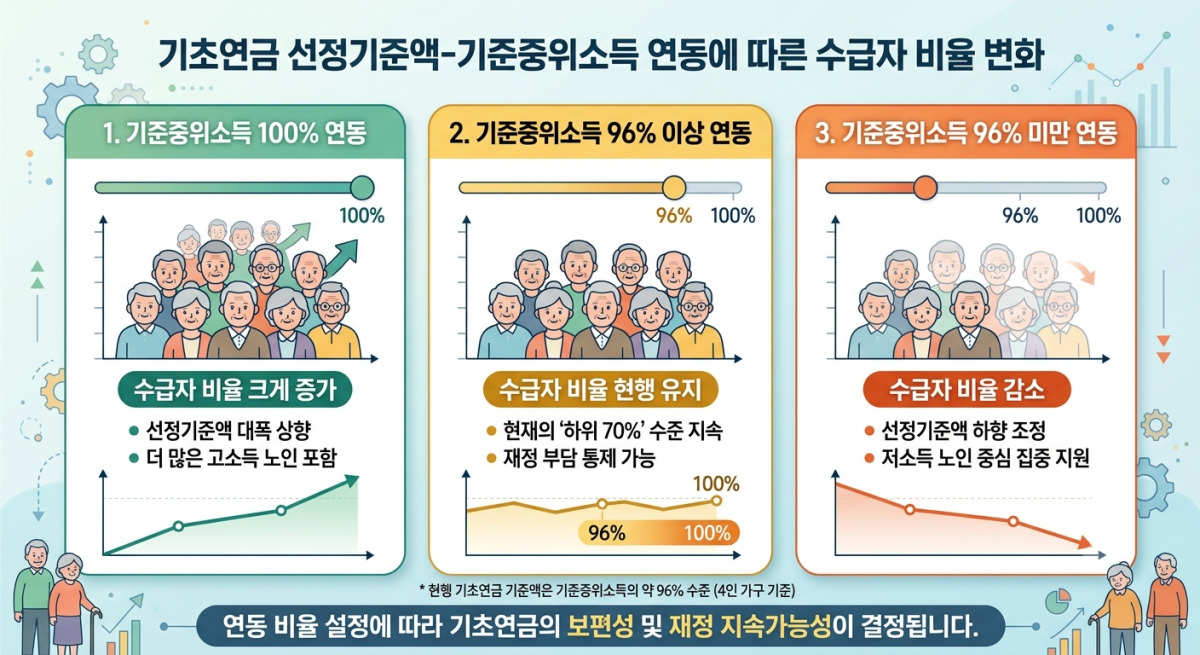
Linked at 100%, the beneficiary ratio ↑
At 96%, the beneficiary ratio unchanged
At 95% or below, the beneficiary ratio ↓
With approval ratings falling, 100% looks difficult
As the Ministry of Health and Welfare announces its Basic Pension reform proposal, the ratio at which it is linked to the standard median income is expected to be the point at issue.
According to the Ministry on the 25th, the government plans to announce the Basic Pension reform proposal as early as the 26th.
The Basic Pension is paid, for the stability of older people’s lives, to those aged 65 and over whose recognized income falls at or below the eligibility threshold announced by the Minister of Health and Welfare, taking income and assets into account.
Because the eligibility threshold is set at the bottom 70% of older people by recognized income, the threshold rises along with any improvement in older people’s economic circumstances, with the result that 70% of older people end up receiving the Basic Pension.
As the baby-boom generation enters and older people’s overall income and assets rise above past levels, the Ministry plans to reform the Basic Pension system so that it is linked to the standard median income, rather than fixing payment at the bottom 70% of older people.
The standard median income is the income of the household standing at the midpoint (50%) when all citizens of the Republic of Korea are lined up by income, and it serves as the criterion for various welfare benefits, including the livelihood benefit.
Oh Gun-ho, co-representative of Welfare State I Make, explained that “the issue is up to what percentage of the standard median income (the Basic Pension) will be paid.”
The reason the linkage ratio matters is that the ratio determines the proportion of beneficiaries.
According to “Directions for Reforming the Basic Pension Selection Method,” published by the Korea Development Institute (KDI) in February, fixing the eligibility threshold at 100% of the standard median income would gradually reduce the beneficiary population from about 70% of all older people to about 57% by 2070.
If, by contrast, the eligibility threshold were adjusted in stages from 100% to 50% of the standard median income, the beneficiary population would fall from 70% of all older people to about 37% — a far larger drop than under the 100% option.
Experts predicted that the Ministry would set the figure at 96% or less of the standard median income in order to reduce the eligible population over the medium and long term.
The current Basic Pension recognized income threshold is 2.47 million won a month for a single household, 96.3% of the one-person household standard median income of 2,564,238 won a month.
Oh explained, “The current Basic Pension recognized income threshold for single households is 2.47 million won a month, which, if linked to the standard median income, corresponds to about 96%,” adding, “If they say they will pay up to 96%, the beneficiary ratio will not change; but if it is set below 96%, the beneficiary ratio is expected to fall.”
Oh forecast, “The government will set a direction aimed at reducing the eligible population,” adding, “but with the government’s approval rating low, a method that reduces it immediately from next year will be difficult.”
Yun Suk-myung, Research Fellow Emeritus at the Korea Institute for Health and Social Affairs, likewise said, “Taking approval ratings and other factors into account, it will be hard to put forward 100%,” and “since the disposable income (real income) taken into account in setting the standard median income is assessed higher than it actually is, it should be set at the 50% level originally mentioned.”
![(연금연구회 성명서 보도. 노컷뉴스) [칼럼] 연기금 카지노 책임론?…'쉬운길' 선택의 결과일 수 있다 (2026.10.20.)](/_next/image?url=%2Fuploads%2Feditor%2F2026%2F10%2Fc6f13b0799b440d0874a9f72413c6f58-0004200449_003_20261020063615439-1.jpg&w=128&q=75)

![(연금연구회 성명서 보도. 중앙일보) [취재일기] 국민 노후보다 코스피를 지킨 국민연금 (2026.10.19. )](/_next/image?url=%2Fuploads%2Feditor%2F2026%2F10%2F7e92f70b0ec843bbb869a4cf46b01f72-0003558751_001_20261019052229249.jpg&w=128&q=75)