
The National Pension Without an Investment Command Tower… Will It Once Again Become a Political Springboard for Chairman Kim Sung-joo? (2026.07.13)
(The Pension Future Forum
wishes to express deep concern
over circumstances that suggest
political judgment is intervening deeply
in the management of the National Pension!)
Amid deepening uncertainty, the role of the National Pension—the stock market's 'biggest player'—is more important than ever. It is time to diversify risk concentrated in particular sectors and, through principled, fundamentals-based rebalancing (asset reallocation), secure the stability of retirement funds amounting to 1,670 trillion won.
Yet at present, the control tower of the National Pension's fund management is effectively failing to function.
Seo Won-joo, the Chief Investment Officer (CIO) who must respond nimbly to market shifts, is serving on a temporary extension through the end of this year owing to delays in selecting his successor.
With the leadership of the top operational officer who holds the rudder of this giant fund thus constrained, what has taken up position on the front line of investment is not the cold logic of capital but political judgment.
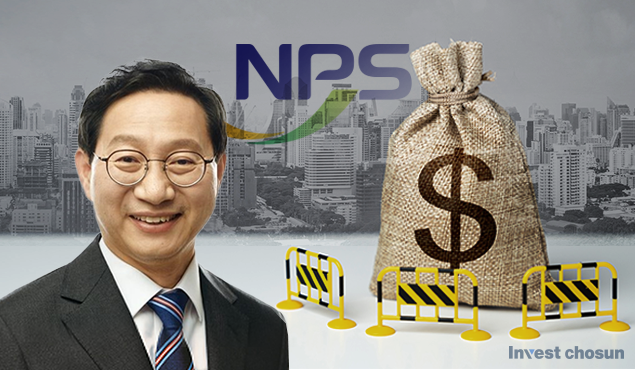
At the center stands Kim Sung-joo, Chairman of the National Pension Service (NPS). A former politician rather than a finance professional, he recently delivered an unusually harsh rebuke of a brokerage report warning of a '74 trillion won sell-off bomb,' asking, "Since when did analysts start playing fortune-teller?"
Critics point out that even before the Fund Management Committee's formal asset-allocation deliberations had taken shape, the organization's top leader stepped in to preemptively shut down the market's reasonable warning signals.
A review of Chairman Kim's record during his previous tenure (under the Moon Jae-in administration) suggests this move is hard to dismiss as a mere one-off outburst. When he spoke out in 2019, invoking the stewardship code, on the Korean Air management-control dispute involving the Hanjin Group's controlling family, there was considerable concern in the market that it amounted to targeted intervention aligned with the government's 'chaebol reform' agenda.
A similar pattern can be traced in the relocation of the fund management division to Jeonju. Even as the barren financial infrastructure triggered a large-scale exodus of key fund managers, the political rationale of balanced regional development took precedence over the potential risk to fund returns. His record of resigning mid-term to run in the 21st general election likewise supports the criticism that the post of pension chief sits on an extension of his political career.
Where he once intervened actively in corporate management under the banner of the stewardship code, he now appears to have chosen passive inaction—suppressing even principled asset allocation in step with the government's 'stock market boosting' agenda.
Ultimately, Chairman Kim's recent remarks leave ample room to be read as a political shield protecting the economic narrative of the '800 trillion won southwestern semiconductor mega-project' that the current administration touts as a signature achievement.
In effect, the aim is to keep an index decline driven by semiconductor selling from turning into a political burden on the government.
That this inconsistent standard—swinging between intervention and inaction—rests entirely on political advantage or disadvantage lays bare the structural vulnerability of pension governance.
https://www.investchosun.com/m/article.html?contid=2026071080059
![(연금연구회 성명서 보도. 노컷뉴스) [칼럼] 연기금 카지노 책임론?…'쉬운길' 선택의 결과일 수 있다 (2026.10.20.)](/_next/image?url=%2Fuploads%2Feditor%2F2026%2F10%2Fc6f13b0799b440d0874a9f72413c6f58-0004200449_003_20261020063615439-1.jpg&w=128&q=75)

![(연금연구회 성명서 보도. 중앙일보) [취재일기] 국민 노후보다 코스피를 지킨 국민연금 (2026.10.19. )](/_next/image?url=%2Fuploads%2Feditor%2F2026%2F10%2F7e92f70b0ec843bbb869a4cf46b01f72-0003558751_001_20261019052229249.jpg&w=128&q=75)