NPS Chairman States That Raising Contribution Rates and Investment Returns Would Prevent Fund Depletion Within the 21st Century (2026.02.16.)
- #연금특위
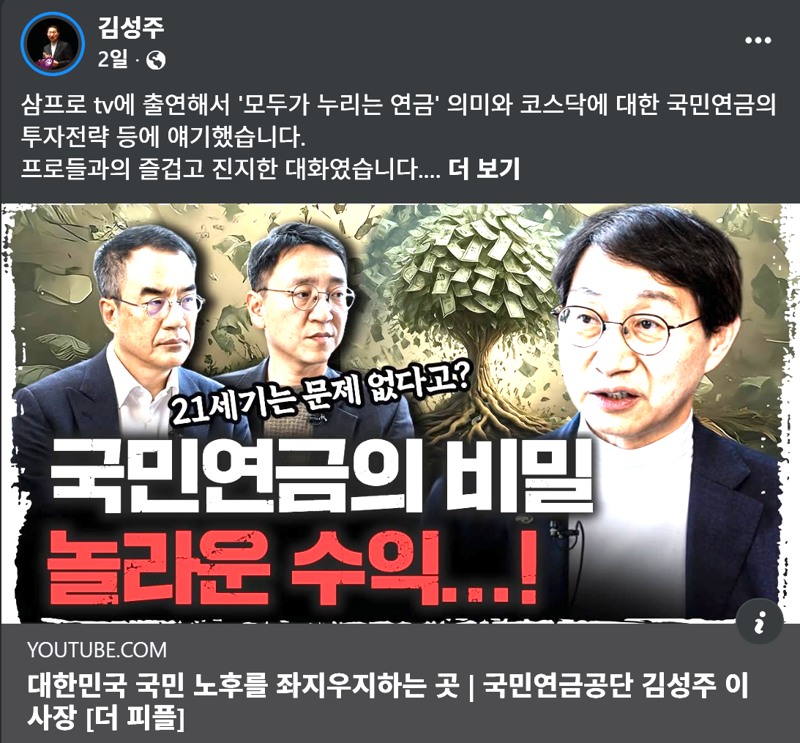
(Regarding the position expressed by the executive leadership of the National Pension Service (NPS) in the article below,
beginning with the 13th Pension Future Forum Seminar scheduled for February 25, 2026,
we intend to provide the younger generation—the stakeholders most directly affected—with the opportunity to voice their own perspectives directly.)
According to the financial industry on the 16th, Kim Sung-joo, Chairman of the National Pension Service (NPS), appeared on the YouTube channel Sampro TV and,
in response to the observation that "the generation in their twenties and thirties believes they will only pay into the National Pension without the fund surviving to pay them benefits,"
stated that "we will build a National Pension system free from concerns about fund depletion until the end of the 21st century—over the next 74 years."
Chairman Kim noted that "additional parametric reform" would be necessary to achieve this goal.
Chairman Kim acknowledged that "the timeline for fund depletion has been pushed back by the preceding parametric reform," and further stated that
"the current average fund investment return rate is 4.5%; raising it by 1 percentage point to 5.5% would delay fund depletion to 2071, and if it were raised just a little further,
a structure capable of sustaining the fund through the end of this century could be established."
Chairman Kim expressed confidence that, given three conditions—an increase in the contribution rate, an improvement in fund investment returns, and expanded government support—
the National Pension Fund could be maintained through the end of this century.
He noted that "the public has already consented to an increase in the contribution rate," and pointed out that "there are currently approximately 10 million people outside the coverage of the National Pension; for all citizens to enjoy its benefits, the government must provide more active support—specifically, it must subsidize pension contributions for low-income earners."
https://n.news.naver.com/article/014/0005479041?sid=101![(동아일보. 유럽 청년 시위) [횡설수설/우경임] (입력 2026.10.21.)](/_next/image?url=%2Fuploads%2Feditor%2F2026%2F10%2Fba49256960d346bfb3f36249f19c291f-1792541429278.png&w=128&q=75)
![(Report on the Pension Future Forum Statement, Nocut News) [Column] Holding the 'Pension Fund Casino' to Account?… It May Be the Result of Choosing the 'Easy Way' (October 20, 2026)](/_next/image?url=%2Fuploads%2Feditor%2F2026%2F10%2Fc6f13b0799b440d0874a9f72413c6f58-0004200449_003_20261020063615439-1.jpg&w=128&q=75)