Pension Future Forum Position Statement on Recent Trends in the Stock, Bond, and Foreign Exchange Markets
- #연금특위
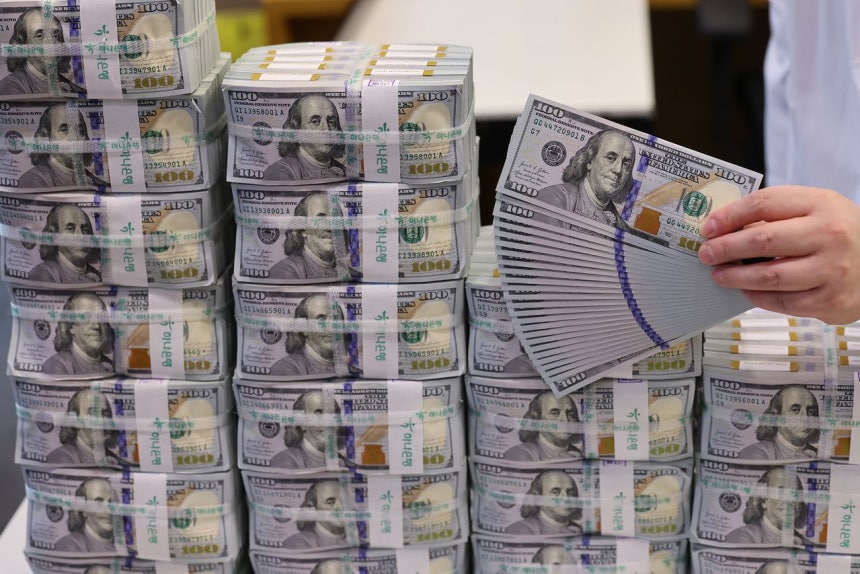
Foreign exchange reserves have fallen by approximately 40 billion dollars since 2021.
What has drawn particular attention in the market is the fact that, following a decrease of 2.5 billion dollars in December 2025, reserves declined a further 2.15 billion dollars in January 2026, marking two consecutive months of decline. This is all the more notable given that the decline is a consequence of the swap arrangement concluded between the Bank of Korea and the National Pension to defend against a fall in the won–dollar exchange rate—that is, to keep the won from appreciating.
Some media outlets have reported the situation as having improved, pointing to the fact that the magnitude of the decline in foreign exchange reserves in January was smaller than in December of the previous year.
This is assessed to be a textbook case of self-serving interpretation. The intense battles over dollar buying and selling observed on multiple occasions in the offshore market in January indicate the possibility that overseas dollar-denominated assets are being sold off to defend the exchange rate and to increase investment in the domestic market.
To elaborate further: if measures to defend the exchange rate through the sale of overseas assets—rather than drawing down domestic foreign exchange reserves—played a larger role,
interpreting a mere month-on-month reduction in the decline of foreign exchange reserves as evidence that conditions have improved is assessed to reflect a rather significant distortion of how events are actually unfolding.
Following two consecutive days of large-scale institutional buying after the KOSPI fell below 5,000 points, the index rose for two consecutive sessions.
In these circumstances, the Chairman of the National Pension Service stated that rebalancing—that is, the automatic sale of assets when the National Pension's target allocation is exceeded, in order to restore the original target weights—would be deferred until the first half of this year.
One cannot help but wonder why the National Pension intends to maintain its overweight position even as the KOSPI continues to rise and individuals in particular are taking on large amounts of debt to invest.
A normal institutional investor—and especially one that has long emphasized its public mission—should play a role in cooling the market during periods of overheating. The question arises precisely because the National Pension appears to be taking actions that are instead stoking an overheating equity market.
In contrast to the rosy picture in the equity market, conditions in the government bond market do not look favorable. With the base rate standing at 2.5%, the yield on the 10-year government bond reached a 52-week high of 3.71% yesterday (February 4) before closing at 3.7%.
The widening divergence from the base rate suggests that the demand base for government bonds in the market is limited. Should government bond yields rise further, the likelihood of foreign investors selling on concerns about investment losses would increase, making it that much harder to absorb bond issuances.
If a supplementary budget were to be compiled ahead of the local elections, conditions in the government bond market could deteriorate further.
In the early hours of this morning (February 5), the won–dollar exchange rate in the offshore market surpassed 1,460 won. While the won–dollar rate may decline sharply in the domestic market today, this is a sign that the trend of won weakness has persisted, making a mockery of two months of currency intervention efforts.
Why are these developments repeating themselves?
The Pension Future Forum judges this to be the result of the absence of any policy vision capable of raising the rapidly declining potential growth rate, and the absence of a blueprint for the structural reform of an unsustainable public pension system.
Far from decreasing, national debt is growing rapidly. The actuarial liability of the Government Employees Pension and the Military Pension—whose need for reform has not been mentioned by any policymaker—has surpassed 1,300 trillion won.
And yet, in the past year alone, approximately 10 trillion won of taxpayer money was expended to pay Government Employees Pension benefits.
Dr. Shin Seung-ryong of the Korea Development Institute (KDI), an advisor to the 22nd National Assembly Special Committee on Pension Reform, has estimated the open unfunded liability of the National Pension at approximately 3,000 trillion won. Even if the fund investment return of the National Pension were raised by 1 percentage point over the next 70 years, the unfunded liability would still exceed 1,200 trillion won. This suggests that the current National Pension remains unsustainable despite the amendment to the National Pension Act in March of last year.
The unfunded liability of the Private School Teachers' Pension, which still holds accumulated reserves, is also estimated to exceed 180 trillion won.
The IMF recently projected that, if Korea's public pensions are left unreformed, national debt would reach 200% of GDP, and called for structural reform.
To secure Korea's long-term sustainability, it is imperative not only to slow or reverse the growth of national debt through the introduction of a fiscal rule, but also to structurally reform the public pension system so that it can be sustained.
The problem is that, despite how desperate the situation has become, calls for structural reform are nowhere to be heard among policymakers.
It is deeply concerning that there appears to be almost no effort to confront the structural vulnerabilities we face, as attention remains intoxicated by the steep rise in the KOSPI index.
The Pension Future Forum judges that it is the won–dollar market that is reflecting this reality.
We urge the policy authorities to open their ears to these expressions of concern and to devote their full efforts to developing proper countermeasures!
https://n.news.naver.com/mnews/article/025/0003501041?sid=101