Pension Future Forum Statement on the Outcome of the National Pension Fund Management Committee Meeting (January 26, 2026)
- #국민연금법
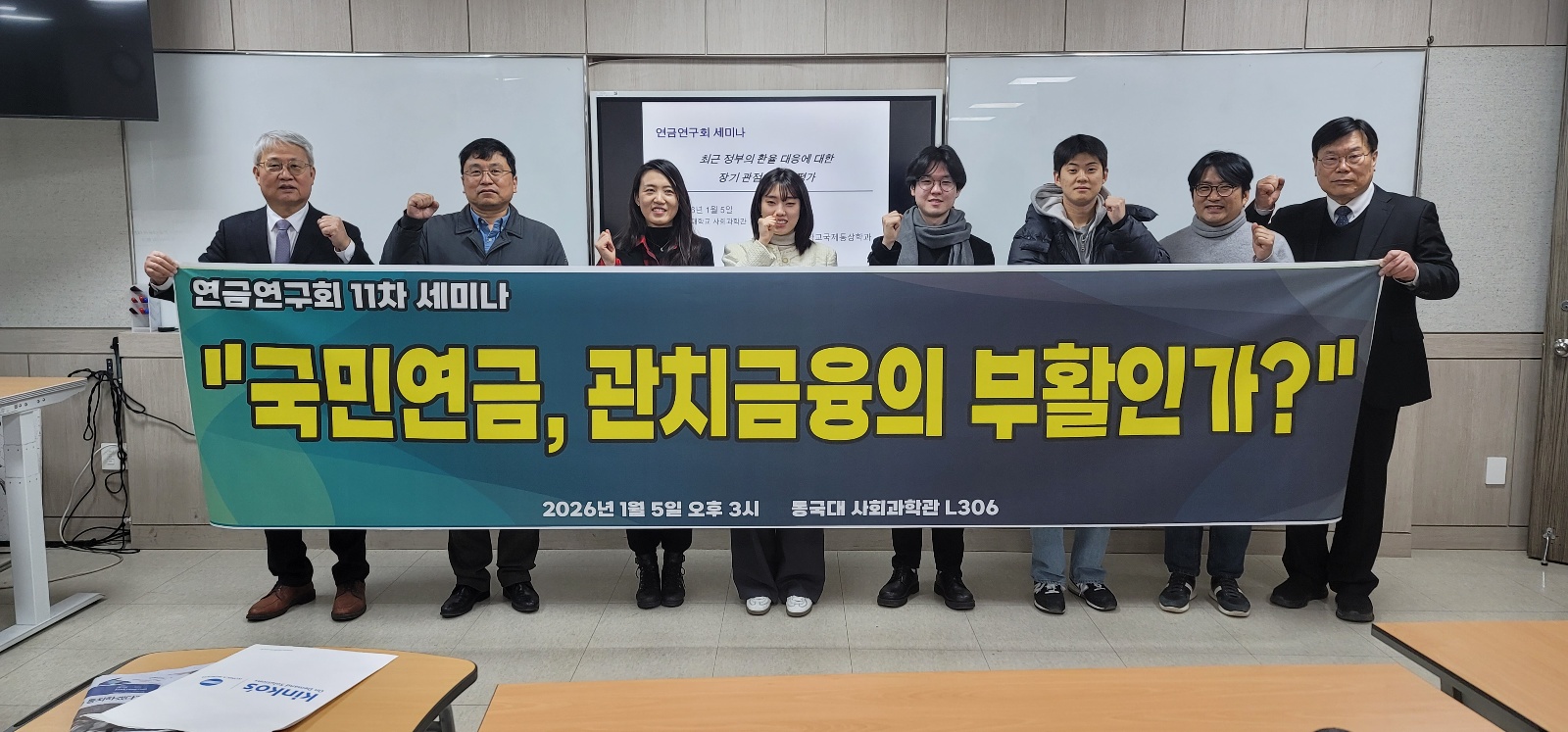
The National Pension Fund Must Not Be Sacrificed as Kindling for Currency Defense! — Pension Future Forum Position Statement on the "Outcome of the National Pension Fund Management Committee Meeting" —
On January 26, the National Pension Fund Management Committee (hereinafter "the Fund Committee") deliberated and resolved the "National Pension Fund portfolio," raising the domestic equity allocation by 0.5 percentage points to 14.9% while reducing the overseas equity allocation from 38.9% to 37.2%, a decrease of 1.7 percentage points. The Fund Committee explained that the change was made "in consideration of the burden of securing foreign exchange and the recent demand-dominant foreign exchange market environment."
As the Fund Committee itself has stated, this amounts to an admission that the National Pension — the last line of defense for citizens' retirement security — is being deployed as pocket money for currency defense. The Pension Future Forum presumes that the Fund Committee's modest expansion of the domestic equity allocation on this occasion was a response to the strong opposition expressed by younger cohorts and the general public. Nevertheless, the Pension Future Forum sets forth its concerns and demands as follows.
First, the present portfolio adjustment of the National Pension Fund cannot be regarded as anything other than a violation of the rule-based principles governing fund management. In the future, "if exceptions become routinely normalized in response to market conditions, the predictability of the asset allocation principles may be undermined." In particular, "if the conditions and end date of any deferral are not clearly specified, the very credibility of 'rule-based management' may be shaken."
Second, the Pension Future Forum publicly inquires whether one additional vice minister, as a government-appointed member, was added through the Fund Committee's normal decision-making process under the pretext of a government reorganization. If such an addition had been made through proper procedures, it would have been appropriate to replace one of the already existing four vice ministers from other government ministries — ministries that have no relevance whatsoever to National Pension fund management. In addition to the Fund Committee's chairperson, the Minister of Health and Welfare, the committee includes the President of the National Pension Service (NPS), as well as the heads of Korea Institute for Health and Social Affairs (KIHASA) and Korea Development Institute (KDI), both government-funded research institutes. There are now as many as eight members (nine including the chairperson) who are highly likely to follow the government's stated policy direction without reservation.
Third, the Pension Future Forum is compelled to express serious concern regarding the downside risk to the National Pension Fund's rate of return as a result of the Fund Committee treating the portfolio as if it were the government's pocket money. In particular, beginning with the publication of a statement on December 3 of last year expressing opposition to the use of the National Pension Fund as a tool for currency defense, the Pension Future Forum has consistently and forcefully criticized the government's policy direction. This is because a task force led by the First Vice Minister of Health and Welfare — claiming to have been delegated by the Fund Committee — has pursued currency defense using the National Pension Fund under the guise of strategic ambiguity.
The Pension Future Forum attributes the primary cause of the recent intensified depreciation of the won to a rapid surge in national debt resulting from the forcible implementation of an expansionary fiscal policy through deficit-based budgeting. In particular, the Forum interprets the large-scale sales of dollars that occurred in overnight offshore markets after December 23 as the result of the liquidation of dollar-denominated assets invested by the National Pension Fund, which had pressed ahead behind a facade of strategic ambiguity.
If one takes into account that the semiconductor super-cycle is unlikely to be sustained over an extended period, it is the position of the Pension Future Forum that it is inappropriate to manage the National Pension — an institution designed to operate over an ultra-long time horizon — according to a short-term perspective.
Since last year, the National Pension has already been maintaining a domestic investment share considerably higher than this year's target of 14.4%. It has typically been the practice of institutional investors to sell equities during periods of sharp price increases, out of concern for subsequent adverse effects.
This is precisely why the Pension Future Forum is compelled to raise serious concerns about the government's decision to convene an emergency meeting of the Fund Committee and increase the allocations to both domestic equities and bonds, even as equity prices had surged sharply in a short period and the National Pension's target portfolio allocations had been substantially exceeded.
Fourth, the Pension Future Forum also expresses strong concern about the possibility that the proceeds from large-scale sales of dollar-denominated assets were used to fund purchases of major KOSPI-listed stocks. Given the current situation in which the anticipated arrival of the semiconductor super-cycle has been a major factor in the recent sharp rise in the KOSPI, the Forum regards this as a matter of serious concern.
The Pension Future Forum further estimates that, in addition to overseas assets directly held by the National Pension, the liquidation of dollar-denominated assets under external discretionary management may also have been included in order to reduce the scale of direct sales. This is because it is surmised that externally managed assets — rather than directly managed assets — would have been sold in order to minimize the accountability exposure that would arise in any future dispute over responsibility. The competent government authorities are obligated to disclose the facts of this matter transparently.
Fifth, given the reality in which the government effectively controls the management of the National Pension Fund, the Pension Future Forum also harbors significant concern regarding the National Pension Fund's attempt to strengthen the stewardship code and issue foreign-currency bonds. The Forum strongly urges that the government and the ruling party immediately cease their efforts to destabilize the National Pension — rather than pursuing measures to strengthen it.
Finally, the Pension Future Forum — which places foremost emphasis on "intergenerational equity" and "the sustainability of the National Pension system" — issues a stern warning regarding the outcome of today's Fund Committee meeting, which determined the direction of National Pension fund management in a manner that undermines the already-existing "National Pension Fund Management Guidelines" through a Fund Committee that cannot but operate in accordance with the government's wishes. The National Pension Fund is not the government's pocket money.
Standing in solidarity with the younger generation, who will bear responsibility for the future of the National Pension, the Pension Future Forum hereby reaffirms its commitment to making every possible effort to ensure that the National Pension is managed properly!
January 26, 2026 Pension Future Forum