
(MBC TV, Newsdesk) Delaying Depletion Without the Burden? — What About the Contribution Burden on Future Generations? (December 14, 2018, 8:05 p.m.)
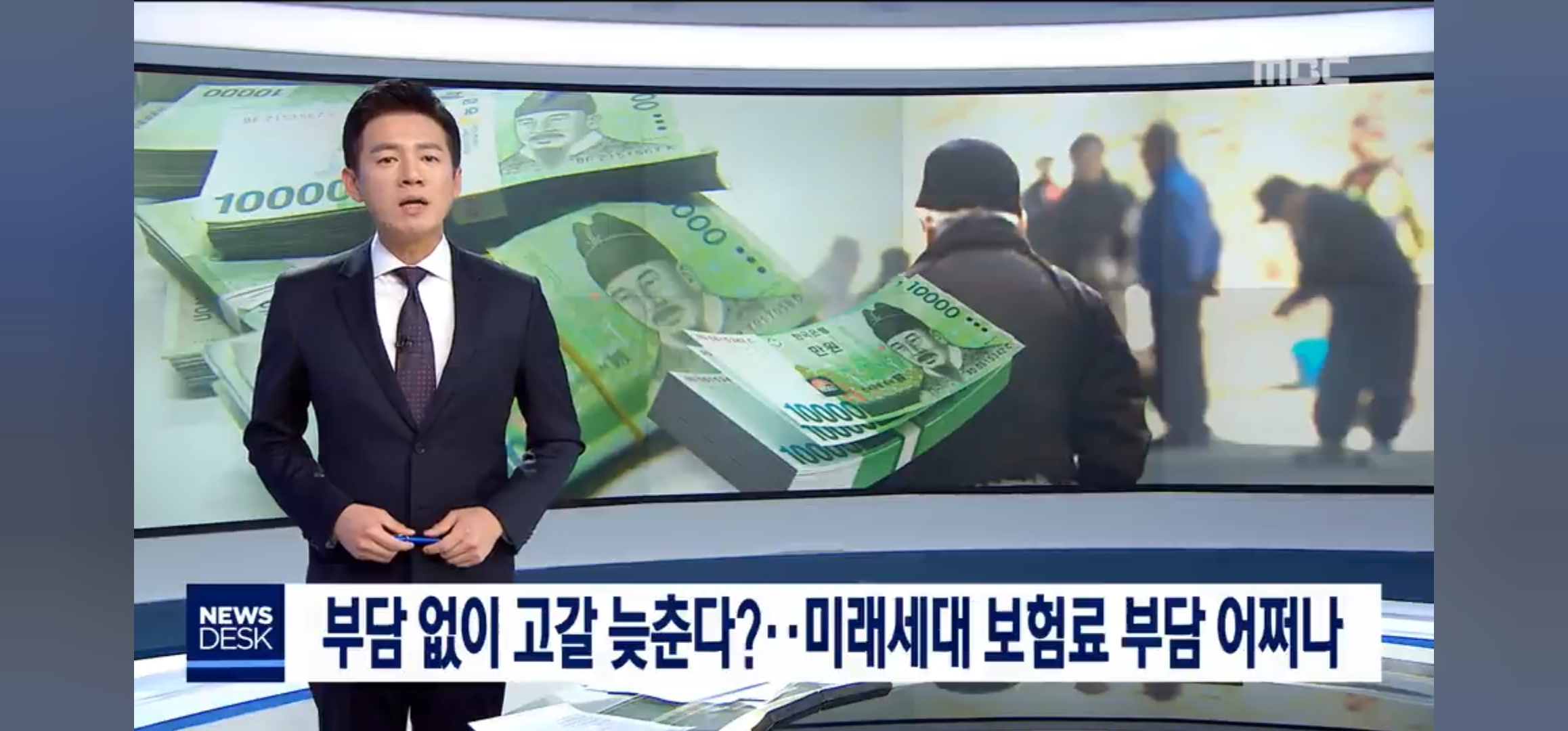
Anchor
According to the government, it has taken both sides into account: stabilizing the pension’s finances and securing old-age income for beneficiaries.
But for the sake of the distant future, the pain of a steep contribution increase will have to be borne someday, and critics point out that, to avoid the immediate burden, the plan put the emphasis on the “present” rather than the “future.”
Reporter Choi Yu-chan reports.
Report
This is the material from the public hearing on the National Pension overhaul held last August.
It states that around 2060, when the finances run dry, a contribution rate of 26.8% would have to be set for the National Pension to be sustained.
If the income replacement rate were raised to 50%, future generations would have to pay contributions of more than 30% of their income at the very least.
[Oh Gun-ho / Chair, Welfare State I Make]
“(In today’s overhaul plan) the year of fund depletion is pushed back. That has nothing at all to do with fiscal stabilization. The information the current generation needs in order to fulfill its responsibility in the National Pension is not being provided…”
Last month, the government was reported to have prepared a plan to strengthen benefit adequacy by raising the Basic Pension and to raise the National Pension contribution rate to as much as 15%.
Criticism arose even then that it was far from fiscal stabilization, but it went back for reconsideration after the President remarked that it did not meet the public’s expectations.
In the end, the overhaul plan put its emphasis on reducing public backlash by lowering the contribution rate further and even putting in tax money.
[Yun Suk-myung / Research Fellow, Korea Institute for Health and Social Affairs]
“The political sphere and the public may like it, but ten years from now the annual funding required (for the Basic Pension) will be 40 trillion won (it is expected to reach…)”
Writing state payment into law, too, was merely declared; the method and the responsibility were tossed to the National Assembly.
The National Assembly, facing the 2020 general election, is hardly likely to welcome a contribution rate increase either.
In the end, the ideal way, paying less and receiving more while securing old-age income and stabilizing the finances, was not found this time either.
This pension reform, too, cannot escape the criticism that it ended as a stopgap measure, leaving behind only conflict between the older generation and future generations.
This has been Choi Yu-chan, MBC News.
ⓒ MBC & iMBC. Unauthorized reproduction, redistribution, and use (including AI training) are prohibited.
https://imnews.imbc.com/replay/2018/nwdesk/article/5067533_30181.html
Attachments
- Screenshot_20261122_184838_Samsung Browser.jpg(318.2 KB)ViewDownload
- Screenshot_20261122_184843_Samsung Browser.jpg(570.2 KB)ViewDownload
- Screenshot_20261122_184857_Samsung Browser.jpg(537.5 KB)ViewDownload
- Screenshot_20261122_184901_Samsung Browser.jpg(828.5 KB)ViewDownload
- Screenshot_20261122_184906_Samsung Browser.jpg(790.7 KB)ViewDownload
- Screenshot_20261122_184925_Samsung Browser.jpg(435.9 KB)ViewDownload
- Screenshot_20261122_184932_Samsung Browser.jpg(818.3 KB)ViewDownload
- Screenshot_20261122_184938_Samsung Browser.jpg(651.8 KB)ViewDownload
- Screenshot_20261122_184942_Samsung Browser.jpg(604.8 KB)ViewDownload
- Screenshot_20261122_184953_Samsung Browser.jpg(543.8 KB)ViewDownload
- Screenshot_20261122_184958_Samsung Browser.jpg(580.0 KB)ViewDownload
- Screenshot_20261122_185002_Samsung Browser.jpg(850.4 KB)ViewDownload
- Screenshot_20261122_185009_Samsung Browser.jpg(608.4 KB)ViewDownload
