
(KBS 1TV) “Pension Reform Young People Can Accept” — Writing “State Payment” into Law (August 29, 2024)
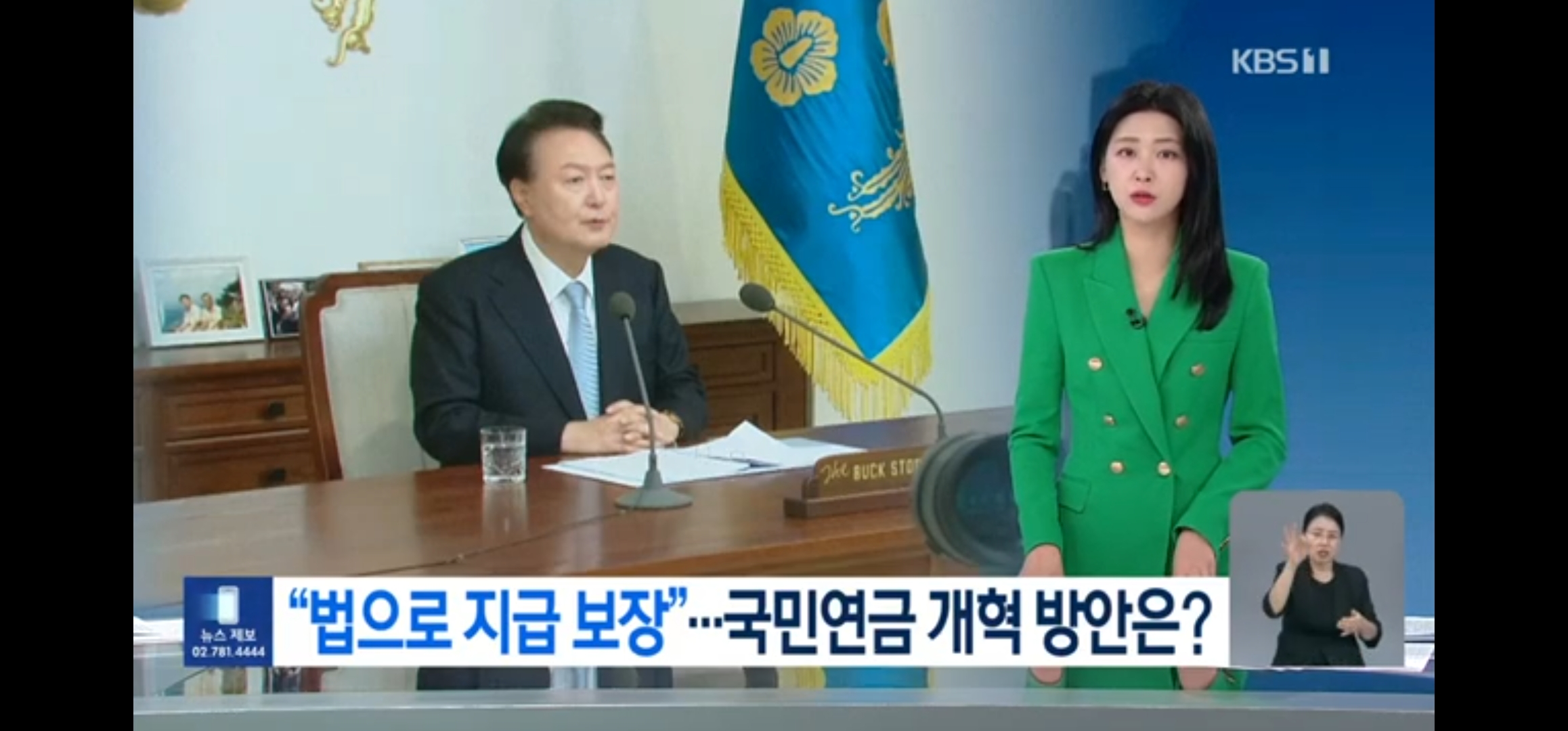
President Yoon Suk-yeol personally unveiled the outline of the National Pension reform plan that will soon be announced. Saying he would pursue reform that the younger generation can accept, he stressed that the National Pension payment guarantee must be written into law. The specific reform plan mainly contains measures aimed at young people, such as contribution increases differentiated by generation.
Reporter Hong Jin-a looked into how experts assess it.
[Report]
The National Pension, facing the risk of fund depletion in 30 years.
Fewer than three in ten people in their 20s and 30s believe they will be able to receive a pension in the future.
[Lee Jin-wook / Busan citizen representative / April this year / 500-member public deliberation meeting on pension reform: “I wonder whether there is a plan under which I can be sure to get back at least what I paid in.”]
President Yoon cited sustainability, intergenerational fairness, and old-age income security as the three principles of pension reform, stressing in particular that the reform must be acceptable to the younger generation.
To that end, he said, the National Pension payment guarantee must be written into law.
However, some expect that, as with the Government Employees Pension, whose payments are guaranteed by law, taxes may have to fill the gap once the fund is depleted, and that reform may be neglected.
[Yun Suk-myung / Research Fellow Emeritus, Korea Institute for Health and Social Affairs:
“In the sense that it could become a factor that leads to neglect of efforts to reform the (National Pension) system, this part seems to call for a very cautious approach.”]
Another reform option is differentiating contribution increases by generation.
A method of raising the contribution rate faster for the middle-aged and older, and more slowly for young people.
It could improve intergenerational equity, but some point out that it would increase the burden on low-income middle-aged and older people.
[Oh Gun-ho / Chair of the Policy Committee, Welfare State I Make:
“Because the people who would bear the heaviest burden from differentiated contribution increases are precisely the individually insured in urban areas and the self-employed….”]
Over the “automatic adjustment mechanism,” which would adjust the contribution rate and benefit amounts in line with the birth rate, average life expectancy, the growth rate, and the like, assessments were divided between those calling it a fiscal stabilization measure and those worried it is premature.
This is Hong Jin-a, KBS News.
Attachments
- Screenshot_20261122_113329_Samsung Browser.jpg(647.0 KB)ViewDownload
- Screenshot_20261122_113336_Samsung Browser.jpg(626.6 KB)ViewDownload
- Screenshot_20261122_113353_Samsung Browser.jpg(718.5 KB)ViewDownload
- Screenshot_20261122_113412_Samsung Browser.jpg(593.3 KB)ViewDownload
- Screenshot_20261122_113428_Samsung Browser.jpg(637.1 KB)ViewDownload
- Screenshot_20261122_113441_Samsung Browser.jpg(768.1 KB)ViewDownload
- Screenshot_20261122_113453_Samsung Browser.jpg(713.6 KB)ViewDownload
- Screenshot_20261122_113500_Samsung Browser.jpg(632.6 KB)ViewDownload
- Screenshot_20261122_113609_Samsung Browser.jpg(510.8 KB)ViewDownload


