
(SBS TV) The Depletion Date Has Been Pushed Back — But How Will the “Automatic Adjustment” Work? (March 21, 2025)
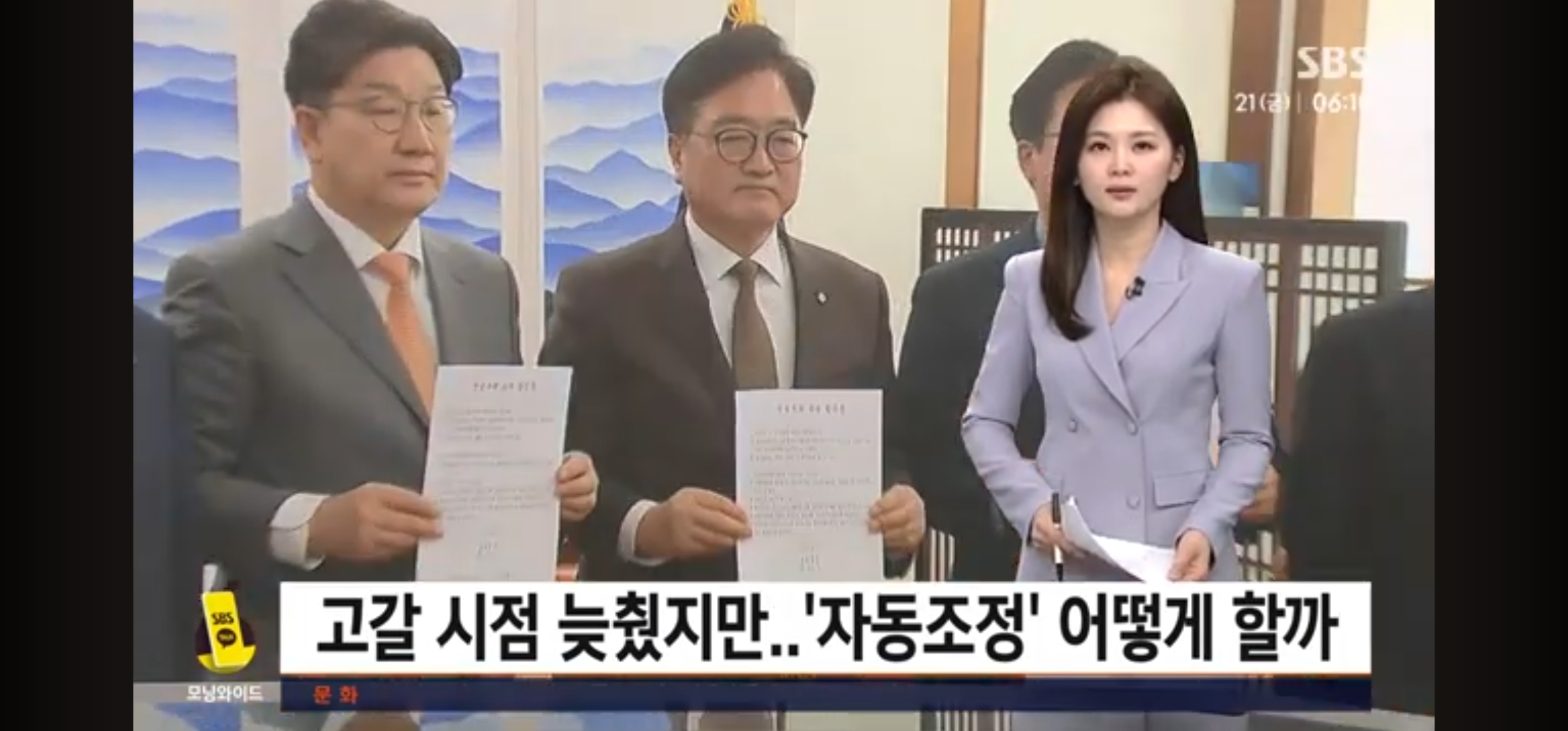
〈Anchor〉
Although it has been decided how much more people will pay and receive, the depletion date has merely been pushed back somewhat, and the fund will still run dry someday. In the end, structural reform is needed to sustain the pension, and introducing a system that automatically adjusts pensions according to economic and demographic conditions is seen as the key.
Reporter Kwon Ji-yoon reports.
〈Reporter〉
Under this parametric reform, which raises the contribution rate from 9% to 13% and the income replacement rate from 40% to 43%, raising the fund’s rate of return by 1 percentage point to 5.5% is expected to push back the depletion date by about 15 years, from 2056 to 2071.
That is because, although the contribution rate rises 1 percentage point more than the income replacement rate and the rate of return has also been raised, the benefits received still far exceed the contributions paid.
[Yun Suk-myung / Research Fellow Emeritus, Korea Institute for Health and Social Affairs:
They have taken fiscal stabilization measures covering only the period until people now in their 50s or so die, and then they call this fiscal stabilization, so it cannot give young people confidence.]
For the pension to be maintained stably, structural reform is needed, and the government and the ruling party point to the “automatic adjustment mechanism” as a main option.
The idea is to adjust benefits automatically by additionally reflecting factors such as demographic conditions and the fiscal situation, beyond the inflation rate currently reflected in pension amounts.
For example, if the population shrinks because of low fertility and life expectancy rises, pensions are reduced as well.
The government projects, on the basis of last year’s figures, that if this mechanism is triggered in 2036, when pension expenditures will exceed contribution revenue, the depletion date could be pushed back by up to 32 years, to 2088.
But there is also strong pushback that it is no different from a pension-cut system.
[Joo Eun-sun / Professor, Department of Social Welfare, Kyonggi University:
With the elderly poverty rate this high, it is neither possible nor appropriate to say that we should introduce, right now, a mechanism that automatically cuts benefits like this.]
The structural reform discussion has been handed over to the National Assembly’s Special Committee on Pension Reform, and since the interests involved are even more complicated than in the parametric reform, it is expected to be even more arduous.
(Video: Gong Jin-gu; Editing: Jung Yong-hwa; Design: Jo Su-in)
Attachments
- Screenshot_20261122_120050_Samsung Browser.jpg(683.0 KB)ViewDownload
- Screenshot_20261122_120058_Samsung Browser.jpg(656.2 KB)ViewDownload
- Screenshot_20261122_120116_Samsung Browser.jpg(700.9 KB)ViewDownload
- Screenshot_20261122_120127_Samsung Browser.jpg(590.1 KB)ViewDownload
- Screenshot_20261122_120132_Samsung Browser.jpg(476.3 KB)ViewDownload
- Screenshot_20261122_120139_Samsung Browser.jpg(874.3 KB)ViewDownload
- Screenshot_20261122_120142_Samsung Browser.jpg(662.9 KB)ViewDownload
- Screenshot_20261122_120146_Samsung Browser.jpg(406.5 KB)ViewDownload
- Screenshot_20261122_120155_Samsung Browser.jpg(319.7 KB)ViewDownload
- Screenshot_20261122_120204_Samsung Browser.jpg(334.5 KB)ViewDownload
- Screenshot_20261122_120210_Samsung Browser.jpg(836.2 KB)ViewDownload
- Screenshot_20261122_120220_Samsung Browser.jpg(696.4 KB)ViewDownload
- Screenshot_20261122_120225_Samsung Browser.jpg(646.9 KB)ViewDownload
- Screenshot_20261122_120231_Samsung Browser.jpg(527.3 KB)ViewDownload
- Screenshot_20261122_120235_Samsung Browser.jpg(870.4 KB)ViewDownload


