
(KBS TV, Economic Inside) A Complete Reconsideration of the National Pension — How Will It Be Revised? November 12, 2018 (6:09 p.m.)
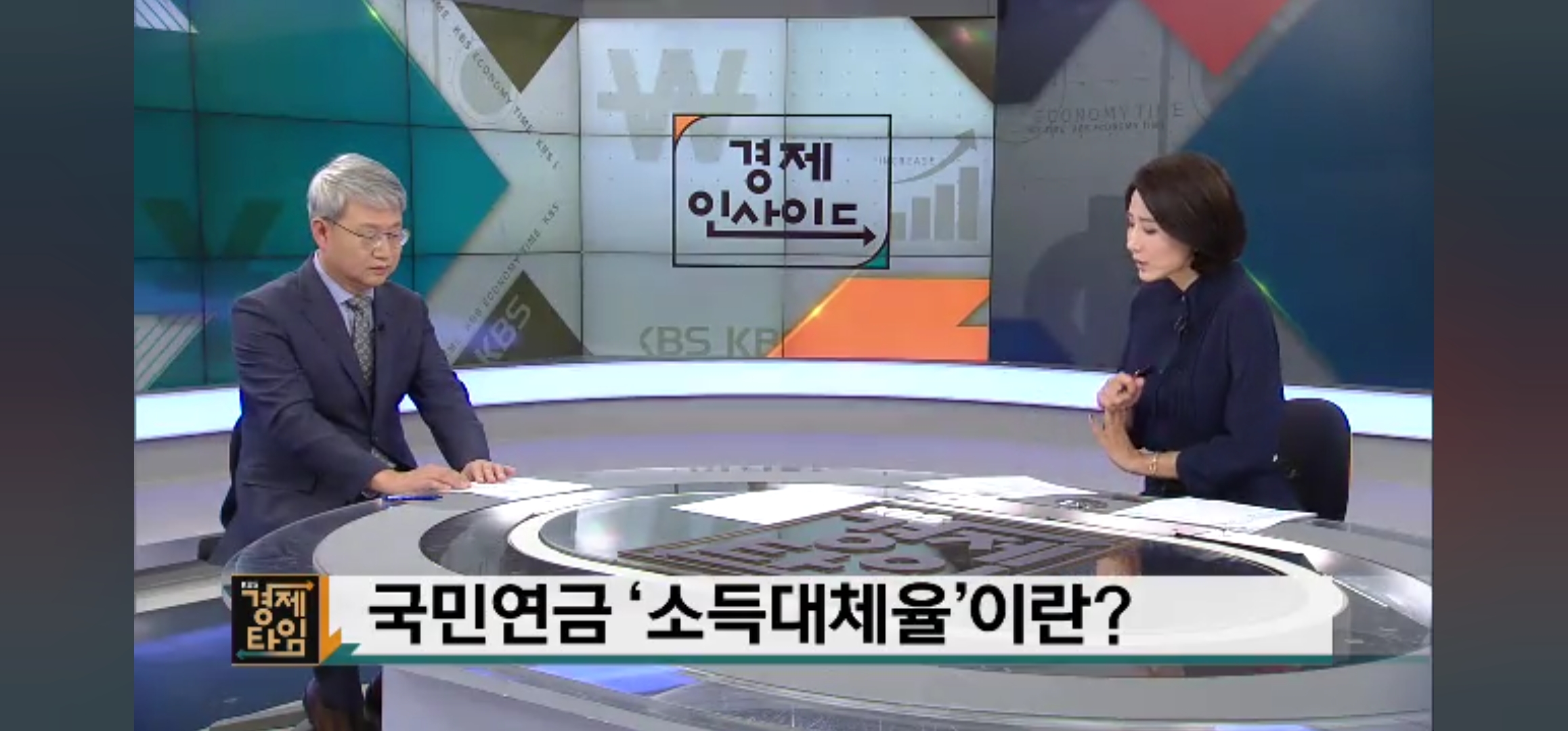
President Moon Jae-in received an interim report on the National Pension reform plan and ordered a complete reconsideration.
The point is that he wants it revised and supplemented from the public’s standpoint.
This appears to be a call to come back with a reform plan that does not raise contributions.
Attention is focused on how the National Pension overhaul plan will be revised.
We take a closer look with Yun Suk-myung, Research Fellow at the Korea Institute for Health and Social Affairs.
The known content of the National Pension overhaul plan comes down to two broad options.
One raises the income replacement rate to 50% and raises the contribution rate; the other lowers the income replacement rate to 40% and raises the contribution rate.
Please explain in detail the “income replacement rate,” which keeps coming up.
Answer
The income replacement rate may sound like a somewhat difficult term to viewers.
You can understand it as the ratio of the amount received as a pension after retirement to the monthly salary earned while working.
When the income replacement rate rises, the pension amount increases.
Anchor
If people can receive a larger pension, raising it would naturally be good from the public’s standpoint, but the burden would rise accordingly, would it not?
Answer
The higher the income replacement rate, the larger the pension received, so it is good news for the people who receive pensions.
But as with most things, where there is a good side, there is also a burdensome side.
If the income replacement rate is raised so that people receive more, someone must bear more of the burden—so when, and who, will bear it?
In particular, the generation that benefits and the generation that bears the burden may differ, and it is questionable whether this can be discussed sufficiently; in that respect, it is an issue on which consensus is not easy to reach, so it must be approached carefully.
Because Korea’s population structure is rapidly worsening in the direction of a weaker capacity to bear the burden, I believe the question of raising the income replacement rate, which could place a heavy burden on later generations in particular, needs to be decided after sufficient social discussion.
Anchor
President Moon Jae-in ordered a reconsideration, saying the overhaul plan did not meet the public’s expectations.
Was he not, perhaps, pointing out that every option in the overhaul plan includes raising the contribution rate?
Answer
I think it can be inferred from two angles.
One is that he seems to have felt that no measure had been devised that would surely fulfill the last presidential election pledge to raise the income replacement rate to 50%.
Even if several alternatives were presented, he seems to have judged that it had not been properly worked out which alternative was a sure way of fulfilling the pledge.
The other, as you said, is that it can be seen as criticism of the failure to find fiscal stabilization measures other than raising contributions, given the public’s negative sentiment toward contribution increases.
Anchor
It is the public who pay for the National Pension, after all.
Whether the contribution rate increase is at a level the public can accept seems very important.
Is the content of the overhaul plan as reported not excessive?
Answer
I, too, was a member of the National Pension System Development Committee, which handled this round of discussions on the pension overhaul.
I remember that during the committee’s discussions, the ministry in charge, the Ministry of Health and Welfare, was very uneasy about raising contributions.
That is because it knew well that the public strongly dislikes contribution increases.
Even so, the fact that it included a plan to raise contributions—and by no small amount—seems to show how deep its concern was as the ministry responsible for running the system.
The reason the Ministry of Health and Welfare had no choice but to put forward a sizable contribution increase, even though the great majority of the public opposes contribution increases in various opinion polls, seems to be that it took into account that Korea’s National Pension contribution level is too low compared with other countries.
Since the average contribution among the OECD member countries to which Korea belongs is around 18% (while providing a similar income replacement rate), it appears to have been an unavoidable choice from the standpoint of the ministry in charge.
Because the process of raising contributions is so far removed from what the public has in mind, the policy authorities seem to be that much more concerned.
Anchor
Anchor
Are there measures being discussed that would let people receive as much as now, or even more than now, without raising the contribution rate?
Answer
Answer
There are ways to pay less and receive more for a time, but there seems to be no way to pay less and receive more forever.
So, depending on how the system is overhauled, the gaps between generations could widen.
Since the National Pension reserves are not projected to be depleted until 2057, raising the income replacement rate now without raising contributions may pose no major problem for paying pensions.
However, after the pension reserves are used up, contributions of 27% or more would have to be collected, so intergenerational conflict is highly likely.
Another alternative is for the government to cover the shortfall in funding for pension payments from the national treasury, without raising National Pension contributions much.
But this alternative, too, could breed discontent in that someone must pay more in taxes, and the discontent of later generations in particular could grow.
Anchor
Anchor
One of the things that makes the public anxious about the National Pension is that payment is not guaranteed. Is this being discussed?
Answer
Answer
There has been much discussion of the payment guarantee.
In particular, the political sphere, including the National Assembly, is very keen on writing the payment guarantee into law.
Expert groups, on the other hand, appear to take a very cautious position.
That is because they believe that, while it could help dispel distrust of the National Pension, in a situation where future reform is unavoidable, the introduction of a payment guarantee provision could be used as grounds for demanding that, instead of painful reform, the state solve every difficult problem related to pensions (by introducing taxes, for instance, rather than pursuing fiscal stabilization through higher contributions).


