(Yonhap News) [Pension Reform] Presidential Candidates Agree Only in Principle — Fund Depletion Keeps Coming Sooner (February 8, 2022)
Agreement on reform only in broad terms, but a wide “temperature gap” over how to carry it out
Enlarge image

Presidential candidates posing for a commemorative photo at the televised debate
(Seoul = Yonhap News) Presidential candidates Sim Sang-jung of the Justice Party, Lee Jae-myung of the Democratic Party of Korea, Yoon Suk-yeol of the People Power Party, and Ahn Cheol-soo of the People’s Party (from left) pose for a commemorative photo before the debate at the KBS studio in Seoul on the 3rd, where a presidential candidates’ debate jointly hosted by the three terrestrial broadcasters was held. February 3, 2022 [National Assembly Press Photographers’ Pool] [email protected]
(Seoul = Yonhap News) Reporter Seo Han-gi = With the four presidential candidates of the ruling and opposition parties agreeing in broad terms on the need for pension reform at the first TV debate on the 3rd, attention is on whether the reform discussion, which had all but vanished amid calculations of political gain and loss, will gain momentum.
At the TV debate, when Ahn Cheol-soo of the People’s Party proposed, “How about a joint declaration that whoever becomes president will reform the National Pension?”, Lee Jae-myung of the Democratic Party responded, “That is a good idea,” Yoon Suk-yeol of the People Power Party also agreed, saying, “Let us promise it right here. It cannot be avoided. It is not optional,” and Sim Sang-jung of the Justice Party agreed with a laugh.
Pension reform is a grave matter on which the nation’s future hangs, but the leading presidential contenders had not put forward specific pension reform pledges, judging that it would not win them votes.
Ahn Cheol-soo, however, released a National Pension pledge under the name “Unified Pension” as his fourth youth policy. It calls for unifying the differing contribution rates, benefit levels, and state and employer cost-sharing ratios of the National Pension and the three special occupational pensions (the Government Employees, Military, and Private School Teachers Pensions) on the National Pension’s standard, to remedy the gaps and inequality among the pensions.
After the TV debate, however, the mood around the pension reform discussion has been changing.
On the 7th, Sim Sang-jung of the Justice Party announced a pension reform plan titled “Those Born in the 1990s Ask: Will We Be Able to Receive Our Pensions?”, stating, “I will raise the National Pension contribution rate to reduce the burden on future generations.”
The argument is that, because under the current National Pension scheme the benefits people receive exceed the contributions they pay, leaving a severe imbalance between contributions and benefits, raising the contribution rate is uncomfortable and burdensome but can no longer be put off if the burden on future generations is to be reduced. Sim is the first of the ruling and opposition candidates to play the card of raising the contribution rate, arguably the key word of National Pension reform.
Like Ahn, Sim also proposed unifying the special occupational pensions, such as the Government Employees Pension, along National Pension lines, applying the National Pension standard starting with newly hired civil servants.
Enlarge image

[Graphic] Presidential candidates’ main pension reform pledges and positions
(Seoul = Yonhap News) Reporter Kim To-il [email protected] Facebook tuney.kr/LeYN1 Twitter @yonhap_graphics
◇ Under the current pension structure, the fund depletion clock keeps running faster
The National Pension now faces a situation in which its finances can only deteriorate further.
Above all, the demographic variables, which have the greatest effect on National Pension finances, are unfavorable.
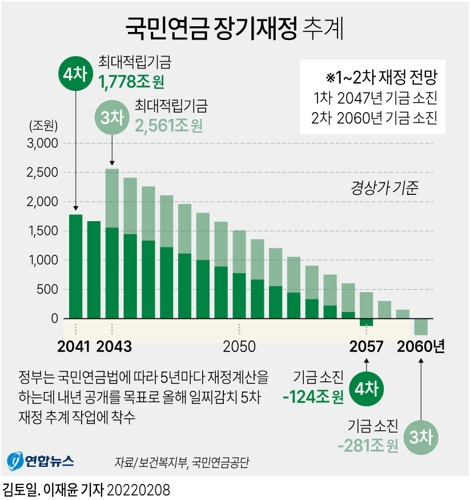
The government carries out a financial projection every five years to promote the National Pension’s fiscal soundness, and the latest, the Fourth Financial Projection of 2018, projected that the National Pension would begin running deficits in 2042 and that the fund would be depleted in 2057.
Yet even this financial projection is regarded as an optimistic estimate.
The Fourth Financial Projection originally assumed a total fertility rate (the average number of children a woman aged 15–49 is expected to bear in her lifetime) of 1.2 as of 2017, 1.32 in 2030, and 1.38 in 2060, but within five years the fertility rate fell from 1.05 (2017) to 0.84 (2020).
Statistics Korea has projected that, with marriages and births declining because of COVID-19, the fertility rate could fall as low as 0.52 in 2025.
On top of that, aging is accelerating, so the fifth financial projection due next year is likely to bring the fund depletion date forward even further.
Given the 2020 fertility rate (0.84) and the expected 2021 rate (in the 0.7 range), it is certain that if the National Pension is left unreformed, its finances will deteriorate even faster.
Some estimate that the cumulative deficit will reach 17,000 trillion won by 2088 (the final year of evaluation), 70 years out, which is the National Pension’s financial evaluation period.
In other words, left as it is, the scheme is fiscally unsustainable.
Once the reserve fund runs dry, there will be no choice but to cover the pensions paid to the older generation with taxes collected from the young generation (the economically active generation) of the day, and there are even estimates that, if the current scheme is maintained without pension reform such as raising contributions, future generations may have to pay 30% of their income in National Pension contributions, given the world’s most severe low fertility and aging.
That is, they would have to shoulder an enormous contribution burden at a level that is realistically hard to bear, with the contribution rate rising to more than three times the current 9%.
Enlarge image
[Graphic] When the National Pension Fund will be depleted
(Seoul = Yonhap News) Reporter Kim To-il [email protected] Facebook tuney.kr/LeYN1 Twitter @yonhap_graphics
◇ Agreement in principle, but a “question mark” over concrete implementation
The presidential candidates have formed a consensus that pension reform is needed, but the concrete question of “how” remains a question mark.
At the TV debate on the 3rd, too, differences emerged among the main candidates.
Lee Jae-myung said, “Reform to resolve the problems of inequality and disparity, including pension fund depletion, is needed, and I agree 100%, but because the interests involved are extremely complex and sharply opposed, it is not easy to present a single unified plan.”
Yoon Suk-yeol said, “Pension reform is an extremely complex problem that takes a great deal of time, so it is very dangerous to hastily set some direction during the campaign and announce it as a pledge; it requires national consensus and must be done on a bipartisan basis.”
Experts stress that the candidates’ agreement on pension reform must not end as empty words and that they should agree on at least a few principles.
Because leaving the National Pension as it is would swell the burden on today’s young people, who will be the children and grandchildren of the current generation, and on future generations beyond what they can bear, they argue, the candidates must agree on the principle that the current generation will bear more.
Yun Suk-myung, President of the Korean Pension Association (Research Fellow, Korea Institute for Health and Social Affairs),
said, “To solve the problems the National Pension faces, the principles and direction must be set so as to guarantee sustainability that young people will also enjoy, intergenerational equity and fairness, and benefit adequacy, and the reform discussion must proceed on that basis.”
Meanwhile, the government conducts a financial projection every five years under the National Pension Act, and it has effectively begun work on the fifth financial projection early this year, with publication targeted for next year.
Because it plans to put forward improvements to the pension scheme, such as the contribution rate and the benefit accrual rate, based on the results of this fifth long-term financial projection, the National Pension reform discussion is expected to get under way in earnest next year. Before this, the government carried out the first financial projection in 2003, the second in 2008, the third in 2013, and the fourth in 2018.
Enlarge image

Yonhap News photo