
(SBS TV, Subtitled News) “Seriously, Why Are You Doing This to Us?” Those Born in 1975, 1985, and 1995 Are Up in Arms — What Is Going On? (September 24, 2024)
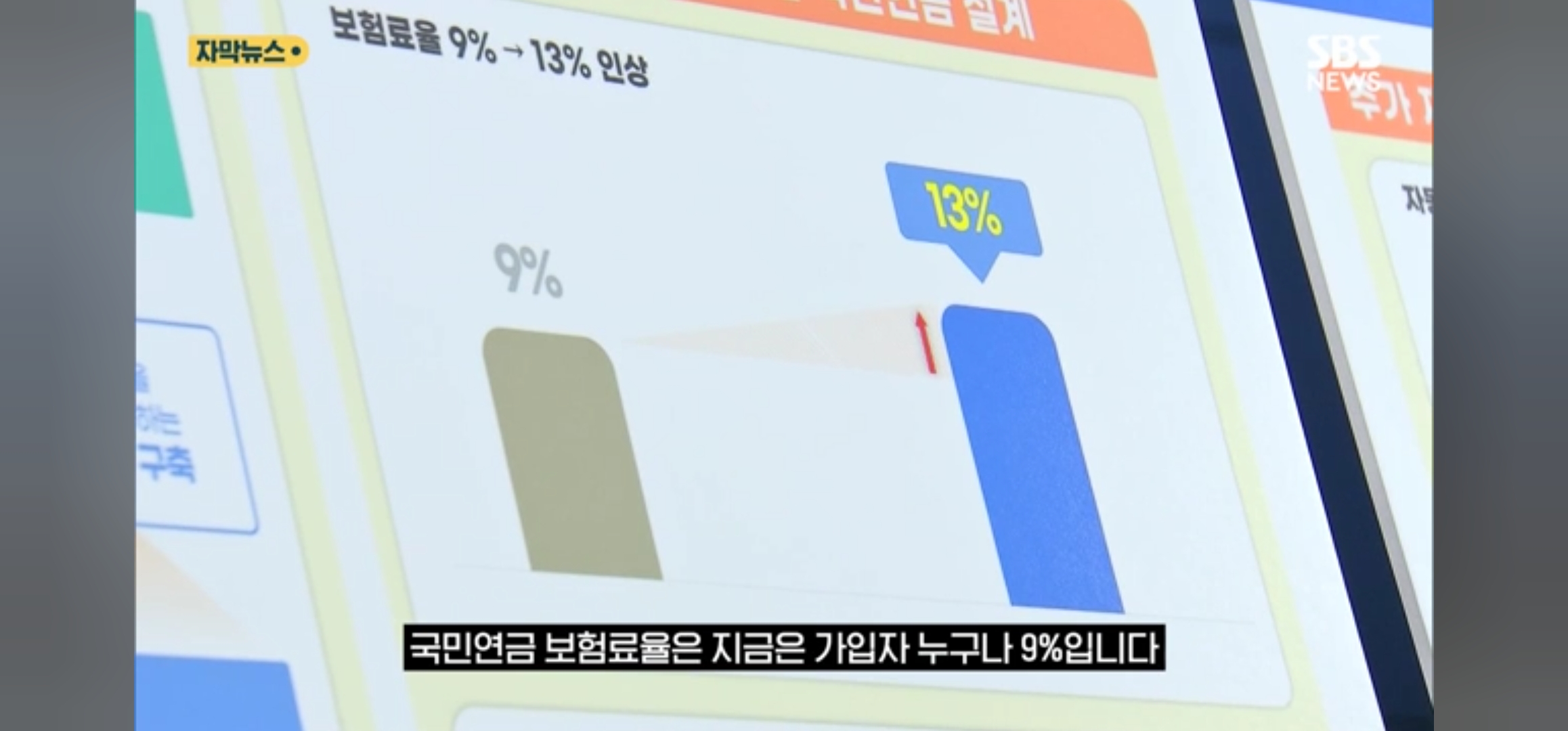
Right now, the National Pension contribution rate is 9% for every member.
The government’s plan is to raise it to 13% to stabilize the pension’s finances, but, to ease the burden on young people, to differentiate the pace of increase, for example by 1 percentage point a year for people in their 50s and 0.25 percentage points a year for people in their 20s.
So how much more would people pay?
Calculating the total additional contributions shows that, for example, those born in 1975, 1985, and 1995 would actually pay more than those born in 1976, 1986, and 1996.
With a monthly income of 3 million won, someone born in 1975, the youngest of the 50s group, would bear an additional 12.24 million won by the time they finish paying contributions.
But someone born in 1976, the oldest of the 40s group, pays only 10.8 million won more. The person born in 1975, one year older, actually pays 1.44 million won more. The same phenomenon appears elsewhere: those born in 1985, likewise the youngest of their generation, bear 1.52 million won more than those born in 1986, the oldest of theirs, and those born in 1995 bear 1.36 million won more than those born in 1996.
This happens because each generation is grouped by decade and a uniform rate of increase is applied within the same generation.
Experts say the timing of contribution increases in the specific years where this “reversal” occurs should be fine-tuned so that the additional contributions to be paid rise gradually with age.
[Yun Suk-myung / Research Fellow Emeritus, Korea Institute for Health and Social Affairs:
I think that if the contribution increases for the age groups with a 5 in their birth year (those born in 1975, 1985, and 1995) were pushed back to July, August, or September (rather than January), the parts where the burden reverses could be resolved.]
The Ministry of Health and Welfare said it is aware of this reversal and would accept remedies if they are worked out in the National Assembly’s legislative process.
Copyright Ⓒ SBS. All rights reserved.
Source: SBS News
Original link: https://news.sbs.co.kr/news/endPage.do?news_id=N1007810436&plink=COPYPASTE&cooper=SBSNEWSMOBEND
Attachments
- Screenshot_20261122_181857_Samsung Browser.jpg(723.1 KB)ViewDownload
- Screenshot_20261122_181901_Samsung Browser.jpg(490.9 KB)ViewDownload
- Screenshot_20261122_181906_Samsung Browser.jpg(612.4 KB)ViewDownload
- Screenshot_20261122_181913_Samsung Browser.jpg(655.0 KB)ViewDownload
- Screenshot_20261122_181920_Samsung Browser.jpg(531.8 KB)ViewDownload
- Screenshot_20261122_181939_Samsung Browser.jpg(436.7 KB)ViewDownload
- Screenshot_20261122_181949_Samsung Browser.jpg(466.3 KB)ViewDownload
- Screenshot_20261122_181952_Samsung Browser.jpg(459.1 KB)ViewDownload
- Screenshot_20261122_182017_Samsung Browser.jpg(940.6 KB)ViewDownload
- Screenshot_20261122_182022_Samsung Browser.jpg(726.7 KB)ViewDownload

