
(KBS, Coverage K) “Only Those Who Want to Pay Should Pay” — Why Does the MZ Generation “Distrust the National Pension”? (December 17, 2022)

‘With finances depleted by low fertility, population aging, and other factors, today’s younger generation may not receive a pension even when it reaches the eligibility age’—as such pessimistic forecasts emerge, the perception that ‘the National Pension is money you will never get back in the end’ is deepening among MZ office workers. (Photo for illustrative purposes only, not directly related to the article; photo source = Getty Images Bank)
※ [Full Program Video] KBS Sisa Gihoek Chang, Episode 379: “Will I Be Able to Receive the National Pension?” - “Pension Paupers in a Rich Country” (aired July 12, 2022)
☞https://www.youtube.com/watch?v=JjtbwUUukc4
* Click the address above to watch the full broadcast of the program on YouTube.
■ “I get angry every time I look at my pay statement”—MZs fuming over National Pension collections, “money they will never get back”
“Prices go up, but salaries stay put”—even so, the monthly “payday” is always welcome to office workers…. If the “take-home pay” deposited in your account somehow seems small, the thing that sends you back to study your “pay statement” closely is the “four major social insurance contributions.” Among them, under the “National Pension,” for the sake of “old-age security” rather than any immediate benefit, every “adult able to work (aged 18 or over and under 60)” is enrolled on a “mandatory” basis and pays contributions amounting to 9% of total income (4.5% from the worker + 4.5% from the employer) every month as an obligation.
For young people in their 20s and 30s, to whom even “a single 1,000-won bill” matters—the so-called “MZ generation” office workers—the “National Pension contributions” collected from them without fail every month are regarded as a considerable burden. Especially in recent years, as pessimistic forecasts have emerged that “with finances depleted by low fertility, population aging, and other factors, today’s younger generation may not receive a pension even when it reaches the eligibility age,” the perception among MZ office workers that it is “money they will never get back in the end” is deepening. We looked into the reasons why young people “distrust the National Pension.”

A survey of 115 young people in their 20s on “young people’s perceptions of the National Pension,” conducted in September–October by the Sound Finance Forum of the National Strategy Institute, found that 67.2% of respondents called the National Pension “a system that is disadvantageous to young people.” (Photo source = provided by the Sound Finance Forum)
■ The National Pension through “MZ eyes” ① Reciprocity: “I would pay if I got back at least what I put in—is it not a ‘bottomless pit’?”
According to the Korea Economic Research Institute and the National Assembly Budget Office, on current trends the National Pension Fund, worth about 740 trillion won as of 2020 (currently about 900 trillion won), is projected to fall to 416.4 trillion won in 2050 and then be depleted in 2055. In a press release in January, the Korea Economic Research Institute projected that, “if the current National Pension system is maintained, starting with those born in 1990, who become eligible to receive the National Pension in 2055 (with benefits beginning at age 65 from 2033), people may be unable to receive the National Pension.”
MZ-generation office workers, who value a so-called fair “give and take,” a kind of “reciprocity,” worry about such forecasts and push back: “Why should we pay money that we will not get back even in the amount we paid in?” On social media and elsewhere, “It would be nice if I could at least get back the principal I paid in, but since I know I will not get it, I would rather invest (the money) myself,” and “We are a generation that will not get it anyway, so why do we have to keep paying?”—posts like these keep appearing.
A survey conducted in September–October by the Sound Finance Forum of the National Strategy Institute of 115 young people in their 20s on “young people’s perceptions of the National Pension” found the National Pension criticized as “a bottomless pit.” Asked why they chose the expression “bottomless pit,” the young people surveyed answered, “It is unclear whether today’s young people will be able to receive a meaningful amount when the time comes for them to collect the National Pension. It seems to be nothing more than a means of supporting the older generation.”
Young people who attended the “Second National Pension Roundtable for Young People,” hosted by the Ministry of Health and Welfare on the 12th, also said, “What we ask of the current management of the National Pension is ‘trust’ and ‘intergenerational equity,’” adding, “Despite concerns about fund depletion and the like, we hope you will give us confidence that we will be able to receive our pensions.”
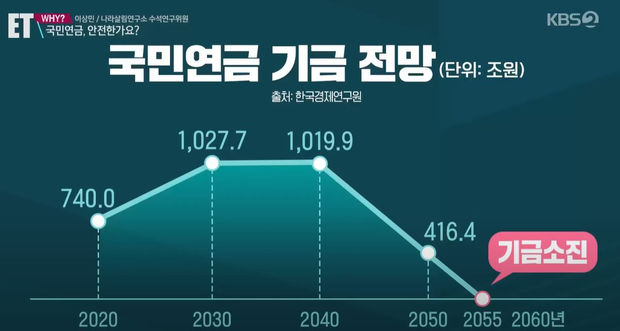
According to the Korea Economic Research Institute and the National Assembly Budget Office, on current trends the National Pension Fund, worth about 740 trillion won as of 2020 (currently about 900 trillion won), is projected to fall to 416.4 trillion won in 2050 and then be depleted in 2055. (Photo source = screen capture of KBS broadcast footage)
■ The National Pension through “MZ eyes” ② Realism: “Pay more and receive later? I would rather pay less and receive less”
If the MZ generation’s “distrust of paying into the National Pension” rests on “reciprocity,” its “criticism of National Pension reform” stems from a “realist” perspective.
As forecasts of “fund depletion” caused by low fertility and population aging—with “fewer people paying in and more people receiving”—keep coming, the “need to reform the National Pension system” has also been raised again and again. Representative reform proposals include ▲adjusting benefit amounts ▲raising the contribution rate ▲raising the age at which benefits begin, among others.
At the “Expert Forum for a Sustainable National Pension,” co-hosted by the Ministry of Health and Welfare and the National Assembly Special Committee on Pension Reform on the 8th, “raising the contribution rate” and “raising the age at which benefits begin” were likewise discussed as ways to improve the operation of the system. The proposal was to raise the “contribution rate,” currently 9%, gradually from 2025 until it reaches 15% in 2036, and to raise the “age at which benefits begin,” which is being raised from the current 62 to 65 by 2033, to 68 by 2048.
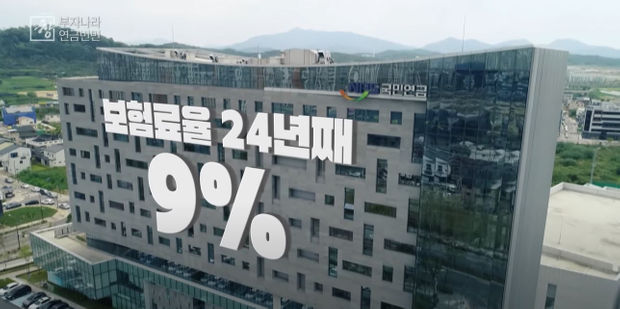
At the “Expert Forum for a Sustainable National Pension,” co-hosted by the Ministry of Health and Welfare and the National Assembly Special Committee on Pension Reform on the 8th, a reform plan was presented to raise the “contribution rate,” currently 9%, gradually from 2025 to 15% by 2036. (Photo source = screen capture of KBS Sisa Gihoek Chang episode 379 broadcast footage)
In this regard, criticism has arisen among young people that “while we accept the need for National Pension reform, we cannot agree with an approach that tries to solve the problem by one-sidedly increasing the burden on the current generation, which will bear the obligation to contribute for a long time.” In particular, with the National Pension’s investment return turning negative as of the end of September (-7.06%; year-to-date returns: -68.0 trillion won), some even point out, “Are the authorities not just trying to increase the burden on young people while failing even to manage the finances stably?” In fact, posts such as “Why do they keep changing the terms to the customer’s disadvantage without even getting the customer’s consent?” have recently appeared in online communities.
Kim Yong-chun, head of the Employment Policy Team at the Korea Economic Research Institute, said in a phone interview with the reporter, “The reason young people are negative about ‘raising the contribution rate,’ one of the National Pension reform proposals, is that they suspect that ‘even if we pay more, the authorities will not manage the fund stably,’” and pointed out, “Since the National Pension is the people’s ‘nest egg for old age,’ should it not serve as a safety net even when the economy is struggling? If it records negative returns through reckless investment, as it has recently, social distrust is bound to grow.”
There is also the position that “if we cannot avoid paying altogether, then rather than paying more and receiving less, or receiving later, we would rather pay less and receive less.” According to the aforementioned Sound Finance Forum survey, the “direction for National Pension reform” most preferred by respondents in their 20s turned out to be the “pay less, receive less” type. Although the differences from the other answers are slight (“pay less, receive less”: 25.0%; “pay as now, receive less”: 24.1%; and so on), it is clear that some young people are averse to reform approaches in which “immediate input must be increased for the sake of later benefits.”
■ Young people and experts: “Disclose ‘the state of fund management transparently’ and pursue ‘a reform that builds on its strengths’ by reflecting young people’s views”
Young people of the same age and experts advise that “to pursue National Pension reform while taking into account the hardships of the younger generation, which bears the burden of contributions for a relatively long period, the authorities must disclose the current state of fund management more transparently than they do now and establish a deliberative structure that reflects young people’s views.”
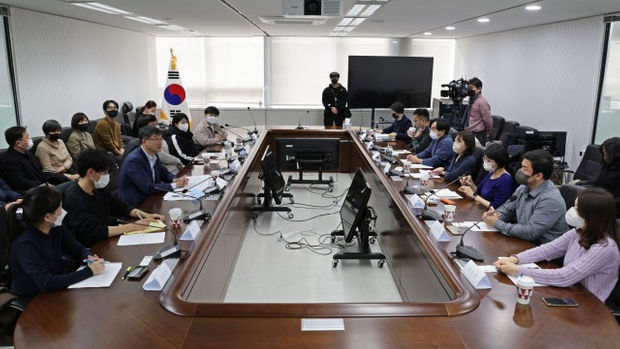
Young people who attended the “Second National Pension Roundtable for Young People,” hosted by the Ministry of Health and Welfare on the 12th, said, “Despite concerns about fund depletion and the like, we hope you will give us confidence that we will be able to receive our pensions.” (Photo source = Yonhap News)
Lee Jae-jeong, an office worker in their 20s who attended the earlier roundtable hosted by the ministry, said in a phone interview with the reporter, “Until now young people have not had many opportunities to learn about the meaning of the National Pension or to get information about it. That is partly why the distrust has grown,” adding, “The authorities say, ‘The chance that the current generation will not receive a pension is close to zero (0). Trust us with it,’ but if the National Pension is such a ‘cost-effective’ (value-for-money) system, should they not discuss, together with young people, a reform plan that even young people who feel financial strain just paying the four major social insurance contributions can agree with? A deliberative structure that can reflect young people’s voices is needed.”
Yun Suk-myung, Research Fellow at the Korea Institute for Health and Social Affairs (KIHASA) and former President of the Korean Pension Association, said, “If the state firmly fixes the structure and runs it properly, the National Pension is certainly a system with better returns than other investment vehicles such as private pensions. It is a financial product that helps every generation, returning everything to the people without deducting a single fee,” adding, “The authorities must properly tell the public ‘what reality the National Pension now faces,’ and experts must persuade young people of ‘the strengths of the National Pension.’ After that, through public deliberation, the operating structure should be reorganized by applying various options ‘so that no particular generation loses out excessively.’” he suggested.
Further advice has also been offered that “the meaning of the National Pension’s existence needs to be considered at the level of society as a whole, reflecting young people’s perspectives.” Kim Kwang-seok, head of the Economic Research Office at the Korea Institute of Economy and Industry, said, “ Some young people who distrust the National Pension even argue that ‘it should be changed into a system people choose rather than an obligation,’ but since it also performs an ‘income redistribution function’ that sustains the community, this cannot but be a matter requiring careful social judgment,” and pointed out, “Before the question of whether it could be realized, whether this is a matter on which national consensus can be reached must be considered first.”

