
(Seoul Economic Daily) Low Birth Rate Has Sped Up Pension Fund Depletion — “What Is the Solution for Future Generations?” (April 14, 2024)
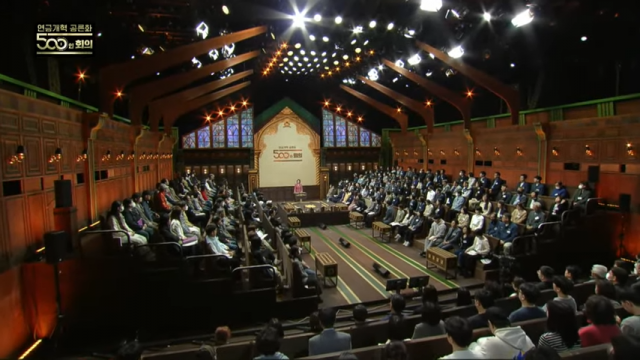
Members of the citizen representative panel attend the “Citizens’ Deliberative Forum on Pension Reform” held at KBS headquarters in Yeongdeungpo-gu, Seoul, on the 13th and discuss pension reform plans. Photo = capture from KBS YouTube account
[The Great Transformation to Reset State Affairs <3> “Passing the Bomb Around” Must End]
Birth rate falling more steeply than expected
Cumulative deficit to date alone: 609 trillion won
Hard to raise contributions all at once
Improve in a direction that stabilizes finances
The “5th National Pension Financial Projection” that the Ministry of Health and Welfare released last year used the “2020–2070 Population Projections,” the most recent data at the time (2021).
Under the medium assumption, those data present a scenario in which the total fertility rate bottoms out at 0.7 in 2024 and then rebounds, stabilizing over the long term at 1.21 around 2050.
The data that the National Assembly’s Special Committee on Pension Reform is using in its deliberations are based on this. So is the projection of fund depletion in 2055.
The problem is that the low birth rate has accelerated further since the Ministry of Health and Welfare’s 5th financial projection.
According to the new “2022–2072 Population Projections” that Statistics Korea compiled at the end of last year, the total fertility rate falls to 0.65 in 2025 and then rebounds, stabilizing at 1.08 in the 2050s. At the end of last year it already plunged to the 0.65 level, and barring any particular variables, it is certain to enter the 0.6 range on an annual basis this year.
The low birth rate has become more serious than at the time of the 5th projection.
Lee Kang-gu, Research Fellow at the Korea Development Institute (KDI),
pointed out, “The fertility rate in the fourth quarter of last year has already been shown to have entered the 0.6 range. The actual pace of the fall in the fertility rate will be faster than Statistics Korea’s projection,” adding, “Considering this alone, it is highly likely that the point of pension depletion has been moved up by one to two years.” In academia, there is broad agreement that the depletion point may in fact have moved up by around three to four years.
Experts urged that the National Pension be turned into a sustainable structure as soon as possible. This is because, even if it is reformed right now into a structure in which no further deficits arise, the fiscal shortfall accumulated so far is 609 trillion won. According to KDI estimates, if pension reform is delayed by about five years, the fiscal shortfall will surge by about 260 trillion won to 869 trillion won. The opposition party is focusing on raising the income replacement rate, but in that case fiscal stability could fall sharply.
Research Fellow Lee said, “Had a financial-stabilization pension reform been carried out under the Moon Jae-in administration, the fiscal shortfall to be borne would have been in the 200 trillion to 300 trillion won range,” adding, “Many experts regret that pension reform was not pursued at the time.”
In fact, last November the advisory panel under the Special Committee on Pension Reform reported two plans to the committee: △ a contribution rate of 13% and an income replacement rate of 50% (the income stability view) and △ a contribution rate of 15% and an income replacement rate of 40% (the fiscal stability view); but in this public deliberation process, the contribution rate increase under the fiscal stability view was scaled back from 6 percentage points to 3 percentage points. The agenda items put to the citizens’ deliberative forum are also reported to include the plan for “permitting pension fund investment in public facilities” that the labor sector has consistently advocated.

As a result, experts are lining up to argue that fiscal stability must come first.
Yun Suk-myung, Research Fellow Emeritus at the Korea Institute for Health and Social Affairs,
expressed concern, saying, “The plan experts preferred most on the advisory committee last year was a contribution rate of 15%,” and “Since the contribution rate rose to 9% in 1998, it has stayed the same for 26 years. The problems that will come in the future if the pension’s fiscal stability is not secured will be at the level of a national crisis.”
Seok Jae-eun, Professor in the Department of Social Welfare at Hallym University, who also took part in the deliberative forum,
said, “In fact, the ‘contribution rate that balances contributions and benefits,’ which secures pension revenue matching the National Pension’s benefit level, is 19.8%,” adding, “It would realistically be difficult to raise it that far all at once, but at the very least the system must be improved in a direction that stabilizes finances.”
Public anxiety is in fact great. During the Special Committee on Pension Reform’s deliberative forum on the 13th and 14th as well, a flood of questions was raised, such as “All of the plans under discussion project that the fund will be depleted; after that, if the system switches to pay-as-you-go, the burden will be considerable. Can this really be called a fundamental reform plan?” and “Public anxiety is considerable; can the old-age income promised through pension reform be guaranteed by law?”
Future generations have even more worries. According to a survey of 1,152 people in their 20s and 30s conducted last July by the Korean Women’s Development Institute, young people strongly perceived that pension reform discussions do not properly reflect their views. Of the respondents, 73.3% said the voices of the younger generation are not reflected in National Pension reform. Only 8% answered that they are well reflected. A senior government official pointed out, “Pension reform is possible only with the consent not just of the current generation but also of future generations,” adding, “If the income replacement rate is raised with only the interests of the current generation in mind, future generations may later say they will not pay into the pension.” The official added, “Raising the income replacement rate, as the opposition party envisions, sounds good but is not sustainable,” and “The political sphere must hurry to make choices for future generations.”
National Assembly Speaker Kim Jin-pyo’s proposal to the effect of “making it mandatory to reform the pension every five years” is also interpreted in the same context. Oh Gun-ho, Chair of the Policy Committee of Welfare State I Make, emphasized, “What matters is setting the direction toward fiscal stability.”

