(KBS 1TV) Agreement on the “Government Employees Pension Reform Plan” — A Strong Backlash Expected (May 4, 2015)
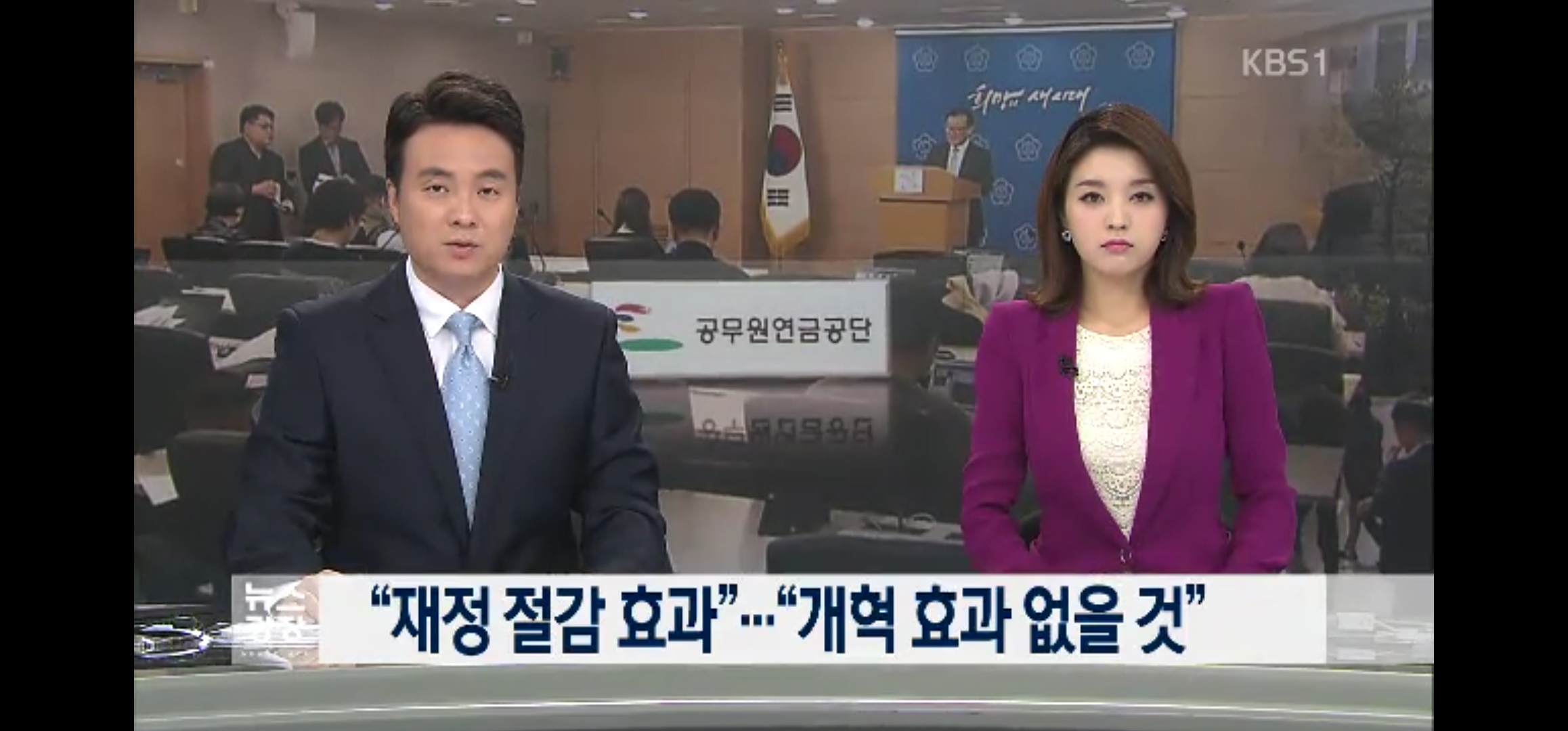
Anchor
The government has assessed that the Government Employees Pension reform plan agreed on by the ruling and opposition parties will produce fiscal savings over the next 70 years.
However, because the accrual rate that government employees will receive is to be lowered by just 0.2 percentage points, and gradually over 20 years at that, a backlash is expected, as critics say the reform will have no effect and concerns are even being raised that National Pension contributions will be increased.
Reporter Kim Sang-hyup reports.
Report
The government first assessed that achieving fiscal savings of 333 trillion won over the next 70 years is a clear achievement.
It explained that this is because, in addition to the reform under which government employees pay more and receive less, a range of savings measures were applied, such as aligning the pension eligibility age with the National Pension at 65, freezing pension amounts for five years, and lowering the survivors’ pension rate.
<Recording> Hwang Seo-jong (Vice Minister, Ministry of Personnel Management):
“A national consensus reached through mutual concessions and burden-sharing, with all stakeholders taking part...”
However, critics point out that fiscal savings materialize properly only when the focus is on cutting what is received rather than on increasing what is paid in, and that the cut in pension amounts is too slight.
For a government employee receiving an average of 3 million won a month, once the agreement takes effect, the amount paid in will rise by 28%, but the amount received will in any case fall by only 10%.
<Interview> Dr. Yun Suk-myung (Korea Institute for Health and Social Affairs):
“If the rate is lowered by a mere 0.2 percentage points, as in the 2009 reform, further reform seems inevitable within a few years, and above all, in that the structural reform originally planned was not achieved”
In addition, if the share of the National Pension benefit relative to average income is raised to 50%, a contribution increase also appears inevitable, raising concerns about considerable resistance.
The ruling and opposition parties agreed to deal with the National Pension increase plan at the regular session of the National Assembly this September, but since this would ultimately place an additional burden on the public, another conflict is foreshadowed.
This has been Kim Sang-hyup, KBS News.
Attachments
- Screenshot_20261121_182403_Samsung Browser.jpg(645.6 KB)ViewDownload
- Screenshot_20261121_182426_Samsung Browser.jpg(540.2 KB)ViewDownload
- Screenshot_20261121_182436_Samsung Browser.jpg(640.1 KB)ViewDownload
- Screenshot_20261121_182449_Samsung Browser.jpg(627.8 KB)ViewDownload
- Screenshot_20261121_182654_Samsung Browser.jpg(758.3 KB)ViewDownload