
(KBS TV, Current Affairs Diagnosis) “Nothing but Debt” vs. “Unfair Cuts” — Controversy over Government Employees Pension Reform (September 22, 2014)
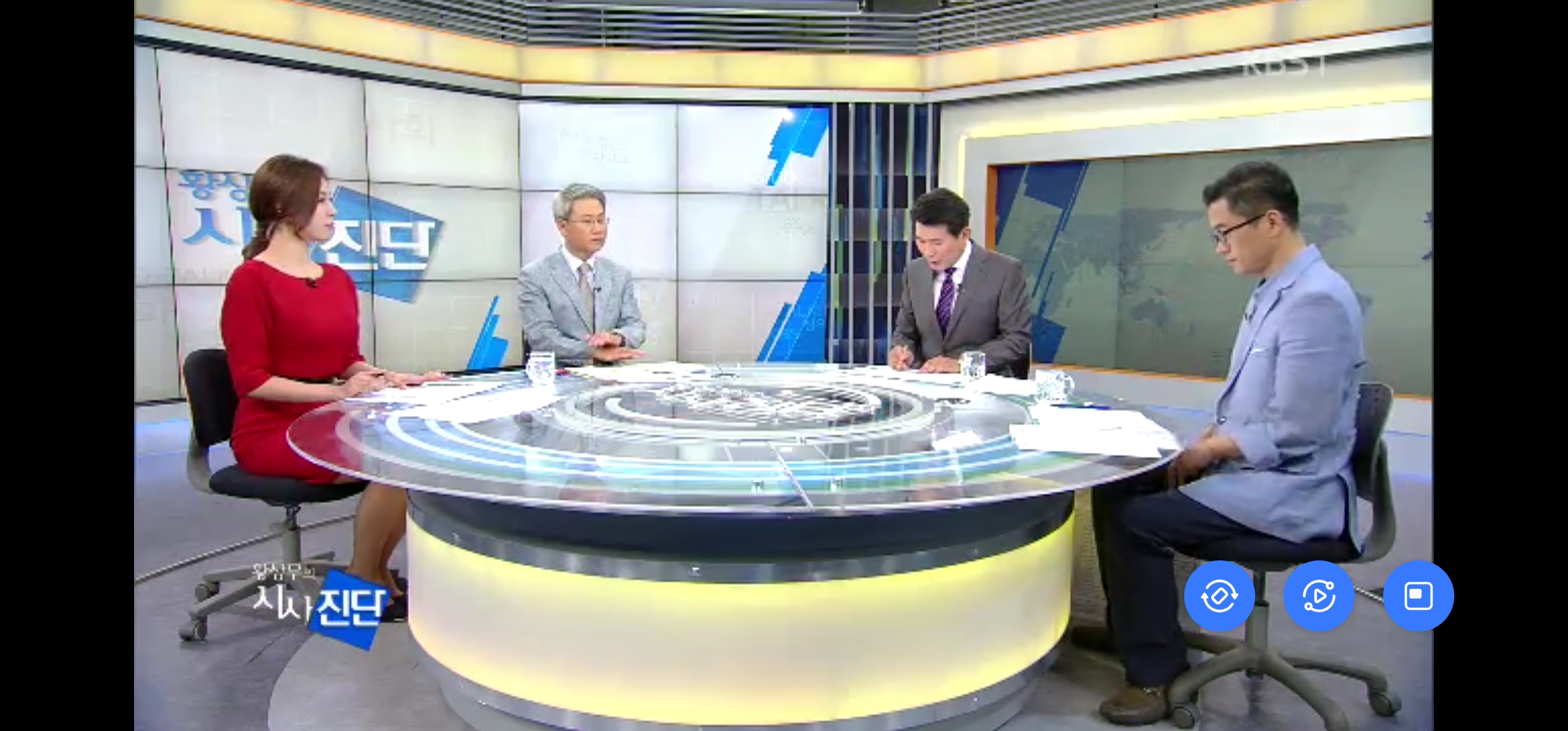
As we saw at the top of the program and in the footage a moment ago, a forum on the Government Employees Pension reform plan was to be held at the National Assembly today, where its contents were to be made public.
But we briefly reported that government employees’ organizations protested fiercely, turning the forum venue into chaos, and the forum was called off.
What exactly happened, and why did it happen? Today we have invited two experts, one who argues that Government Employees Pension reform is necessary and one who opposes it, to hear their views in detail.
We are joined by Yun Suk-myung, Research Fellow at the Korea Institute for Health and Social Affairs, and Lee Chung-jae, chairman of the government employees’ union.
Good evening.
-Good evening.
-Before we begin the debate in earnest, Announcer Lee Seung-yeon will summarize what was to be presented at today’s forum, the forum at the National Assembly — what the Government Employees Pension reform plan contains.
-The civil service was once called the most stable place of all, so much so that it was known as an “iron rice bowl.”
Now a veritable typhoon is sweeping through it.
The current reform plan is regarded as quite drastic.
It is on screen now.
As you can see, the gist of the reform plan is that the money paid into the pension would rise by 43% from the current level, while the money received would fall by about one-third.
In figures, employees currently bear about 7% themselves.
The government also pays the same rate.
But this would be expanded in stages to 10%.
The benefit rate, however, which determines the amount received, would actually fall.
And as the table shows, for those appointed after 2016 the structure of the pension would in effect change.
-What Announcer Lee Seung-hyun presented was 7%, 4.5%, 7%, 4.
5%; since this is talk of integration, the point is that, whereas contributions are currently made at 14%, with integration they would be lowered to about 10%.
-That is right.
It is said that this level would mean bearing a burden for benefits altogether similar to the National Pension.
There is a video that explains this a little more simply.
Let us watch it together.
-Let us look at the pay slip of Mr. Hwang, a grade-5 civil servant with 20 years of service.
His total pay last month was about 3.85 million won before tax.
You can see that 379,000 won of it was deducted for the pension.
Leaving out the government subsidy and calculating simply, after retirement Mr. Hwang will receive 870,000 won a month as a pension, 2.3 times what he paid in.
For now, these are far more favorable terms than the National Pension, which pays 1.7 times.
The gist of the Government Employees Pension reform plan drawn up by the Korean Pension Association is to pay more and receive less than now.
The contribution rate that employees must pay during their service in order to receive a pension would be raised from the current 7% to 10% from 2016.
As for the money received, whereas members are now paid on average 2.3 times what they paid in, the plan would make it differ little from what they paid in.
Under this plan, Mr. Hwang, introduced earlier, would have to pay about 190,000 won more toward his pension from 2016, but the money he receives would be about 310,000 won less than under the current system.
The plan also adjusts the age at which the pension begins to 65 from 2033, as in the National Pension, and cuts the benefits of retirees already receiving the pension.
If this reform plan is implemented, the amount of taxes put into the Government Employees Pension is estimated to fall by about 42%.
-That was Reporter Kim Na-na’s explanation.
-We have heard Reporter Kim Na-na’s explanation all the way through, and the key point is to pay more and receive less than now.
That is the substance, right?-What they bear rises by about 43%, while what is cut means receiving 34% less.
Because of this, a great deal of backlash is expected within the civil service.
It has just been explained, but I think I need to put it a bit more bluntly.
The reason the Government Employees Pension problem has blown up so much is that the scheme was first introduced in 1960, when, as you may not remember, Korea’s life expectancy was 52.
-It was 52?-It is now 81, so in 50 years we have added 30 years.
Adding 30 years means that the period of receiving a pension has grown by that much.
The great turmoil now sweeping our society over Government Employees Pension reform comes not from envy of civil servants but from the fact that our society has changed so fast that it can fundamentally no longer support this scheme — that point needs to be made first.
Next, the captioned VCR segment explained things well, but we need to look more precisely at the reality of the Government Employees Pension; earlier the figure of 870,000 won and so on came up, but that refers to the employee’s own share.
-That is the employee’s own share, right?-Combined, it comes to 1.74 million won.
-So there is that much more in government subsidy?-So the pension amount he actually receives is about 1.74 million won.
The person in the example shown earlier has a monthly salary of 3.85 million won, does he not? He is a grade-5 officer, yet that is the situation; but as of the end of last year, the average pay of our civil servants is 4.47 million won.
-The average pay is 4.77 million won.
-More than this person.
-So it is.
-The Government Employees Pension problem is now being discussed as one lump, but the Government Employees Pension problem is that, overall, it is a scheme that pays out far more than members paid in.
That is one part.
And if you go into the details, unlike the National Pension, the Government Employees Pension has no income redistribution function, so it operates on a 100% earnings-related basis.
So among civil servants, pay is not that high and there are many in senior positions, are there not? Since the average monthly pay I mentioned earlier is 4.47 million won, it may be more telling if I explain with an example of 5 million won: at 5 million won, 33 years of membership gives a pension of about 3.14 million won.
And at 7 million won, the pension is expected to be 4.39 million won.
-So it is vastly higher than the level of the ordinary National Pension.
-If the contribution period is equalized at 33 years, the National Pension pays only 990,000 won for the same income.
-To sum up your first point: because it is a structure built long ago, and life expectancy has risen this much, it simply cannot be sustained in its current state.
And second, compared with something like the National Pension, members receive far too much — that is what you are saying.
-Severance pay is small, and it is said to have other features, such as an industrial accident insurance character and compensation for civil servants, but even taking that into account, the gap is too large to compare.
-All right.
Let us stop there for now.
Chairman Lee, civil servants are now protesting enormously.
First of all.
We will hear why they are protesting later; how strongly are civil servants protesting now?
-The Government Employees Pension today is this.
Since the Park Chung-hee regime, the idea has been that civil servants have meager pay, small severance pay and all kinds of disadvantages while in service, so they should receive a pension after retirement.
For us it is perhaps an unwritten rule, a customary constitution.
And these things are being taken by the daughter, President Park Geun-hye.
-That was how it was done at its introduction.
-And now they say they will abolish it.
-Not abolish, but reduce it.
-In effect, that is how we see it.
And when floods strike, disasters occur or foot-and-mouth disease breaks out, civil servants work at the risk of their lives.
They have all done that because of the pension.
And now they intend to cut that pension to a degree we simply cannot accept.
In fact, even our country’s president receives 95% of his remuneration as a pension.
His annual salary is about 230 million won.
Members of the National Assembly receive a pension of 1.2 million won after serving just one year.
The very leaders of this country do not bear such pain themselves but instead shift it onto lower-grade civil servants, which is why there is enormous anger, and a rush for early retirement is now sweeping the public service.
Also, our civil servants, in taxes too.
I would like to say that the anger is very great.
-Just a moment.
I understand what you mean, and I understand that civil servants are agitated, but he raised two points — what about those two points? First, this scheme simply cannot be sustained; it was made in the past, 30 years ago.
Second, it is excessive compared with the ordinary National Pension.
So it must be reduced somewhat.
How would you respond to that?
-First, I think you need to look at overseas cases.
Of course, population aging is not something that affects civil servants alone.
The same goes for the general public.
If we look at it in terms of deficits, our Basic Pension costs more than 10 trillion won a year.
It is surging every year, and in 2040 it will take 100 trillion won in a single year.
It is clear that the National Pension will be depleted around 2040 or 2050.
Then it will be tens of trillions of won a year; so if the Government Employees Pension, a small part, is in view, will the state then refuse to support the Basic Pension or the National Pension later just because they are all in deficit? There are such aspects, and in addition, Korea’s GDP growth over the past 10 years has been 76%.
I expect it to be about 38% over the next 10 years.
That is around 40%.
Then government finances grow by that much.
Only by looking at all of that together, instead of simply seeing deficits — I think you should see the Government Employees Pension, and the National Pension and the Basic Pension, as social security and welfare.
-Let me ask one more question.
What do you see as the biggest problem with the reform plan now being pursued by the Korea Institute for Health and Social Affairs and the government?
-First, in drawing up this reform plan — this time, notably, it was the Pension Association that put it forward, was it not? The Pension Association is a body led by chaebol insurers and securities firms.
Since it has always been a body that talks of shrinking public pensions and promoting private ones, once you know that body’s identity, there are parts we cannot agree with at all.
There is also the special nature of civil servants’ pensions.
There is the low pay during service — in the general service, it is only 77% of companies with 100 or more employees.
Severance pay is at most only 39%.
These special features.
And civil servants are not covered by the Basic Pension either.
Nor by industrial accident insurance.
This reform plan did not discuss those aspects at all.
It simply intends to cut the Government Employees Pension.
For young serving employees in particular, it set the level lower than the Basic Pension.
So it does not match the National Pension in equity, and it does not comprehensively consider equity within the civil service — between senior and junior grades, between retirees and serving employees, and even new hires — which is why we find it hard to agree.
-I mean that the Government Employees Pension has been reformed three times in the past.
It has been reformed, but there is a lot of criticism that when civil servants were told to reform it themselves, they did not carry out a single proper reform and in fact kept civil servants’ benefits just as they were.
-This time the Pension Association led the pension reform plan and was going to present it at a public hearing, but that fell through for various reasons.
It is regrettable that the government or the ruling party did not take the lead in announcing a plan drawn up by the government, but as the moderator just said, we are told that we carried out pension reforms in 1995, 2000 and 2005.
At the time those pension reforms were said to have been done well, but after just a few years there were many assessments that they were not reform but deterioration, were there not? Because those who mainly drew up the reform plans — the ones overhauling the Government Employees Pension scheme — were civil servants themselves, there were many results that looked like reform on the surface but were deterioration underneath; so this time, as I said earlier, not out of envy or jealousy toward civil servants but because our society has changed so much, a plan was first drawn up to adapt to that changed social environment, and we should first hear that plan out, see what is wrong with it, and if not that plan, then what we will do in the future.
Do not be alarmed.
Today, people aged 65 and over make up only 13% of our total population.
2040 seems very far off, but it is only 26 years away.
By then, people aged 65 and over will approach 38%, close to 40%, of the total population.
In this situation, if we keep carrying these schemes forward from where we stand now, it is not just the Government Employees Pension: our society as a whole will be heading toward a cliff.
So I think the more desirable approach is first to look at why such a plan could not but come out, and, if the plan has problems, to move toward fixing them.
-Then, just a moment.
Announcer Lee Seung-hyun, you have prepared something on the deficit trend caused by the Government Employees Pension and how large it is projected to be, right?-I will explain while we look at the screen.
The deficit subsidy for the Government Employees Pension.
Based on the current situation, under the current scheme it is expected to approach 2.4 trillion won this year alone.
Next year it will rise to over 3 trillion won.
In 2019 it is expected to exceed 5 trillion won.
But that is under the current scheme.
Looking at the Korean Pension Association’s reform plan, the picture changes again.
-Dr. Yun, please explain.
-As the announcer said, this year’s deficit subsidy.
The problem is that if we keep this scheme as it is, the cumulative deficit over the next 10 years is 53 trillion won.
Then from 2021 the annual deficit subsidy alone rises to 7 trillion won.
And again, do not be alarmed.
In the 2030s, the contribution revenue borne by civil servants and the state will be 8.7 trillion won.
-Let us zoom in on the screen a bit.
-The deficit subsidy will be 14.4 trillion won, nearly doubling; if we leave this as it is, the deficit subsidy grows exponentially.
-So it must be fixed as shown below?-If it is fixed — 2030 and 2040 are too far off, so looking at 2020, six years from now — if this plan is passed, about 2.8 to 3 trillion won of the deficit subsidy could be saved in 2020 alone.
Last year.
-If left alone, about 6.6 trillion won.
-Left alone.
That is 2020, but it grows exponentially, and in 2030, ten years after that, the deficit subsidy rises to 14 trillion won.
-So in any case it cannot but be fixed, it must be fixed — that is what you are saying.
-The only question is when.
-Let us hear a rebuttal.
-Among the causes of the Government Employees Pension deficit, the government also bears responsibility.
In the past — the IMF crisis, restructuring, the privatization of the railway corporation — it inflicted fiscal losses on the Government Employees Pension of about 25 trillion won in present value.
It has not repaid that either.
A public pension is a structure that inevitably produces deficits.
For example, the idea is that one bears a certain amount during service and the state, and society, add to that responsibility to guarantee people’s old age, so I can only say that deficits are inevitable.
Looking at foreign cases too — it is said that the Government Employees Pension of our civil servants runs large deficits, but in Korea’s case the government’s subsidy rate for the Government Employees Pension, including severance pay and pensions, is now 7%.
In Japan it is 27.7%.
In the United States it is 35.5%.
In Germany, civil servants pay nothing at all.
In France, the government bears 62%.
The differences are very large.
Foreign countries all have such cases as well.
For reference, Dr. Yun Suk-myung said earlier that the average pension of civil servants is 4.47 million won, but our grade-9 civil servants join at 30.
They are all university graduates, most of them.
Their annual salary is under 19 million won.
In our small and medium-sized enterprises the average annual salary is 24.53 million won.
In large companies it is 37 million won.
It is only half.
That is the reality.
So within the civil service, too, the salary gap between senior and junior grades is large.
Especially since this is also linked to the pension, I do not think it should be viewed simplistically.
I have looked at one case myself.
If you look at the case.
-You have prepared one.
-This civil servant, for example, after 27 years of service — 27 years and 3 months — is set to receive 1.7 million won as a pension.
But our civil servants now pay a 7% employee contribution, under the current arrangement.
The general public pays 4.5%.
Suppose that members of the ordinary National Pension paid more, at 7%.
Also, you said the ordinary National Pension was 840,000 won earlier, but I do not remember exactly what average was used.
Because the Government Employees Pension requires 20 or more years of membership, while the National Pension requires only 10 years.
-840,000 won is the average for those who have served 20 years or more; the average pension currently received from the National Pension is only 840,000 won.
-The 27-year portion is 840,000 won.
I will say that, on that assumption, there is no big difference, and that this includes all of civil servants’ remuneration.
Because it includes the portion of our low pay during service.
If anything, in a way, there is a relative disadvantage.
-In any case, these are civil servants who are stuck with meager pay and poor working conditions and, as you said earlier, who rushed out at the risk of their lives when national disasters struck.
-I would like to raise a rebuttal.
When calculating civil servants’ meager pay, one sometimes hears that in Korea comparing with firms of 100 or more employees is not enough, nor 300 or more, and that the comparison must be with large companies like Samsung or LG.
For reference, take our close neighbor Japan: in Japan the yardstick for comparing the private sector with civil servants is the average of workplaces with 50 or more employees.
-So they compare with a much lower figure.
-And so the pension amounts differ in reality.
Earlier it was said that the average monthly pay is 4.47 million won, but as of last year the average pension was 2.19 million won, was it not? From October next year, in Japan the pension amounts of civil servants and the public will all be integrated to the same level.
The same amount.
From October next year.
Currently, civil servants receive about 2.17 million won a month from the Government Employees Pension, but for those subject to our reform, let me speak in terms of the reform benchmark.
It is based on 2012; comparing on the basis of someone receiving the average at an ordinary company, the monthly pension in Japan is now expected to be 1.85 million won — Japan’s Government Employees Pension, that is.
For the general public it is 1.65 million won.
-If we look at the screen for a moment.
-The difference is only 200,000 won.
This is about Japan.
The difference is only 200,000 won, yet the Japanese public said they could not accept even that 200,000-won difference, so from next year it will be cut by 200,000 won and the pension amounts for civil servants and the public alike will be the same, at 1.65 million won.
-That is Japan, but if we compare Korea’s Government Employees Pension with the National Pension.
-If the benchmarks are aligned, it is 2.19 million won; 2.19 million won for 33 years of membership.
The 840,000 won is that — the National Pension figure is based on 40 years of membership.
-Based on 40 years of membership.
-As I said earlier, whether it is 4 million or 5 million won, 40 years of membership gives the maximum, and if you equalize at 33 years it is 990,000 won.
-990,000 won.
-And let me add just one more thing.
I say this because I have had no chance to clarify it.
It is said that a major reason the Government Employees Pension runs deficits is that the state’s burden is smaller than in Japan, Germany, France and the United States.
-Did you say earlier that it is smaller?
-There is something to point out there.
The reason we must reform the Government Employees Pension quickly is this: it is true that these countries’ state burden is larger than ours, but in Japan’s case, until before October 1959, civil servants paid nothing toward the pension and the state bore it all.
From 1959 the cost has been shared 50-50.
So why is the state’s burden for the Government Employees Pension large in Japan? The cohort before 1959 is called the onkyu generation, the generation whose pensions were set to be paid 100% from taxes.
It is large because support for that generation is included.
In the United States, the reason such costs are high is that it is paying down liabilities already incurred.
The current generation is bearing the cost so as not to burden later generations.
For reference, the accrued pension liability of Korea’s Government Employees Pension, counting the Government Employees Pension alone, is about 490 trillion won.
Including retirement allowances, it is 515 trillion won as of the end of last year.
If that 515 trillion won of liabilities is repaid over 50 years, the annual burden from that alone exceeds 10 trillion won.
So the 7 trillion won currently going in.
Last year’s government contribution of 5 trillion won plus the deficit subsidy of 2 trillion won makes 7 trillion won, does it not? If repayment is added, it exceeds 10 trillion won, so if we ran it like other countries, our government contribution would have exceeded 17 trillion won.
The state’s share of total expenditure could become very large.
So when we make comparisons, I think we have to be very fair and use the same yardstick.
-I have a rebuttal too.
If you are going to criticize, criticize properly.
Data from the research institute of the Government Employees Pension Service assume someone employed in 2010 who joins the National Pension or the Government Employees Pension alike for 30 years, with the same average pay over the entire period of service.
Comparing the contributions paid with the return in severance pay and pension received, the National Pension comes to 3.2 times.
For civil servants it is said to be about 2.7 times.
You can check that in the Government Employees Pension Service’s receipts.
Next, on foreign cases — you mentioned the case of Japan earlier.
In Japan, the entire population receives the basic pension.
Civil servants receive it, and the public receives it.
That amounts to about 600,000 to 700,000 won per person.
Combined for a married couple, it comes to about 1.4 to 1.5 million won.
Ordinary civil servants receive the Employees’ Pension Insurance.
Local civil servants receive more than 2 million won in mutual aid pensions.
Some receive 1.9 million won — you mentioned 1.8 million won earlier — and I would say they receive all this on top, combined; and as in Japan, so abroad: in most foreign countries, civil servants’ pay during service is higher than in the private sector.
As for severance pay, in Japan you get 140 million won after only 18 years of service.
Here, even after 23 or 24 years of service.
In Japan, after nearly 40 years of service, severance pay is.
-Just a moment.
Let us stop here.
Given the time, we will hear just one more rebuttal and then wrap up.
-Viewers must be getting quite a headache.
I was trying not to use numbers either, but I am saying this because viewers might really misunderstand the claim that the National Pension’s benefit-to-contribution ratio is higher than the Government Employees Pension’s.
-I do not quite understand it either.
-The claim that the Government Employees Pension’s return is now 2.
3 times on average refers to those who joined after 2010 following the 2009 reform.
For those who joined before 1980, the benefit-to-contribution ratio exceeds, say, 4.5 times, and for those who joined in 1990 it exceeds 3.5 times.
But the crucial difference here is that for civil servants, whether the monthly pay is 1 million, 2 million, 5 million, 7 million or 8 million won, the benefit-to-contribution ratio is 3.4, 4 or 3 times, whereas the National Pension has a redistribution ratio, so above 2 million won the ratio does not reach the 2.7 times you mentioned, and at 4 million won the ratio barely exceeds 1, if that.
-Let us stop here.
I am sorry.
Given the time, I wish we could talk much more, but let us stop here.
Still, in moderating today’s debate, this thought occurs to me.
In any case, whether it is the National Pension or the Government Employees Pension.
The Government Employees Pension in particular must in any case be guaranteed with the public’s taxes, and both civil servants and the public understand that civil servants make sacrifices; but given the nation’s circumstances, civil servants are people who serve the country — truly devoted people — and if the state’s finances are this strained, I also think they should perhaps be willing to give a little more ground to some extent.
And I also think that those of us pursuing pension reform need to lend an ear once more to the difficult situation of civil servants.
That is all we will hear today.
Thank you for your remarks.
-Thank you.
-It is September, when the grain ripens.
In Incheon, they say, there is great joy in harvesting golden fruit.
Wishing Korea well, I would like to close today with this song.
I am walking with you in small steps.
Your heart and the moon are following behind.
That is what it says.
Today was a day on which pension reform set nerves quite on edge.
But with the hope that Korea will do well, and carrying the hearts of all its people, Hwang Sang-moo’s Current Affairs Diagnosis, which reads Korea’s today, ends here for today, and we will see you again next Wednesday.
Thank you, everyone.


