
(Dong-A Ilbo) [The Pension 3.0 Era] <Part 3> How to Reform the Special Occupational Pensions (August 23, 2013)
Equity Controversy over the Government Employees Pension’s High Benefit Rate
62% of Experts:“It Must Be Overhauled Right Now”
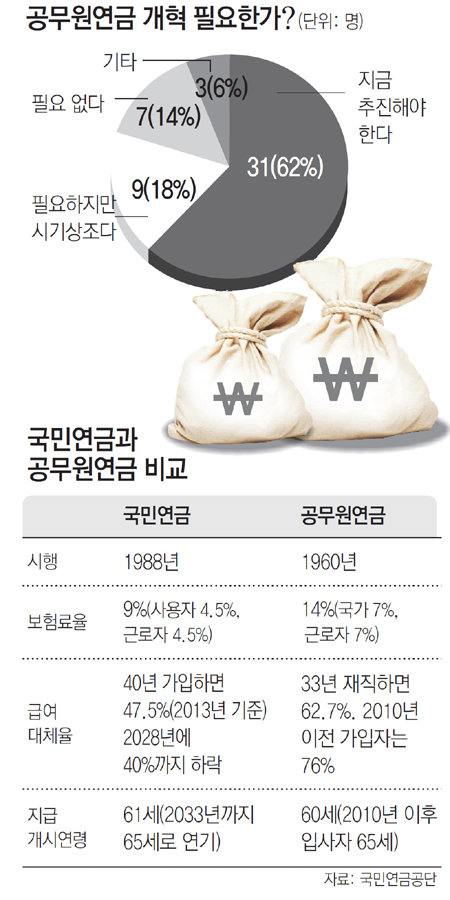
Whenever National Pension reform is discussed, one thing always comes up: public opinion that the special occupational pensions, such as the Government Employees Pension, the Private School Teachers Pension, and the Military Pension, must also be fixed.
The National Pension was changed twice, in 1998 and 2007, in a “pay more, receive less, receive later” manner, increasing the burden on contributors. For example, the ratio of pension receipts to average income over the contribution period (the income replacement rate) was cut from 60% to about 40% by 2028. Even that level is attainable only after a full 40 years of National Pension enrollment. The age at which pension payments begin will also be pushed back from 60 to 65 by 2033.
By contrast, under the Government Employees Pension, for a person who has served the maximum period (33 years), the benefit rate reaches up to 62.7%. This figure is the lowered one that resulted from the 2009 amendment of the Government Employees Pension Act. Those who became civil servants before 2010 are guaranteed the previous benefit rate (76.0%). This is a high level even considering that the Government Employees Pension contribution rate is 14%, higher than the National Pension contribution rate of 9%. Herein lies the reason the equity controversy never ends.
○ A majority of experts: “Occupational pension reform is needed”
Of the 50 welfare experts surveyed by the Dong-A Ilbo, 62% (31) agreed that occupational pension reform is needed right now. Only 18% (9) said it is needed but premature, and 14% (7) said no reform is needed.
Kim Soo-young, President of the Busan Welfare Development Institute, pointed out, “The fiscal instability of the occupational pensions is far more severe than that of the National Pension, and (their deficits) are filled with treasury subsidies,” adding, “It is hard to expect citizens to accept a situation in which only the National Pension is touched while the occupational pensions are left alone.”
There is also considerable criticism that the 2009 Government Employees Pension reform was ineffective. Although it lowered the benefit rate from 76.0% to 62.7%, this applies only to those who became civil servants from 2010 onward.
Yun Suk-myung, Director of the Pension Research Center at the Korea Institute for Health and Social Affairs, said, “Government Employees Pension reform must start by applying the same benefit rate to civil servants appointed before 2009 and those appointed from 2010 onward,”
adding, “Vested rights should be granted for the period up to 2009, but the revised benefit rate should be applied equally to new and old civil servants.”
The fact that part of the Government Employees Pension’s deficit is covered by taxes is also a source of discontent for citizens. The occupational pensions first ran a deficit in 1993, when expenditure exceeded revenue. During the 1997 foreign exchange crisis, retirements surged, and the fund, which stood at 6,201.5 billion won at the end of 1997, shrank to 1,775.2 billion won by the end of 2000. In 2008 the annual deficit exceeded 1 trillion won. Since 2001 the government has been paying “subsidies” to cover expenditure in excess of pension revenue.
○ Concerns about the side effects of reform
According to an analysis by the Korea Institute for Health and Social Affairs, next year the Government Employees Pension’s expenditure will exceed its revenue by more than 2 trillion won, and the deficit is projected to keep growing. As a result, the subsidies will also increase by an annual average of 17.8% in 2014–2020. This happens because revenue grows by an annual average of 3.3% while expenditure grows by an annual average of 7.8%.
But some voices also worry about the side effects of occupational pension reform. They argue that the efforts made to become civil servants, teachers, or soldiers and the toil of performing their duties must be compensated through pensions. There is also the view that cutting pension amounts would lower the productivity of state organizations and increase the likelihood of corruption.
Professor Kim Yeon-myeong of the Department of Social Welfare at Chung-Ang University said, “If civil servants and soldiers are not guaranteed security in old age, they may resort to all kinds of means, such as illicit accumulation of wealth, while in office,” adding, “The right approach is to guarantee them properly and in return keep them from doing wrong.”
There is also the opinion that Government Employees Pension reform will not be easy, because it is an explosive issue that could shake a government.
A professor at a regional university predicted, “Former President Park Chung-hee secured loyalty by introducing the Government Employees Pension, the Private School Teachers Pension, and the Military Pension,” adding, “If the Park Geun-hye administration reforms the occupational pensions, strong resistance from civil servants and soldiers is expected.”
Reporters Yoo Geun-hyeong and Lee Saem-mul [email protected]

![(KBS TV. 이슈&뉴스] 공무원 연금, '세금 먹는 하마'?...'사회적 합의' 절실 (2013년 10월 23일)](/_next/image?url=%2Fuploads%2Feditor%2F2026%2F11%2Fcfe4824d207e450c8cad3a7c73e2fb04-Screenshot_20261122_221550_Samsung-Browser.jpg&w=128&q=75)