
(Weekly Chosun) A Reform for the 86 Generation? The Generational-Conflict Time Bomb Hidden in the Democratic Party-Led Pension Plan (March 30, 2025)
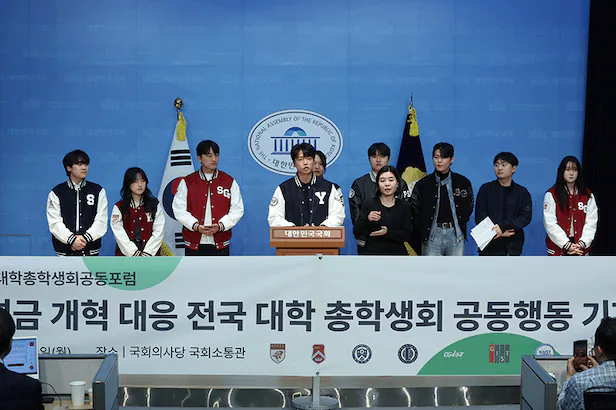
University students of the Korea University Student Council Joint Forum, including those of Seoul National University, Yonsei University, Korea University, Sogang University, and Hankuk University of Foreign Studies, speak at a press conference of the Nationwide University Student Councils’ Joint Action in Response to National Pension Reform, held on March 24 at the National Assembly Communication Hall in Yeouido, Seoul. Photo: Newsis
The National Pension parametric reform bill that passed the National Assembly on March 20 was led by the Democratic Party of Korea. Even so, within the Democratic Party, mainly among young members, there is talk that “it is only because it is the party line—honestly, it makes no sense.”
A Democratic Party aide in his twenties said, “What young people in their twenties and thirties feel about this National Pension amendment is close to rage,” adding, “It is like taking away fresh money and promising to give it back as old money.” He emphasized, “As of 2023 the total fertility rate is 0.72, yet the National Pension financial projection is based on the assumption that fertility will recover to around 1.2 in the long run. The actual depletion date could come much sooner,” and “Because a National Pension in which people pay less and receive more was an unsustainable structure from the start, it will become an even more ferocious generational conflict from here on.”
The first pension reform in 18 years merely delays the fund’s depletion by eight years, from 2056 to 2064. The contribution rate was raised from the current 9% to 13%, but the income replacement rate, which had been painstakingly lowered from 60% to 40% under the Roh Moo-hyun administration in 2007, was raised back to 43%. The income replacement rate, currently 41.5%, had been scheduled to fall in stages to 40% by 2028. The contribution rate required for a balance between contributions and benefits—that is, to pay a 40% income replacement rate without a deficit—is 19.8%, far from the 13% contribution rate set in this reform. And by raising the income replacement rate to 43%, that rate has become 21.2%.
“For people in their twenties, the pension is an extra tax”
Even though the amendment was agreed upon by the ruling and opposition parties, as many as 84 lawmakers voted against it or abstained in the plenary session. Lawmakers in their thirties and forties from both the ruling and opposition parties jointly voiced criticism of the pension reform bill. On March 23, eight lawmakers—Representatives Kim Jae-seop, Kim Yong-tae, and Woo Jae-jun of the People Power Party, Representatives Lee So-young, Jeon Yong-gi, and Jang Cheol-min of the Democratic Party of Korea, and Representatives Lee Ju-young and Cheon Ha-ram of the Reform Party—pointed out that “it raises the immediate insurance benefits and raises the contribution rate for later generations,” and that “the older generation gets to enjoy the enhanced benefits first, while the burden once again falls to future generations.” They urged that the Special Committee on Pension Reform be composed mainly of lawmakers in their thirties and forties.
Young people’s attention is focused on what happens after the fund is depleted. The worry “Will I at least get back what I paid in?” has bred distrust of the system. The Democratic Party argues that future generations, too, will be able to receive their pensions because the payment guarantee has been written into law, but any consideration of how they will be able to receive them is missing. Lee (22), a Democratic Party member, said, “They say the pension reform pushed back the fund depletion date, but it does not even reach my eligibility age,” adding, “Taking money we will never receive under the name of the National Pension is no different from levying an extra tax on people in their twenties alone.”
The Korea University Student Council Joint Forum, made up of the student councils of nine universities including Korea University, Sogang University, and Yonsei University, held a press conference at the National Assembly on March 24 and pointed out that the system “has been overhauled into a structure that places a greater burden on the younger generation in their twenties and thirties and concentrates benefits on the older generation,”
and that “in a situation where the younger generation’s distrust of the pension is already great, it has deepened that distrust and further deepened the imbalance between generations.”
Pension Reform Youth Action, a coalition of youth groups including the Righteous Youth Alliance, Free Citizen Education, and the Korea Youth Legislative Research Association, urged Acting President Han Duck-soo to exercise his right to request reconsideration (veto), arguing that the National Pension amendment “only delays the fund’s depletion and is no different from before in that it proposes to exploit future generations and divide up the pension among ourselves.”
An opinion poll revealing a generational difference in attitudes toward this pension reform has also come out. According to a survey that Straight News commissioned from the polling firm Jowon C&I of 2,012 adults aged 18 or older nationwide on March 22–24, only 30% of respondents in their thirties or younger approved of the pension reform bill passed by the National Assembly. Among those in their thirties or younger, opposition exceeded half. Among those aged 18–29, only 29.1% approved and 52.9% disapproved. Among those in their thirties, too, 32.7% approved and 56.9% disapproved. This differs greatly from all respondents, among whom 50.0% approved and 35.9% disapproved. (For details, see the website of the National Election Survey Deliberation Commission.)
Until now, pension reform discussions have been a tug-of-war between “sustainability” and “old-age income security.” In other words, it was an agenda on which positions split along conservative and progressive lines.
The conservative camp stressed the fund’s sustainability and maintained that structural reform was needed.
The progressive camp argued that the current income replacement rate does not properly guarantee old-age income.
This was also why pension reform ultimately broke down at the end of the 21st National Assembly. But now that the bill has passed the National Assembly by agreement between the ruling and opposition parties, the “generational conflict” surrounding the pension has surfaced.
Kim Woo-chang, Professor of Industrial and Systems Engineering at KAIST, who served on the private advisory committee of the National Assembly’s Special Committee on Pension Reform, said, “Because the power over pension reform lies with the older generation, it is only natural that if it does not act now, it will be resented by the next generation,” adding, “Because the generations after the fund is depleted will have to pay a contribution rate of over 30%, they will inevitably resent even more today’s young people, who will be the elderly of the future.” This means that generational conflict over the pension system will intensify further from now on and will repeat itself from generation to generation.
A reform for the 86 generation, not the young?
According to the Fifth National Pension Financial Projection of 2023, even if the contribution rate were raised to 12% and the income replacement rate lowered to 30%, the fund would be depleted in 2070, and the pay-as-you-go contribution rate at that point is estimated at 26.5%. The pay-as-you-go contribution rate is the contribution rate that would apply if the amount needed to pay benefits to that year’s pension beneficiaries were covered by collecting contributions from that year’s contributors. Under this parametric reform, those born in 1999, who will reach eligibility age just as the reserve is depleted, can be guaranteed a 43% income replacement rate only by “exploiting” the younger generation of their day. For today’s young people to receive a pension in the future, a “generational war” is unavoidable.
Yun Suk-myung, Research Fellow Emeritus at the Korea Institute for Health and Social Affairs, who leads the Pension Future Forum, said that the winners and losers of this pension overhaul are clearly divided.
“2064, the extended fund depletion date, marks a period during which those aged 50 and over can receive their pensions with peace of mind until they die.
Under the previous pension system, the pay-as-you-go contribution rate as of 2078 was 35%, but this overhaul has raised it to 38%.
The burden on later generations after the fund is depleted becomes even greater.
Rather than easing the burden on the young, this amendment has degenerated into a measure aimed at entrenching the pension vested interests of the 86 generation.
Canada pays a contribution rate of 11.9% for an income replacement rate of 33%. Norway has a contribution rate of 18.1% and an income replacement rate of 42%. They pay more and receive less than we do.”
A Democratic Party official pointed out, “The generational conflict that pension reform has exposed is not simply a conflict between the elderly generation and the younger generation, but a conflict between the 86 generation, which holds vested interests, and the next generation,” adding, “Because Korea is aging so fast, generational conflict is bound to become enormous in other fields beyond pensions as well.” The official said, “Only a method in which the older generation shared at least some of the burden could have persuaded young people even a little, but the reform was pushed through far too irresponsibly,” and “We must not only adjust the National Pension’s numbers but also touch the ‘selective welfare’ of the Basic Pension, which the Democratic Party is reluctant to talk about.”
Politicians’ eyes are on the pension
After pension reform broke down in the 21st National Assembly, the government presented a single plan last September, but pension reform discussions in the political arena dragged on. Instead, the pension reform bill passed amid the turmoil of waiting for the outcome of President Yoon Suk-yeol’s impeachment trial. A People Power Party leadership official said, “This National Pension amendment already contains provisions whose greatest benefits go to the support base of Democratic Party leader Lee Jae-myung,” adding, “Forming a special committee and reflecting structural reform requires a decision by the Democratic Party, and I doubt whether it has the will.”
On March 25, the National Assembly formed a Special Committee on Pension Reform of 13 lawmakers from the ruling and opposition parties. The People Power Party said it had assigned three of its five committee seats to lawmakers in their thirties. These included all three—Representatives Kim Jae-seop, Kim Yong-tae, and Woo Jae-jun—who had earlier held the press conference criticizing the National Pension amendment. In the Democratic Party, by contrast, Representative Mo Kyoung-jong was the only lawmaker in his thirties to join the committee. None of the Democratic Party lawmakers who had held the press conference criticizing the pension reform were included; instead, Representatives Kang Sun-woo and Kim Nam-hee, who are in their forties, joined. This is why there are concerns about whether the voice of the younger generation will be properly reflected in pension reform discussions.
Jang Woo-young, Professor of Political Science and Diplomacy at Daegu Catholic University, pointed out, “Pension reform is an issue that spans many axes, including generational conflict, so it needs fine-tuning, but ahead of an early presidential election it was in some respects used like a spoil of war,” adding, “This is because, in a chaotic phase, people’s attention is drawn elsewhere, so the details do not come to light.” On why the People Power Party agreed to a National Pension amendment that raises the income replacement rate, he said, “It was a political reaction aimed at not losing the initiative on a key agenda to the Democratic Party, not an agonized decision.”
As criticism mounted among young people, potential presidential contenders from the ruling camp also weighed in on the pension issue. Han Dong-hun, former leader of the People Power Party, wrote on his social media (SNS), “They raised ‘the money you pay in’ slowly over eight years, but ‘the money you receive’ immediately. The 86 generation, which will receive more pension right away, gets the honey, while the younger generation, which will receive a pension only after paying the increased amount for decades, is left holding the bag,” and argued that the pension reform should be discussed anew after a veto was exercised. Representative Ahn Cheol-soo and former Representative Yoo Seung-min also stated that a veto should be exercised.
According to an official in former leader Han’s camp, the outline of pension reform that Han has in mind consists of two main elements: generationally differentiated increases in the contribution rate and the introduction of an “automatic adjustment mechanism,” a minimal structural reform. These were also included in the single plan the government announced last September. The Ministry of Health and Welfare proposed raising the contribution rate to 13% at differentiated paces by generation, over four years for those in their fifties and over 16 years for those in their twenties. Under this approach, the rate would rise each year by 1 percentage point for those in their fifties, 0.5 percentage points for those in their forties, 0.33 percentage points for those in their thirties, and 0.25 percentage points for those in their twenties. The automatic adjustment mechanism, which adjusts pension increases by linking benefit amounts to life expectancy or to changes in the number of contributors, is reportedly in operation in 24 of the 38 member countries of the Organisation for Economic Co-operation and Development (OECD).
Within the People Power Party, however, some point out that it will be difficult to officially demand a veto of a plan the party leadership itself agreed to.
Representative Park Su-young of the People Power Party, who had chaired the ruling party’s Special Committee on Pension Reform and resigned in protest against this amendment, said, “The best course is to give the National Assembly’s Special Committee on Pension Reform full authority and allow structural reform to be discussed before January 1 next year, when the amendment takes effect,” adding, “Whether the income replacement rate is kept at 40% or raised to 43%, an automatic adjustment mechanism must be introduced, the income replacement rate should also be raised in stages like the contribution rate, and the government’s obligation to guarantee payment should be deleted.”
https://www.chosun.com/politics/2025/03/30/BSITW4L7DZBM7LLDBS4PLIIHRY/

