(Chosun Ilbo) Issue at Stake: Perspectives on the Saenuri Party’s Government Employees Pension Amendment Bill (November 26, 2014)
Posted November 26, 2014, 5:19 a.m.
In Favor: Political considerations must be set aside; the focus should be on sustainability.
The gap with the National Pension is too wide, and benefit payments are far too generous relative to contributions made.
Even if the ruling party’s bill passes, 13 trillion won in tax revenue must be injected annually for 65 years.
An automatic adjustment mechanism suited to an aging, low-growth society should be introduced.
Yun Suk-myung, Research Fellow, Korea Institute for Health and Social Affairs; Ph.D. in Public Finance, Texas A&M University
Assessments of the Saenuri Party’s amendment bill for the Government Employees Pension are divided. Within the civil service there is strong discontent that the bill seeks to pin on civil servants the blame for a fiscal instability that arose because the state did not play its proper role. On the other hand, many also point out that a low-intensity reform would leave the pension system with little sustainability, and that large differences in how the system applies depending on when civil servants were appointed would make conflict between new and old civil servants inevitable. With such opposing claims coexisting, the shortcut to solving the problem is to communicate the relevant facts accurately.
When the Government Employees Pension was introduced in 1960, its average benefit rate (the ratio of the pension to pre-retirement income) was 40% on average, and the pension could be received from age 60. Thereafter it expanded steadily until 1991, when the retirement allowance was introduced. The benefit rate rose by as much as 90%, to 76%. The survivors’ pension paid to spouses also rose by as much as 75%. The pensionable age was lowered so that, with 20 years of membership, a pension could be received from one’s 40s.
While we were going in reverse, Sweden, a leading welfare state, began discussing pension reform in 1985, judging that the existing pension system would be difficult to maintain in a new environment of population aging and low growth. After much turmoil, from 1999 (2003 for civil servants) it switched to a system in which pensions are received in proportion to what one has paid. Austria, Japan, Germany, and Norway also introduced automatic adjustment mechanisms to secure sustainability.
What about us? The National Pension, which started later than the Government Employees Pension, cut its benefit rate by as much as 43%, painful as that was. It was a preemptive response, taken before anyone had even received a pension. Even so, at the time of the 2007 reform this National Pension was criticized as a “half-baked reform,” because contributions could not be raised. Yet now that Government Employees Pension reform is on the table, there are calls to raise the National Pension’s benefit rate and “level toward the middle,” on the grounds that the National Pension was cut too much—even though last year’s National Pension financial projection forecast that contributions would have to rise from 9% to 16% for its finances to stabilize.
Foreign cases prove that the outlook for our National Pension was not wrong. In Germany, where, as in Korea, the benefit rate will fall to 40% by 2030, contributions are already around 19% of income. The contribution level the German government is targeting for 2030 is 23% of income.
The Government Employees Pension’s benefit rate was cut to 62.7% of income by the 2009 reform. For an accurate comparison, one point must be made clear. Because the Government Employees Pension matures at 33 years, applying the same membership basis as the National Pension (40 years) turns the pre-2009 benefit rate of 76% (33 years) into 92% (40 years), and the post-2009 rate of 62.7% (33 years) rises to 76% (40 years). After the reform, the gap in benefit rates between the Government Employees Pension and the National Pension actually widened—even though the Government Employees Pension’s finances are far more unstable.
There is another problem. Unlike the National Pension, which applies the same system to everyone after the point of reform without discriminating between older and newer generations, the Government Employees Pension applied its most painful reform measures only to new appointees. The effect of the reform was bound to be markedly reduced. This is also why the deficit grew sharply within less than five years of the reform.
The claim that the fiscal instability of the Government Employees Pension was caused by the state’s failure to play its role is also exaggerated. The Government Employees Pension Fund diverted by the government is estimated at about 17 trillion won in present value. Of this, more than 10 trillion won has already been made up through deficit subsidies. After 2020, the annual deficit alone will exceed 7 trillion won. In two to three years, the subsidies will more than make up for the fund the government is said to have diverted.
The claim that the state’s burden is small compared with other countries also stems from a misunderstanding. Those countries carry a heavy government burden because their ratio of pension beneficiaries to civil servants is two to three times higher than ours. Their government burden is also larger in part because they pay down accrued liabilities in advance so as not to shift the burden onto later generations. If, like these countries, we paid down in advance the Government Employees Pension’s accrued liability of 484 trillion won (515 trillion won including the retirement allowance), our state burden would be by no means small.
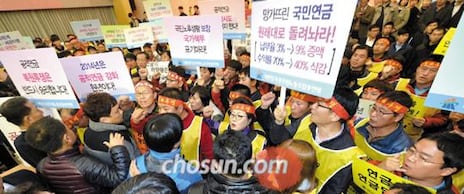
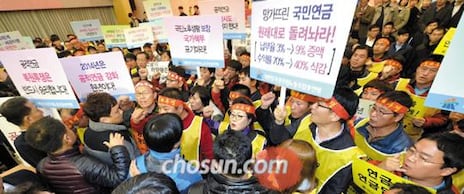
At the Government Employees Pension Reform National Forum held at the Government Complex Daejeon on the 13th, members of civil servants’ unions block the entrance and confront forum participants.
The claim that civil servants pay high Government Employees Pension contributions is also inflated. It is only recently that civil servants have come to bear more for the Government Employees Pension than is borne for the National Pension. Until 2009, contributions were based on “monthly remuneration” (about 65% of “taxable income,” the National Pension’s basis), so even though the contribution rate was high, the contributions actually paid were not. The 8.5% contribution on a “monthly remuneration” basis paid until 2009 equals 5.525% on the National Pension basis—only 1.025 percentage points higher than the National Pension (4.5%). For one year, in 1998, National Pension contributions were in fact slightly higher.
Government Employees Pension contributions rose in earnest only from 2010 onward. The sense of paying heavy contributions arises because the reference income on which contributions are calculated rose sharply. With the income used to calculate contributions up 54% and the contribution rate raised to 7% in 2012, the absolute amount of contributions increased substantially. The important point, however, is that pension amounts rise as much as the reference income does. This is why the number of high-amount pensioners will increase rapidly in the future.
For civil servants who retired before 2000, especially those with 20 years of service, the benefit-to-contribution ratio (the ratio of pension received to money paid in) exceeds six at a minimum. Even for those appointed in 2006, the ratio exceeds three. Can such a Government Employees Pension be sustained? The size of the pension received is also a problem. Although Korea’s national income is about two-thirds of Japan’s, from 2020 Korean civil servants are projected to receive over 1 million won more per month on average than under Japan’s pension for government employees.
Viewed objectively, one cannot but agree that the Government Employees Pension is unsustainable. Even if the Saenuri Party’s amendment passes, a deficit subsidy averaging 13.4 trillion won a year will have to be injected from taxes over the next 65 years. Given that the budget for the National Basic Living Security System for low-income households is in the 8 trillion won range annually, it is hard to deny that the deficit subsidy is excessive.
The Government Employees Pension must be reformed under the principles of equity between the general public and civil servants and between older and newer generations of civil servants, and of minimizing the burden shifted onto future generations. That is why political considerations should be minimized and reform discussions that take sustainability into account should be expedited. The lesson to draw from foreign reform cases is, in all likelihood, the spirit behind introducing an automatic adjustment mechanism that shuts out political considerations.
Against: Civil servant anxiety is being maximized while fiscal improvement remains inadequate.
Civil servants resent being branded an “immoral and self-serving group.”
The ruling party’s bill shifts the burden of resolution onto current and future civil servants.
It is not feasible to make the Government Employees Pension and the National Pension identical overnight.

Jeong Chang-ryul, Professor of Social Welfare, Dankook University; Ph.D. in Social Policy, University of Sheffield, UK
People hold diverse views on the recent active discussion of Government Employees Pension reform. From the general public’s perspective, Government Employees Pension reform is a measure to normalize the abnormal, whereas civil servants, though highly dissatisfied, worry about public censure that would brand them as selfish if they openly opposed it. Lower-ranking civil servants, whose salaries are low and whose pensions are therefore also small, resent being lumped together with those who receive large pensions. In particular, they consider it unreasonable that the Government Employees Pension is compared on the same basis as the National Pension, even though it has the character of comprehensive insurance that also covers severance pay and compensation for work-related injuries.
In fact, from civil servants’ standpoint, there is some cause for feeling wronged by the recent reality in which the Government Employees Pension is under attack. Even when they are pushed out by their juniors and retire in their early 50s, they face restrictions on changing jobs under the label of “gwanpia” (bureaucratic mafia). They also resent being pressured through a public-opinion campaign that treats civil servants as an immoral and self-serving group, as though the Government Employees Pension were a great privilege. What also angers civil servants is that past governments spent tens of trillions of won from the Government Employees Pension Fund at low interest rates as they pleased, and are now saying that, because the fund has been depleted, the Government Employees Pension cannot be paid as promised in the past.
Nevertheless, the Government Employees Pension has come to be criticized as a privileged system because of some unreasonable provisions. Most decisive is that its finances have reached a point at which the government can no longer stand by and watch. Last year, too, the roughly 2 trillion won that was short for paying the Government Employees Pension to 360,000 retirees and survivors was covered with citizens’ taxes under the name of government subsidies. By 2020 that amount is expected to reach 6 trillion won a year. The reason the civil servants’ unions, which used to react with strong rejection at the mere mention of Government Employees Pension reform, now agree, albeit passively, that some degree of reform is necessary is that they cannot ignore this serious fiscal problem.
A rational plan for Government Employees Pension reform should minimize the anxiety that pension reform causes civil servants while maximizing the fiscal savings that are the goal of reform. Yet the plan the ruling party has put forward is irrational in many respects. The point is not opposition to Government Employees Pension reform itself, but that the problems arising from the irrationality of the ruling party’s plan are too great.
The most fundamental reason the ruling party’s plan is criticized is that it is lukewarm about addressing the causes of the Government Employees Pension’s problems. Because the National Pension’s fiscal problem lies in the future, the key there may be what to do from here on. But the Government Employees Pension’s fiscal problem has already materialized, and its cause is that current pension recipients receive far more in pensions than they paid in. The core of reform should therefore be an adjustment for current pension recipients. Yet the ruling party’s plan seeks to shift the solution onto current or future civil servants without taking bold measures for them.
The ruling party’s plan would deduct about 2–4% from the pensions recipients receive and apply it as a fiscal stabilization contribution, but this amounts to no more than a face-saving gesture. Some experts have already proposed plans that would draw pension recipients into actively joining the reform, minimizing contribution increases for current civil servants while taking deficit improvement and equity into account, yet the ruling party’s plan is preoccupied with shifting the burden onto certain strata of incumbent civil servants.
Another problem is equity within the civil service. For incumbent civil servants, the contribution rate is to be raised substantially, to 10% of income, to solve the fiscal problem. For new civil servants, by contrast, the plan is to lower the contribution rate to 4.5% of income, the National Pension level, while cutting the benefit level by almost 60% or more and offsetting part of the cut by introducing a severance pay system like that of private companies. But almost no country has introduced a scheme that, within the same occupational pension, sets contribution levels more than twice apart in this way and also splits benefits into two tiers. The ruling party says this stems from its plan to align the Government Employees Pension with the National Pension, but if far lower contributions than now are collected from new civil servants, revenue will fall, the fiscal savings will all but disappear, and only the irrationality within the system will increase.
Making the Government Employees Pension identical to the National Pension can be discussed from a long-term perspective, but it cannot be done in one stroke while the gap between the two remains as wide as it is now. The ruling party seems to think that a single reform can solve all the problems of the Government Employees Pension, but this, too, can only be seen as a misdiagnosis of the problem.
It is also a problem that the plan raises the Government Employees Pension eligibility age to 65 while offering no alternative on extending the retirement age. In advanced countries, raising the pension eligibility age is synonymous with extending the retirement age. Yet the ruling party’s plan, which tells civil servants to fall in line because most ordinary citizens, too, retire before reaching the National Pension eligibility age, is something civil servants cannot accept. It would be reasonable to adjust the retirement age together with the age at which the pension is drawn, while devising a way to adjust the changes in pension amounts that arise from extending the retirement age. Telling civil servants to retire at 60 and start drawing a pension at 65 only maximizes their anxiety.
The government and the ruling party appear set on pushing Government Employees Pension reform through by means of a public-opinion campaign. Because the ruling party’s plan says that “future civil servants will be aligned with the National Pension,” the public may receive it as a reform policy that removes the civil servants’ privilege known as the Government Employees Pension. But the ruling party’s plan reveals its limits: it tries to align mechanically with the National Pension without considering where Korea’s old-age income security system should go, and while stressing fiscal stabilization, its actual fiscal savings are quite weak.
The fact that the government and the ruling party have judged that “the Government Employees Pension is a fiscally unsustainable system and reform is indispensable” does not justify every improvement measure the ruling party has put forward. The government and the ruling party should not cling to their existing plan but should present a revised plan that is rational while also maximizing fiscal savings.
https://www.chosun.com/site/data/html_dir/2014/11/25/2014112503988.html