(Maeil Shinmun) Yun Suk-myung: “If President Yoon Handles National Pension Reform This Way, He Will Be a Successful President” [News Cabinet] (August 28, 2024)
President Yoon to Give a National Briefing on the 29th — National Pension Reform Plan to Be Unveiled
Contribution Rates Raised at Different Speeds by Generation — “Splitting Between Generations Is the Wrong Approach”
“Backlash from People in Their 50s? Theirs Is a Generation That, Without Precedent Anywhere in the World, Receives More Than It Paid In”
Introducing an Automatic Adjustment Mechanism — “You Cannot Get Everything at the First Spoonful, but the Direction Must Be Set Right”
“Extend the Mandatory Contribution Age by Five Years — Working to 70 Raises the Income Replacement Rate by 26%”
Expanding the Military Service Credit Is Positive — “All 20 Months of Service Should Be Recognized”
Expanding the Childbirth Credit Amid Low Fertility? — “Unlikely to Encourage Births”
“Roh Carried Out Pension Reform When His Approval Rating Was at Rock Bottom — If Yoon Succeeds at Reform, His Rating Could Rise”
“Even If People in Their 40s and 50s Temporarily Pay Higher Contributions, They Still Get Far More Benefits Than Those in Their 10s and 20s”
“Cumulative Deficits Must Change and the Unfunded Liability Must Shrink for It to Be Reform — The 21st National Assembly’s Plan Increased Them”
“Other Countries Already Carried Out Painfully Tough Pension Reforms 20 Years Ago”
“The Redistributive National Pension Must Be Reformed into a 100% Earnings-Related Pension”
Yun Suk-myung, Research Fellow Emeritus at the Korea Institute for Health and Social Affairs and former President of the Korean Pension Association. Maeil Shinmun YouTube, “Lee Dong-jae’s News Cabinet”
- Broadcast: Maeil Shinmun YouTube 〈Lee Dong-jae’s News Cabinet〉 (weekdays 18:30–19:30)
- Host: Lee Dong-jae, Guest Editorial Board Member, Maeil Shinmun
- Guest: Yun Suk-myung, Research Fellow Emeritus at the Korea Institute for Health and Social Affairs and former President of the Korean Pension Association
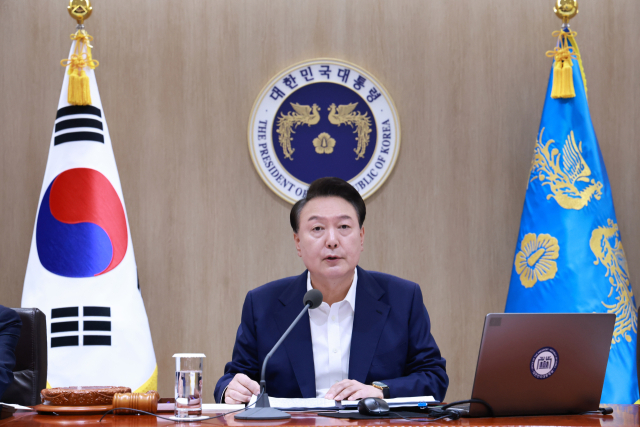
President Yoon Suk-yeol speaks at a Cabinet meeting held at the presidential office building in Yongsan, Seoul, on the 27th. Yonhap News
▷Lee Dong-jae, Guest Editorial Board Member (hereafter Lee Dong-jae): We now begin Part 2 of News Cabinet. President Yoon Suk-yeol is expected to announce a pension reform plan, including the National Pension, sometime this week. Many have pointed out that, if things stay as they are, fund depletion in 30 years is in fact unavoidable, and that it will place a heavy burden on future generations. Future generations faced a situation in which they would pay more than half of their monthly salaries to the state as contributions and yet would not receive anything themselves. So we have invited Yun Suk-myung, Research Fellow Emeritus at the Korea Institute for Health and Social Affairs, a leading expert on the National Pension and a former President of the Korean Pension Association, to talk about this. Welcome, Committee Member Yun.
▶Yun Suk-myung, Research Fellow Emeritus at the Korea Institute for Health and Social Affairs (hereafter Yun Suk-myung): Yes. Hello.
▷Lee Dong-jae: Hello. Last May, at the very end of the 21st National Assembly, you came on our program to speak about parametric reform of the National Pension, and after some time we have invited you back once again to discuss a pension-related topic.
▶Yun Suk-myung: Thank you. Last May, the plan being discussed in the National Assembly was essentially a deterioration packaged as a reform, and tremendous pressure was brought to bear to have it accepted—the media and experts came out in force. The opposition leader and even the former Speaker of the National Assembly stepped in, urging that it be accepted, and it was even attached as a condition for a leaders’ summit—all over this single pension issue. At the time, our Pension Future Forum, though very much alone, kept saying that the bill really must not be allowed to pass. In that situation, Maeil Shinmun invited me on, and I was deeply grateful. Yongsan was holding out all alone back then, and because Maeil Shinmun gave me that platform, I was able to convey what I wanted to say—so, belatedly, I thank you once again.
▷Lee Dong-jae: Oh, the thanks are ours. When you say Yongsan held out alone, you mean President Yoon held out alone, correct?
▶Yun Suk-myung: Yes, exactly. At the time I even went so far as to say, “If Yongsan accepts this bill, it becomes a historical accomplice.” And because the President did not become that accomplice, I wrote in a column—something I had not done in a very long while—that “President Yoon Suk-yeol has done a great thing,” and I made clear in the column that this was no flattery aimed at landing myself some position. Certain reform directions are now emerging as expected, and those will have to be evaluated on their merits, but the fact that we turned 180 degrees in just those few short months—if that is formally announced as such, I think, historically, it could become quite a news story internationally as well.
Yun Suk-myung, Research Fellow Emeritus at the Korea Institute for Health and Social Affairs and former President of the Korean Pension Association. Maeil Shinmun YouTube, “Lee Dong-jae’s News Cabinet”
▷Lee Dong-jae: Then the next thing we want to ask about: among the reform measures the presidential office is expected to put forward, one has drawn attention. It is said that the speed of contribution rate increases will differ by generation. In other words, the idea is ultimately to lower the contribution burden on future generations. How do you see this?
▶Yun Suk-myung: Let me talk about people who are 55 now. Suppose someone aged 55 entered the labor market late—say they joined the National Pension at 30. Women usually enter the labor market from about 25, but if this person entered the labor market and joined the National Pension at 30, they will have been enrolled in the National Pension for 25 years by now. If they have been enrolled for 25 years, that means they joined in 1999. The contribution rate then was 9%. But from 1999 to 2007, as I said a moment ago, the income replacement rate was 60%. In 2008 it was 50%, in 2009 49.5%, and this year it is 40%. The first and only year in which this person, just before retiring, gets an income replacement rate of 40% applied is this one. And even if the income replacement rate is kept at 40%—as I cried out loudly last time, in May as well—to keep the 40% income replacement rate without shifting debt onto later generations, contributions of 19.8% would have to be collected right now. Twenty percent would have to be collected. I do not know what contribution level President Yoon Suk-yeol has in mind for the announcement—I would like it raised to 15%, but whether 15% will come up or not, I do not know. The National Assembly had agreed on about 13%, so if it is 13%, then, for example, since the contribution rate is 9% now, that means raising it by 4 percentage points to 13%, does it not? Some say it will be raised by 4 percentage points at once, others that it will be raised by 1 percentage point a year over four years. Even if it is raised to 13% at a stroke over four years, these are people who, back when the 60% income replacement rate applied, paid only 9% when they should have been paying close to 30%. And now they get 40% applied for exactly one year—a very low rate, yet even for that they should be paying 19.8%, so if they pay 13%, what does that mean? They are paying nearly 7 percentage points less.
▶Yun Suk-myung: Is that really so unfair? The younger generation, on the other hand, I said would have to pay 8% to bear a 40% income replacement rate without shifting debt onto later generations. If they themselves do not bear it, then in the end taxes or something else has to go in. And those taxes, too, will all be borne by the economically active population of that time, will they not? So, the younger generation also pays low contributions—the plan is only to raise theirs more slowly. For example, if the rate is raised by 4 percentage points—I do not know what plan will be announced—and one side gets it raised immediately over four years, then this side might have it raised over eight years or somewhat more slowly. In the end, the same contribution increase happens. So if you compare these two groups, how is this splitting between generations?
▶Yun Suk-myung: Also, people in late middle age, in their 50s and older, ask why we are trying to adopt a system with no precedent anywhere in the world—but theirs is a generation that, almost without precedent anywhere in the world, receives far more than it paid in. If the government explains that well and the President explains it well, I do not think they will have much ground to oppose it. Even so, they receive many times more benefits than the younger generation. At the very least they should say: “We are sorry to receive this. Somehow we ended up running the pension system into a mess, and we think this much is a small consideration we can show the younger generation—so could you not bear with us at this level?” Saying something like that—“We are sorry that this is all we could do”—that is how they should approach it. This approach of saying “it only splits the generations, so why discriminate against us?”—I think that is a badly mistaken approach.
Yun Suk-myung, Research Fellow Emeritus at the Korea Institute for Health and Social Affairs and former President of the Korean Pension Association. Maeil Shinmun YouTube, “Lee Dong-jae’s News Cabinet”
▷Lee Dong-jae: The contribution rate—that is, the money paid in. When contributions are raised, slowing the speed of increase for young people to lower the burden on future generations, or introducing an automatic adjustment mechanism to delay the point of fund depletion—it seems those will be included. You mentioned the term automatic adjustment mechanism a moment ago. Please explain a bit about the automatic adjustment mechanism. And please keep your answer short.
▶Yun Suk-myung: I first proposed introducing it 25 years ago. I made a similar argument at the time of the 4th financial projection in 2018 and the 5th financial projection in 2023. Our pension system now is like this, is it not? It promises to pay a certain amount regardless of how much you pay in, does it not? What Sweden’s 1996 automatic adjustment mechanism is, is a system that pays out as much as you paid in. People may ask why the state should run a system that pays out as much as you paid in—what paying out as much as you paid in means is that, on top of the principal you paid, it actually adds the economic growth rate. Without taking a single fee, unlike financial institutions. What the automatic adjustment mechanism is about is this: in Korea, without precedent anywhere in the world, the birth rate is falling and life expectancy is rising, is it not? The economy is also heading toward low growth. So because the system promises to pay regardless of what you paid in, everyone opposes even raising the contribution rate, do they not?
▶Yun Suk-myung: And so, the side with the larger population, the side holding power, keeps trying to make the pension system favorable to itself and to politicize it, does it not? The automatic adjustment mechanism is basically about depoliticizing it, not leaving it to politicians’ judgment— when the fertility rate falls and life expectancy rises, that would have a negative effect on pension finances, would it not? And when the economic growth rate falls—calculating those three factors every year and automatically reflecting them in the pension finances so that the system becomes sustainable is what we call an automatic adjustment mechanism.
▷Lee Dong-jae: Then if such figures are reflected like that—a pension also has the aspect of predictability—would that not create a problem in terms of predictability?
▶Yun Suk-myung: That is being criticized a lot right now. The side that used to stress so strongly that the income replacement rate must be raised is suddenly coming out and confessing that, because the gap between the contributions paid and the income replacement rate in Korea is so large, introducing an automatic adjustment mechanism would make the income replacement rate fall far too much, so it must not be done. Then why did they want to raise it before? But here, too, it is hard to get everything at the first spoonful this time, is it not? As I see it—I have been advocating an automatic adjustment mechanism since 2025, but I think it is very meaningful just to set the direction of the automatic adjustment mechanism right. Ours is a DB (defined benefit) system, whereas Sweden’s is a DC (defined contribution) system—a system that pays out as much as you paid in. What we have consistently argued, ever since we put forward fiscal stabilization measures in 2018, is that since you cannot get everything at the first spoonful, let us go through one or two stages. So, as Finland does, a DB system—what we pay out is fixed now, is it not? Keep that system, but if we are here and Sweden is there, let us first go about halfway between. That is, keeping the DB, defined benefit, system, what I propose—I mentioned life expectancy a moment ago, did I not? What Finland does is this: when life expectancy rises—say the National Pension would pay Hong Gil-dong 500 million won in total from the start of benefits until his death. It pays the same 500 million won, but Hong Gil-dong has been paying contributions since his 30s, and when he reaches 65 and begins receiving his pension, it is determined that he will live five years longer. If he lives five years longer, that is 60 months, since a year has 12 months, is it not? The pension has to be paid for 60 more months. Even if the system was balanced, that much fiscal instability arises, does it not? So what Finland does is deduct, from the monthly payment out of the 500 million won, as much as the 80 months’ worth being paid out. Then the total is the same, but the money received each month goes down, does it not?
▶Yun Suk-myung: Then on predictability, which you raised: what Finland does is reform the labor market. Life expectancy does not rise by two or three years in a single year; it rises little by little, like 0.3 a year, right? So by cohort, they already have people work that much longer and contribute to the pension longer, so that pensions do not fall.
▷Lee Dong-jae: So in the end, there is the part about having to work longer.
▶Yun Suk-myung: We live in an age of 100-year lives, and what the side that wants to raise our income replacement rate further is saying is that even in the age of 100-year lives, 50 years from now we will be enrolled in the National Pension for only 26 years. Being enrolled in the National Pension for 26 years means that, in an age of 100-year lives, the state officially recognizes 26 years of economic activity. Then you live to 100 and must spend 74 years dependent on someone else for support. That is not a pension system—that makes it hard for this country to survive, does it not? So we should work a bit longer, and in the future—we used to hold 60th-birthday celebrations, but now people would look at you strangely for holding one, would they not? So other countries already—when I went to Norway in 2012, Norway had already opened up its pension system so that those who wish can pay contributions until 75. Japan, too, is now pushing to have people work until 70.
▶Yun Suk-myung: So this may seem far off now, but 20 to 30 years from now, if we create employment-friendly environments in which older workers, too, can work in offices, I think people will be able to work until 70. Only those whose health allows it, not everyone compulsorily. Then, the income replacement rate—the one in the OECD report. That is, our mandatory contribution age is 59, and a 2022 OECD report says that extending it by five years to 64 would increase the income replacement rate of the pensions we will receive by 13%. So in the short term we extend it by five years, and if, through labor market reform, 20 to 30 years from now we work until 70, that is a 10-year extension, is it not? Then the income replacement rate increases by 26%. Every other country is already doing this. If we do this, then next, the automatic adjustment mechanism—many people, even experts, do not understand it and all ask whether it will make the income replacement rate drop a lot, but the plan I proposed is nothing like that either. First, contributions—since I proposed it last year, I proposed raising them over ten years to 15% by 2033, that is, by about 6 percentage points, 0.6 percentage points every year.
▶Yun Suk-myung: First, raise contributions for about ten years—raising them faster would be even better. And in 2033 our pension eligibility age becomes 65. Then, rather than introducing it immediately from that point, over the 20 to 30 years from then—I mentioned it, did I not? Introduce a concept like a life expectancy coefficient linked to life expectancy, with an effect equivalent to raising contributions by about 2 percentage points; then there is no obstacle at all to receiving pensions, and predictability is 100%.
▶Yun Suk-myung: And other countries have already done far more than that—70% of OECD member countries have introduced far tougher automatic adjustment mechanisms. Since going that way at the outset would be too painful for us, we take an intermediate step toward an automatic adjustment mechanism: as I said, raise contributions first and then, from ten years later, introduce the automatic adjustment mechanism gradually and partially—then we can make a soft landing without any problem at all. From that standpoint, I see almost no problem, and on this I hope President Yoon Suk-yeol will have confidence and announce a plan that is firmly faithful to the basic principles of the automatic adjustment mechanism.
Yun Suk-myung, Research Fellow Emeritus at the Korea Institute for Health and Social Affairs and former President of the Korean Pension Association. Maeil Shinmun YouTube, “Lee Dong-jae’s News Cabinet”
▷Kim Sae-bom: Some civic groups are criticizing the application of different contribution rates between generations. They criticize it on the grounds that it was not discussed even in the National Pension Financial Estimation Committee. What do you think about this?
▶Yun Suk-myung: If they say it was not discussed in the Financial Estimation Committee—the plan that a majority of experts on the Financial Estimation Committee supported, raising contributions to 15% and introducing the automatic adjustment mechanism I mentioned a moment ago, was backed by two-thirds of the experts. The Public Deliberation Committee did not even put that plan on the table. Is that not where things went wrong in the first place? Not even putting forward the plan that most experts on the Financial Estimation Committee and on the advisory committee of the National Assembly special committee approved and supported, and now saying “it was not even discussed in the Financial Estimation Committee, so let us not talk about it”—is that not putting the cart before the horse? So on that point—I would not call it utter nonsense, but I wish they would be honest and say things that are consistent.
▷Lee Dong-jae: And it seems measures related to childbirth and military service will also be included. In what is to be announced the day after tomorrow, that is, expanding the childbirth and military service credits, and raising the Basic Pension to 400,000 won a month—it is said to be 330,000 won at present—also appears to be included. The entire period of service would also be recognized as part of the pension contribution period. How do you see this?
▶Yun Suk-myung: First, I have consistently stressed the military service credit. What is the state doing, taking young people in the prime of their vigor? Should that not be compensated? So for me, if it is 20 months, then 20 months. Putting in tax money at 100% for the entire period to provide the credit—that is a very good move.
Yun Suk-myung, Research Fellow Emeritus at the Korea Institute for Health and Social Affairs and former President of the Korean Pension Association. Maeil Shinmun YouTube, “Lee Dong-jae’s News Cabinet”
▷Lee Dong-jae: And the childbirth part?
▶Yun Suk-myung: The childbirth part seems somewhat problematic. Right now the childbirth credit leaves out the first child and is provided from the second child onward. Including the first child is a good move. But what some are floating is that even if people have, say—unlikely as it is—seven or eight children, the childbirth credit would be granted for all of them, and that looks problematic for two reasons. The first is that the childbirth credit is currently 30% borne by the current generation, with 70% shifted onto future generations. Providing a childbirth credit means easing the burden of childbirth and childrearing and recognizing its social value, does it not? Our fertility rate is very low, and the National Pension’s finances are unstable as it is; shifting 70% of the fiscal burden onto later generations means the current generation takes the credit while shifting even more of the burden onto later generations.
▷Lee Dong-jae: So it will not really have an effect on encouraging births?
▶Yun Suk-myung: I do not think the effect on encouraging births will be that large. But since compensation for it is said to be needed, about 50 months are currently recognized. I think that is enough. The problems I raise are on two fronts. One: the current generation now bears only 30% of this—the current generation should bear the remaining 70% as well. That is right. And another—this is a somewhat sensitive point—what one often hears these days is that wealthier households have more children, is it not? If the childbirth credit is expanded indiscriminately, it can end up collecting taxes and accelerating the National Pension’s fiscal instability while helping the wealthy, producing a regressive effect on income.
▶Yun Suk-myung: So birth-promotion policies and the like should be handled through other social policies. In the pension system, it would be better simply to keep the roughly 50 months we have now, extend it to the first child, and have taxes bear 100% instead of 30%. Then it would go, and I think will go, in a very good direction.
▷Lee Dong-jae: Military service seems like a good idea, but for childbirth there seems to be no need to expand it further.
▶Yun Suk-myung: For military service only six months are recognized now. Does that make sense? All of it should be recognized.
Yun Suk-myung, Research Fellow Emeritus at the Korea Institute for Health and Social Affairs and former President of the Korean Pension Association. Maeil Shinmun YouTube, “Lee Dong-jae’s News Cabinet”
▷Kim Sae-bom, Columnist (hereafter Kim Sae-bom): At present, the structure is that paying a 9% contribution rate guarantees a 40% income replacement rate. At the very end of the 21st National Assembly, there was a push for a parametric reform raising the contribution rate to 13% and the income replacement rate to 44%. At the time, you criticized it. So how do you think the contribution rate and the income replacement rate should go?
▶Yun Suk-myung: At the time, we at the Pension Future Forum stepped forward and held two press conferences at the National Assembly, saying that the forces pushing this would surely be put before a historical hearing. Why did we say that? Because even if the income replacement rate is simply kept at 40% as scheduled, contributions of 19.8%—20%—would have to be collected to avoid shifting debt onto later generations. That is the result of the 5th financial projection. If the income replacement rate is raised to 44%, contributions of 21.8%—22%—would have to be collected to avoid shifting the burden onto later generations. But if the contribution for 44% is 13%, then 13% is collected where 22% should be, so what does that mean? It collects 9 percentage points—8.8 percentage points—less, does it not? That much debt keeps increasing. It shifts even more of the burden onto later generations. They packaged that as a reform plan, and quite a few politicians, experts, and media outlets even made threatening remarks along the lines of “If you do not accept this, will Yongsan take responsibility?” So what I said was that you who package a deterioration as a reform will surely face a harsh verdict from history, and I said at the time that if Yongsan accepted the plan, it too would become a historical accomplice. On this program as well, I said that 13% for a 44% income replacement rate is nonsense. International experts, too—at an OECD meeting, experts from Norway, Finland, Australia, and Japan, assessing our pension system, all said with one voice that even keeping the income replacement rate at 40%, contributions far higher than 13% must be collected. It is not just me saying this. So when every media outlet came out in May, during the 21st National Assembly, saying pass it, that was packaging a deterioration as a reform—something happening in a state of mass hallucination, as if we were all walking toward a cliff. That is why I keep making what sound like flattering remarks: that Yongsan blocked it all on its own is enormously significant. So even now, keeping the income replacement rate at 40%, we must collect contributions of about 20% to keep the unfunded pension liability of more than 1,825 trillion won from growing further. So I think it would be good for Yongsan, too, to summon some courage and tell the public: “This is the reality of our National Pension.” And while saying so, to plead and appeal along the lines of: “We cannot get all the way there right away, but at least we must do this much so that this generation can hold its head up before future generations, before the younger generation.”
▷Lee Dong-jae: But this reform plan seems likely to hurt President Yoon Suk-yeol’s approval rating. How do you see that?
▶Yun Suk-myung: I think it depends on how you look at it. In the case of President Roh Moo-hyun, he carried out pension reform when his approval rating was at rock bottom, did he not? And back when the Roh Moo-hyun administration was reforming pensions, the voices calling for the National Pension to be abolished were loud, but now people are asking for more, are they not? They know a lot about the National Pension’s strengths, do they not? So: “Even if it is somewhat painful, we will fix it so that it reliably pays until death.” If just that is conveyed properly, then older and younger people alike could all welcome it, could they not? I think if it is conveyed properly, his approval rating could even go up. People would say, “We chose the right president.” And if the automatic adjustment mechanism that I keep stressing is properly introduced, then President Yoon Suk-yeol—his approval rating is very low right now, but again, this is not flattery.
▶Yun Suk-myung: If he reforms this properly, President Yoon Suk-yeol will join the ranks of Germany’s Chancellor Schröder in 2004, then—mentioning Japan is a bit awkward—Prime Minister Koizumi in 2004, then France’s President Macron last year, and Britain’s Prime Minister Blair in the 2000s.
So,
▶Yun Suk-myung: All of those countries carried out pension reform. In 2004, Germany and Japan introduced automatic adjustment mechanisms. And last year President Macron carried out pension reform despite the opposition, did he not? Among countries with presidential systems, President Macron is the only one who carried out reform. The other countries have parliamentary systems. So if President Yoon Suk-yeol pushes this through properly, I think it would become a matter of great interest and a case study not only in our country’s history but worldwide, including in international academia. So, to say it once again: if he does it properly, he can rise to the ranks of Blair, Koizumi, Schröder, and President Macron.
▷Lee Dong-jae: Rise to their ranks.
▷Kim Sae-bom: But looking at the reform plan the presidential office is preparing, the 2030 generation is expected to be somewhat better off than now, while people in their late 40s and 50s are expected to push back.
▶Yun Suk-myung: How do I see that—well, the best thing for pension reform now is this: in economics they say the fundamentals are the basis, and the most basic thing is simply to disclose the facts as they are.
In fact, as I said earlier, even if people in their 40s and 50s now temporarily pay slightly higher contributions, they get far more benefits than those in their 20s and, in the future, those in their 10s. Not only themselves—when they die, the benefits that go to their spouses are far greater too. If just that is conveyed properly, there is nothing left to say.
Yun Suk-myung, Research Fellow Emeritus at the Korea Institute for Health and Social Affairs and former President of the Korean Pension Association. Maeil Shinmun YouTube, “Lee Dong-jae’s News Cabinet”
▷Lee Dong-jae: Young people often say things like this: “I would rather just not pay into the National Pension and not receive it.” In fact, it has gone so far that they even say, “I will give up everything I have paid so far, so just let me stop paying.”
▶Yun Suk-myung: There are even harsher things being said. I do not know whether I should say this on air, but: “We do not do it now because we have no power, but the 586 generation who lead this decision-making—when we later reach positions where we make the decisions, we will send the 586 generation who are discussing this absurd pension reform off to a ‘pension goryeojang’”—“we will goryeojang them.” Voices like this, full of anger, are boiling over in young people’s online communities. People in their 50s and 60s who receive pensions should listen carefully to this. Goryeojang—is that not horrifying?
▷Lee Dong-jae: In the end, for a reform plan to be legislated and take root, there will have to be various procedures. Publicizing the content of the reform plan and gathering public opinion also seem necessary. How do you think this should be approached?
▶Yun Suk-myung: First, as I see it, the President should announce the direction, and meanwhile—there are the concepts I mentioned, the unfunded liability, and also the cumulative deficit through 2093 in the financial projections. The cumulative deficit and unfunded liability if the current system is maintained; the cumulative deficit and the size of the unfunded liability under the plan discussed in the 21st National Assembly; and if the Yoon Suk-yeol administration announces a plan, there will be that plan, will there not? If they show how the cumulative deficit and the unfunded liability change under that plan, people will see this is real reform. They have to shrink for it to be reform, do they not? Under what was discussed in the 21st National Assembly, they grow larger. Because they call increasing the burden on later generations a reform, I said they packaged a deterioration as a reform, did I not? So I would like them to put together a fact book.
▶Yun Suk-myung: Next, when we reformed in 2007, there was what was called “100 Questions and 100 Answers”: the 100 most important topics that the general public most misunderstood, did not know about, and were curious about were selected, and each was explained in detail on a page of its own. Publicity materials of that kind—and also public broadcasters and the like should tell the facts as they are. I think it would be fine to spend money on that sort of thing. Not irresponsible talk like in the old days, when the Ministry of Health and Welfare or the National Pension Service said the National Pension will be paid no matter what, unless the country collapses. Instead: “These are the facts. If this is left as it is, we will just compete over which generation gets a little more, and in the end the country will be on the verge of collapse. Even if it is painful, we must prepare from now on, and we are not the only ones doing this—other countries already carried out reforms far more painful than ours 20 years ago. Even if we do it now, we are 20 years late.”
▶Yun Suk-myung: I think it would be good just to state the international facts as they are like this. Elsewhere we talk so much about international matters, yet when it comes to pensions, people hold up systems that other countries already buried 20 to 30 years ago and say we must keep them, that anything else violates the principles of social insurance. So-called experts keep talking about things that were all put in the grave 20 years ago. They say these are the principles of social insurance and the principles of pensions, but everyone has already abandoned them. What it means that Sweden introduced an automatic adjustment mechanism in 1999 is that it changed its system into one that pays out only as much as you paid in.
▶Yun Suk-myung: At the time, Korean social welfare experts sharply criticized Sweden, saying it had grown close to the United States and in the end was going in a strange direction—but lo and behold. Now 70% run Swedish-style systems, do they not? We are not going first; we are trying to follow very late, and only a little at that. If we cannot do even that much, we will inevitably lose our national competitiveness. If this is properly made known, would the President’s approval rating fall? I think it would go up.
▷Lee Dong-jae: Then on structural reform—looking at the pieces you have contributed so far, you have stressed it a great deal. What do you think is the most important pension-related structural reform?
▶Yun Suk-myung: Whenever it comes up, people say that it means touching retirement pensions, the Basic Pension, and the Government Employees and Private School Teachers Pensions as well, so let us do it later—but that, too, is somewhat different from the facts. The core of structural reform is this: our National Pension has an income replacement rate of 50%—half of it based on the average of the insured—and because there are many low-income self-employed people, this average income is far lower than actual income. And the income the National Pension recognizes is capped at around 6 million won, so it is far too low compared with the incomes of high earners. The income replacement rate is very low. So what matters is not raising the income replacement rate to 45% or 50% now, but simply running our pension system properly, as most OECD member countries do. The first step is to convert the National Pension into an earnings-related pension. Right now, only two OECD member countries have an income-redistribution function built in. Those are Korea and the United States. Every other country has an earnings-related pension.
▶Yun Suk-myung: So, although it is difficult now, if the National Pension is converted into a 100% earnings-related pension, the dissatisfaction of the middle- and higher-income groups can be largely resolved. And if the income level recognized by the pension is raised too, pension amounts increase greatly. Then the problem that arises here is that the pension amounts of low-income people fall, do they not? Automatically—we collect taxes and give the Basic Pension unconditionally to 70% of older people aged 65 and over, do we not?
▷Lee Dong-jae: We do.
▶Yun Suk-myung: If we go straight to an earnings-related system, the logic of selecting and concentrating the Basic Pension on the lower-middle- and low-income groups will naturally emerge, will it not? Then, since the number of recipients shrinks, the Basic Pension amount can be increased. And there is a system that Germany provides: because Germany has introduced an automatic adjustment mechanism on top of an earnings-related pension, the pension amounts of lower-middle- and low-income people are quite small. What they do there is this—we argue a lot about whether our income replacement rate should be 40% or 50%, do we not?—for those who have faithfully contributed to the national pension, they provide what for us would be an income replacement rate of 50%. It recognizes the merit of having contributed for a long time despite hardship. It is not paid out of the pension fund but funded with taxes. Even so, the money the state has to put in over the long run is smaller. Rather than people failing to prepare for old age and the state paying a tax-funded Basic Pension, it pays something extra on top of what they contributed—and if that is not enough for them, more can be added through the Basic Pension. Then, while reducing the number of Basic Pension recipients, if it is paid at about our minimum cost of living, then under the National Pension the middle- and higher-income groups will see their pension amounts increase dramatically compared with now, so they can live very stable lives. And the lower-middle- and low-income groups receive more in pensions through an additional National Pension payment or a larger Basic Pension, do they not?
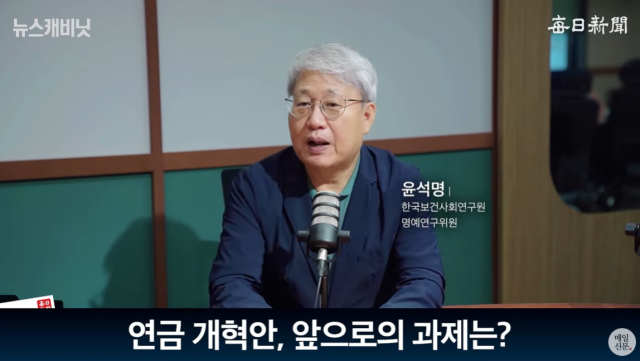
Yun Suk-myung, Research Fellow Emeritus at the Korea Institute for Health and Social Affairs and former President of the Korean Pension Association. Maeil Shinmun YouTube, “Lee Dong-jae’s News Cabinet”
▶Yun Suk-myung: If it is converted into an earnings-related system like this, and fiscal stabilization is done properly, every income group receives more in pensions while the entire system becomes sustainable. And what is even better is that, if that happens—the Government Employees and Private School Teachers Pensions are hiding in the background now, are they not? The Government Employees Pension alone will need 10 trillion won in taxes next year to cover its deficit. And then, the Private School Teachers Pension has an unfunded liability of 195 trillion won as of 2023. That is a debt of more than 500 million won per person. Yet it is hiding just below the surface, merely watching which way the wind blows, is it not? But if the National Pension is converted into an earnings-related system—not merging it with the Government Employees and Private School Teachers Pensions—what the OECD keeps recommending is this: there are only four countries in the world that, like us, run the National Pension and the Government Employees and Private School Teachers Pensions separately. This kind of thing is not publicized, is it? The four countries are Korea, Germany, France, and Luxembourg. And Germany, already in 2007—from 2008—has run its civil servants’ pension on a 100% funded basis, so it does not pass anything on to future generations. France is a somewhat complicated country. In any case, that means virtually no one now runs them separately. Neither civil servants nor professors who call themselves experts are saying anything about this. I know their intentions, though I will not go into them here, but in any case, if the National Pension is converted into an earnings-related system, then the Government Employees Pension—absurdly needing 10 trillion won from the national treasury next year to cover its deficit—and the Private School Teachers Pension, already carrying an unfunded liability of more than 500 million won per person, can be run on a basis similar to the National Pension. Then, if National Pension reform is done properly, the Government Employees and Private School Teachers Pensions can automatically follow toward sustainability as well. But one thing you absolutely must not misunderstand: the National Pension’s reserves are now 1,110 trillion won—about 1,200 trillion won.
▶Yun Suk-myung: But the Government Employees Pension can pay benefits next year only with 10 trillion won in taxes, and the deficit subsidy will keep growing, will it not? I am absolutely not saying we should merge them. As schemes, the National Pension exists separately, the Government Employees Pension exists separately, and the Private School Teachers Pension exists separately. But the standards by which they are run can be unified. Converting the National Pension into an earnings-related pension is the most essential structural reform. Saying nothing about this core of structural reform and instead claiming that structural reform means discussing retirement pensions, the Basic Pension, and the Government Employees and Private School Teachers Pensions together, so that raising structure means nothing can be done—that is not true. The core of structural reform is changing the structure of the National Pension: converting today’s income-redistribution function into a 100% earnings-related system is the most essential structural reform, and if that is done, the other problems can follow automatically. Experts and the government say almost nothing about this. I would be grateful if the media would shine a focused light on this point.
▷Lee Dong-jae: Understood. Then let us ask you one last thing. As a pension scholar, if you have something to say to the younger generation, please share it, and then please say a brief word to the presidential office about this pension reform as well.
▶Yun Suk-myung: What I would say to young people now is: do not keep talking about opting out. Do not go chasing overseas stocks as a “Seohak ant” and the like—you will understand once you get older. When the state pays back as much as you paid in, the reason it beats everything else, as other countries all do, is that it does not take a single fee. On the contrary, the government puts in extra money, adding economic-growth interest to what you paid, so if the National Pension is run properly, there is no system as good as the National Pension. So instead of thinking about whether we lose or not, young people too should keep speaking up so that it is quickly changed into a system in which you receive as much as you paid in, one way or another, and this system must be kept sustainable—young people today will also turn 60 before they know it. That is when they can feel that this really, truly is a good system.
▶Yun Suk-myung: So approach that part somewhat objectively and talk about making it sustainable, rather than about abolishing it. And as for the presidential office, in any case, even with approval ratings low and in that situation, what is being reported in the media now seems to be moving in a desirable direction. In particular, if President Yoon Suk-yeol himself announces something like an automatic adjustment mechanism, that would be about the most revolutionary overhaul plan in the history of Korea’s pension debate. It is the most advanced plan. So, just in case— if an automatic adjustment mechanism is to be introduced, there are some painful aspects. To dilute them, there may be talk around the President of things that could blur the core of the automatic adjustment mechanisms already operating in Sweden, Germany, and Japan, things that could reduce the pain—but the moment such things are put in, the purpose could fade badly.
▶Yun Suk-myung: So even if it is somewhat milder, I really hope you will announce an automatic adjustment mechanism in a form that captures 100% of its basic spirit. Then I think you will surely rise to the ranks of Schröder, Koizumi, Blair, and President Macron.