(Maeil Shinmun) An Apology from a 60-Something Intellectual Who Paid 100 Million Won into the National Pension and Will Receive 400 Million Won Back (2024-06-02)
Yun Suk-myung
“Japan, with twice Korea’s contribution rate,
receives 1.29 million won”
“Let us receive less pension…
I do not want to be blamed by young people once I am old”
“My own grandchildren are precious as gold…
so why a debt bomb for other people’s children?”
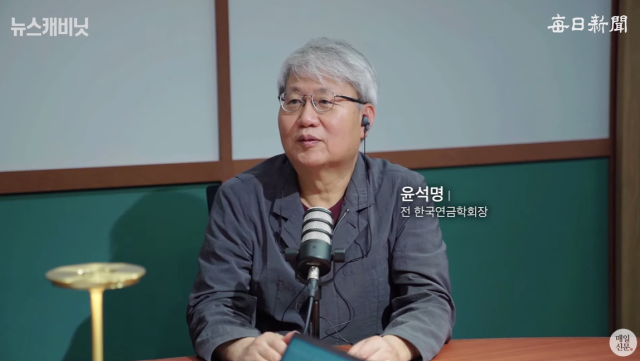
Yun Suk-myung, former President of the Korean Pension Association. Source: Maeil Shinmun YouTube “Lee Dong-jae’s News Cabinet”
Yun Suk-myung (63), former President of the Korean Pension Association, who worked for 25 years as head of the Research Coordination Office at the National Pension Research Institute and head of the Social Security Research Division at the Korea Institute for Health and Social Affairs, began receiving the National Pension this year. What he receives is about 1.75 million won a month.
The money he paid in over 26 years is about 110 million won. If he lives to 83, the life expectancy of Koreans, he will receive at least 420 million won. “The difference, 310 million won, is a weight that young people will have to shoulder,” he said, adding, “National Pension benefits must be boldly reduced.”
Appearing on Maeil Shinmun’s YouTube channel <Lee Dong-jae’s News Cabinet> on the afternoon of the 27th, the former association president said this, asking, “Japanese people, whose national income is higher than ours, pay a contribution rate of 18.3%, twice ours, yet they receive 1.29 million won, far less than I do. Can this system be sustained?” Korea’s contribution rate is 9%.
According to the Korea Economic Research Institute, if the current National Pension system is maintained, those born in 1990, who start receiving the National Pension in 2055, will not receive a single won from the National Pension. For people born after 1990 to receive a pension as well, the contribution rate must be raised or benefits reduced.
In July 1988, when the former association president was at his first job, the contribution rate was 3% and the income replacement rate 70%. By paying only 3% of income, one could receive 70% of one’s average monthly income after retirement. Through two pension reforms since then, the contribution rate rose to 9%, but it has stayed there for 26 years. The income replacement rate fell to 60% in the first reform in 1998, and in the second reform, begun in 2006, only the income replacement rate was lowered, to 40%.
Earlier, in a deliberative poll of 500 citizen representatives conducted by the public deliberation committee under the National Assembly Special Committee on Pension Reform, 56% chose “the plan to raise the contribution rate from the current 9% to 13% and the income replacement rate from the current 40% to 50%.” The ruling and opposition parties agreed to raise the contribution rate—the money paid in—to 13%, but could not narrow their differences over the income replacement rate—the money received (People Power Party 43%, Democratic Party 45%).
The ruling and opposition parties then found common ground at “a contribution rate of 13% and an income replacement rate of 44%.” But they ran on parallel tracks over whether to pursue “structural reform,” such as integrating or linking the Basic Pension. With the ruling and opposition parties ultimately failing to agree on a National Pension reform plan, the pension reform task was passed on to the 22nd National Assembly.
On this, the former association president still argues that the discussion of a “pay more, receive more National Pension overhaul” is misguided. “Why are we trying to reform pensions in the first place?” he asked. “Is it not to reduce the burden on future generations?”
The former President of the Korean Pension Association explained that the contribution rate must be raised to 22%—not 13%—in order to avoid passing the burden on to future generations under an income replacement rate of 44%. Defining the plan under discussion as “a deterioration plan,” he criticized it sharply, saying, “Accepting this would make us historical accomplices.”
He added: “Among our 586 generation, there are those who say, ‘We supported our parents and our children alike, and we built the infrastructure—Incheon International Airport, the Gyeongbu Expressway—so do not resent us for receiving more pension benefits.’ I am strongly opposed to that position.”
It was also pointed out that intergenerational equity is severely undermined in Korea, which has the world’s lowest fertility rate. Moreover, because future generations do not have voting rights, it is difficult at present to increase the burden on the current generation through pension reform that demands “paying more and receiving less.”
The former association president explained, “With the fertility rate heading into the 0.6% range, a generation of 200,000 births will have to support generations of 700,000 or one million births.” He said, “Some experts say: you treat your own children and grandchildren as precious as gold, so why tell everyone to hand this ‘debt bomb’ to other people’s children?”
He proposed a structural reform scenario that would keep the income replacement rate at 40% while converting our National Pension system into an earnings-related pension. An earnings-related pension means a long-term savings-type pension of the “pay more, receive more” kind, without the National Pension’s income redistribution function.
Under the current National Pension system, high-income earners have a lower benefit-to-contribution ratio than low-income earners, which favors low-income earners. Under an earnings-related pension, by contrast, the more one pays in, the more one receives, so there is no advantage or disadvantage by income. “Young people who join from now on will also be able to receive more pension than I do,” the former association president said.
“The plan now under discussion is too harsh on young people. The pension structure must be overhauled in an innovative way. The plan under discussion now is a deterioration,” he said, adding, “When I am old, I want to walk the streets freely without being blamed by young people.”