
(Dong-A Ilbo) [Premium Report] Japan: “No Discrimination in Pensions” — Abolishing the Government Employees Pension Altogether (2014-01-22)
Two Pensions, Two Retirements <Final Part>
Government Employees Pension Reform in Advanced Countries
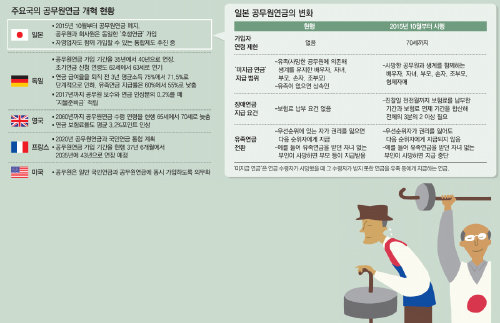
《 Advanced countries such as Japan, the United States, and those of Europe have long worked on reform to resolve the fiscal burden facing their existing government employees pensions and the problem of equity with ordinary citizens. The reforms have focused on government employees pensions, with their many benefits. Japan abolished its government employees pension altogether and had civil servants join the pension that company employees join. Europe operates separate government employees pensions but is raising contributions and lowering pension amounts while also delaying the eligibility age. We look at the content of government employees pension reforms in major countries. 》
[Japan] Mutual Aid and Employees’ Pension Insurance to merge from next year so that civil servants and company employees receive the same amounts
From October next year, Japan will abolish the “Mutual Aid Pension,” the equivalent of Korea’s Government Employees Pension. Instead, all civil servants must join the National Pension (basic pension), which the entire population joins, and the Employees’ Pension Insurance, which ordinary company employees join. Pension discrimination between civil servants and ordinary company employees will disappear, and civil servants and company employees who pay the same contributions will have the same pension amounts and eligibility conditions after retirement.
The origin of Japan’s pension system is the “Workers’ Pension,” created in 1942 during the Pacific War. The Workers’ Pension was the forerunner of the Employees’ Pension Insurance that company employees join. When the National Pension was created in 1961, the “era of pensions for the entire population” began. Thereafter, with high growth, pension amounts traced an ever-rising curve. In 1973, which the government proclaimed “Year One of Welfare,” it introduced inflation-indexed pensions, creating a pension system that did not lag behind those of Europe’s welfare states.
But Japan is regarded as a prime example of a country that is aging the fastest in the world while its births are falling sharply. For people to live out the rest of their lives on a generous pension after mandatory retirement, the burden on the younger generation cannot help but grow. There are also limits to covering deficits from government finances. In the end, the Japanese government began pension reform work in 1984. The reform plan at the time focused on “securing financial resources” and “fairness.”
The reform plan pushed back the pension eligibility age of the Mutual Aid Pension, which civil servants join, from 56 to 60. It also included measures to cut pension amounts by 15–20% and to cut the contribution rate by 20%. This lightened the burden on current civil servants while also reducing the pension amounts they would receive in the future. For the Employees’ Pension Insurance, which company employees join, pension amounts were to be kept the same while contributions were to roughly triple over 30 years.
Ultimately, it was decided to make the Mutual Aid Pension identical to the Employees’ Pension Insurance. Both the Mutual Aid Pension and the Employees’ Pension Insurance collect contributions in proportion to income, but the Mutual Aid Pension was far better in its contribution rate and pension amounts. For example, the Mutual Aid Pension’s contribution rate was about 0.5% lower than that of the Employees’ Pension Insurance. Also, under the Employees’ Pension Insurance the survivor’s pension is no longer paid once its recipient dies, but under the Mutual Aid Pension it is paid even to grandparents or grandchildren.
Reforms of contributions, pension amounts, and so on were legislated, but the work of merging the Mutual Aid Pension and the Employees’ Pension Insurance was slow. It was not until August 2012, some 30 years after the first reform plan, that the merger bill passed the Diet.
From October next year, everyone—the self-employed, company employees, civil servants, and so on—will basically join the National Pension, and company employees and central and local civil servants must additionally join the Employees’ Pension Insurance. Not only will the Mutual Aid Pension that civil servants used to join disappear, but the supplementary amount that existed only in the Mutual Aid Pension will also disappear. Going a step beyond merging employees’ pensions, the Democratic Party is arguing that even the self-employed should be able to join the same pension.
Horie Naoko (堀江奈保子), a senior researcher at Mizuho Research Institute, said of the new pension system, “Correcting the pension gap between employees—company employees and civil servants—deserves credit,” but added, “Problems remain, such as the time it will take to unify the two sides’ contribution rates and how to handle the reserves for paying the supplementary pension amounts that applied only to civil servants.”
[United States] Civil servants appointed after 1984 join both the national pension and the government employees pension
In the 1980s, the United States overcame the equity problem by having civil servants join two schemes at once: the general national pension and the government employees pension. The aim was to halve the government’s fiscal burden for the government employees pension and the inequity with ordinary people.
In the United States, too, from 1935 the social security pension system (OASDI) that ordinary people and the self-employed join and the pension systems for civil servants, soldiers, and others were operated separately. But under the 1983 federal employees pension reform, civil servants appointed from 1984 were switched to a two-tier structure: they first join OASDI along with ordinary people and the self-employed, and then also join the newly established Federal Employees Retirement System (FERS).
Kim Yong-ha, Dean of the Graduate School of Global Management at Soonchunhyang University, said, “The core was to separate the past from the future with 1984 as the dividing line, partly resolving the problem of equity between ordinary citizens and civil servants while at the same time reducing the federal government’s fiscal burden from the accumulation of government employees pensions.”
[Europe] Germany extends the contribution period from 35 to 40 years... Britain raises the eligibility age from 65 to 70
European countries, where career civil service systems developed early, have generally chosen to keep their government employees pensions while reducing the government’s fiscal burden.
In Germany, the concept of a professional career civil service has developed over a long time. In the 18th century the monarch’s retainers were elevated to state civil servants, and laws made in the modern era also stipulated that retired civil servants be guaranteed an adequate livelihood. The state bore the full cost of all the resources needed for pensions. Civil servants did not pay a single cent in pension contributions, and the government had to pour 47.1% of total civil service personnel costs into pensions.
After reunification in 1991, the government’s fiscal burden grew, and gross domestic product (GDP) growth fell from 0.2% in 2002 to negative territory in 2003, earning the country the nickname “the sick man of Europe”; it then drew the sword of government employees pension reform. In 2003, Chancellor Gerhard Schröder of the Social Democratic Party (SPD) announced the “Agenda 2010” reform plan, which included a government employees pension reform plan.
In 1998 the German government extended the contribution period for the government employees pension from 35 to 40 years and raised the age for applying for an early pension from 62 to 63. In 2003 it lowered the pension benefit rate in stages from 75% of average income over the three years before retirement to 71.5% by 2010. From 2011 it also lowered the survivor’s pension rate from 60% to 55%. To prepare for a sharp rise in pension spending through 2017, it is operating a “payment reserve system” that sets aside 0.2% of civil servants’ pay and pension increases.
British Prime Minister David Cameron has also pursued government employees pension reform since taking office. Under the 2011 reform plan, the pension eligibility age is to be raised in stages from the current 65 to 67 by 2026, and the contribution rate raised by an average of 3.2 percentage points, with the plan of reducing the pension burden by 32 billion pounds (about 56.62 trillion won) a year.
Under the pension reform plan of Chancellor of the Exchequer George Osborne announced late last year, the pension eligibility age will again be pushed back, to 70, by 2060. The British government believes this will allow it to save 500 billion pounds over the next 50 years.
France is attempting a reform that mixes the U.S.-Japan and Germany-Britain types. After merging the pensions of public enterprises into the national pension in 2003, it plans to merge the government employees pension with the national pension as well in 2020. In the second pension reform of 2003, the contribution period required to receive a full pension was set to rise from the current 37 years and 6 months to 43 years by 2035, the same as for national pension members.
In the third pension reform of 2010, the contribution period for civil servants to receive a full pension was changed to 41.5 years and the pension eligibility age to 62. At the time, President Nicolas Sarkozy raised the minimum retirement age for “partial pension receipt” from 60 to 62 and the age at which a “full pension” can be received regardless of years worked from 65 to 67.
But the Socialist government that took power in 2012 returned the pension eligibility age for some workers from 62 to 60. Workers who began working at 18, women workers with three or more children, the unemployed, and others were allowed to receive a pension from age 60.
<Special Reporting Team>
▽Team Leader Ha Jong-dae, Deputy Managing Editor
▽Lee Jin, International News Editor; Reporters Lee Seong-ho (Society), Yoo Geun-hyung (Policy and Society), Lee Won-ju (Economy), Kim Kyung-je and Byun Young-wook (Photo)
▽International News Desk Correspondents Park Hyung-jun, Jeon Seung-hoon, and Shin Seok-ho
▽Newsroom Manager Kim Ah-yeon

![(KBS TV. 이슈&뉴스] 공무원 연금, '세금 먹는 하마'?...'사회적 합의' 절실 (2013년 10월 23일)](/_next/image?url=%2Fuploads%2Feditor%2F2026%2F11%2Fcfe4824d207e450c8cad3a7c73e2fb04-Screenshot_20261122_221550_Samsung-Browser.jpg&w=128&q=75)