
(Dong-A Ilbo) [Editorial] The Government Employees Pension, “33 Years in Deficit”: Reform Can Be Put Off No Longer (2026-04-28)
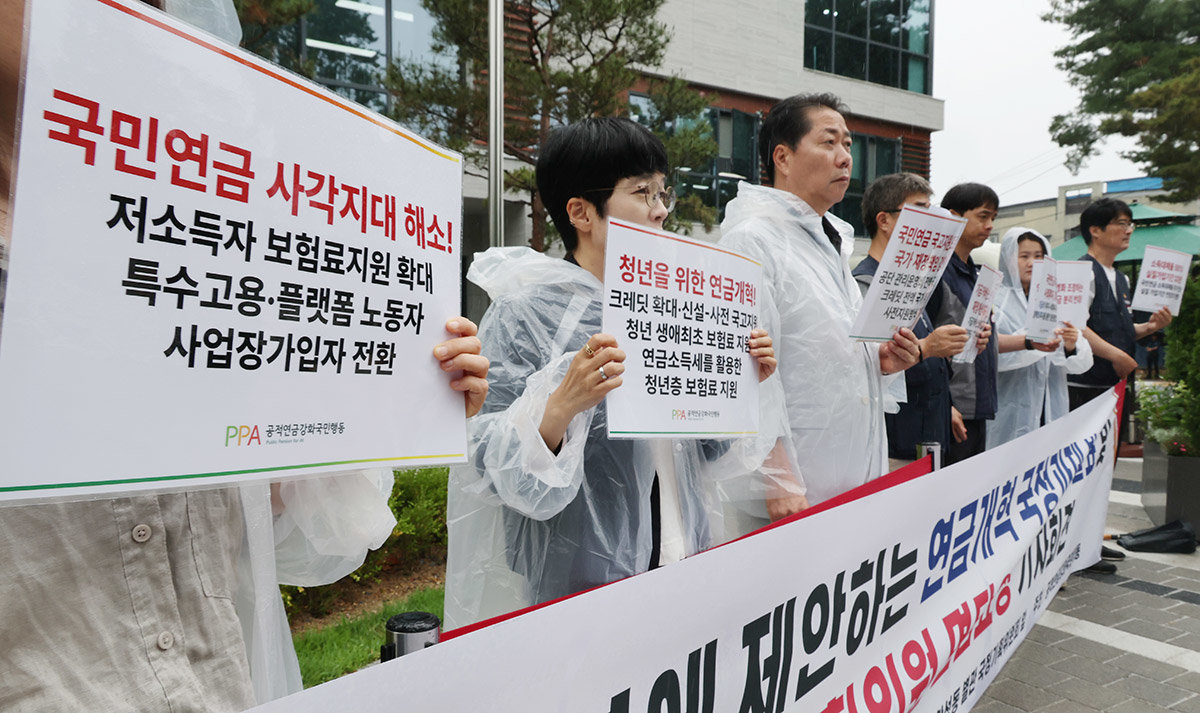
The Public Pension Strengthening People’s Action (Pension Action) holds a press conference in front of the State Affairs Planning Committee in Jongno-gu, Seoul, on the morning of June 25 last year to announce pension reform national agenda items proposed to the new government and to request a meeting with members of the State Affairs Planning Committee. 2025.06.25 Newsis
An estimated 9 trillion won or so in taxpayers’ money was put into covering the Government Employees Pension deficit last year alone. That is because the amount spent on retirees and others far exceeded the money paid in by pension members, producing an enormous deficit. With government spending swelling year after year, reform of the Government Employees Pension, which drains taxpayers’ money like “a bottomless jar,” can be put off no longer.
Since it first ran a deficit in 1993, the Government Employees Pension has been stuck in a chronic “deficit swamp” for more than 30 years. Between 1982 and 2024, the number of Government Employees Pension members roughly doubled, while the number of beneficiaries drawing pensions jumped about 186-fold over the same period. Beneficiaries grew rapidly to 53.8% of all members. This came back as an enormous deficit. In the end, since 2001 the state has been covering the Government Employees Pension deficit. According to the National Assembly Budget Office, the state money provided to the Government Employees Pension reached 7.4712 trillion won on a 2024 settlement basis.
There have been several opportunities to reform the Government Employees Pension. When the number of pension beneficiaries rose sharply in the 1990s, the government reformed the Government Employees Pension in four major rounds, in 1995, 2000, 2009, and 2015. In the fourth reform, under the Park Geun-hye administration, it even created a “National Grand Compromise Body” and attempted a structural reform merging the Government Employees Pension, the National Pension, and others. But it failed to produce a final agreement and passed the ball to the National Assembly. In the end it amounted only to a parametric reform of the “pay more, receive less” kind.
Political stopgaps only slowed the pace of fiscal deterioration. According to the National Assembly Research Service, the share of the government subsidy in Government Employees Pension account revenue rose from 28% in 2015 to 34% in 2024. The problem is that, as Government Employees Pension beneficiaries increase and benefit amounts grow, the size of the pension deficit and the government’s fiscal burden will swell to unmanageable levels. The International Monetary Fund (IMF) has projected that Korea’s pension spending will grow faster from 2025 to 2030 than that of any other Group of 20 (G20) country. Before it is too late, Government Employees Pension reform, which has sunk beneath the surface for the past 10 years, must be restarted.
It is inequitable for the National Assembly Special Committee on Pension Reform to discuss only National Pension reform while leaving aside the Government Employees Pension, into which enormous sums of taxpayers’ money are already being poured. Even now, a social grand compromise body for pension reform should be created, and structural reform plans—such as merging the Government Employees Pension with the National Pension and with other occupational pensions such as the Private School Teachers Pension and the Military Pension, or introducing a “fiscal automatic adjustment mechanism” to reduce deficits—should be put on the table. Pension reform brings pain, but it is something that must be done now for the future of the nation and of the generations to come.

![(KBS TV. 이슈&뉴스] 공무원 연금, '세금 먹는 하마'?...'사회적 합의' 절실 (2013년 10월 23일)](/_next/image?url=%2Fuploads%2Feditor%2F2026%2F11%2Fcfe4824d207e450c8cad3a7c73e2fb04-Screenshot_20261122_221550_Samsung-Browser.jpg&w=128&q=75)