
(YTN TV) Government Employees Pension: “Pay More, Receive Less” — The “Accrual Rate” Is the Sticking Point (March 29, 2015)
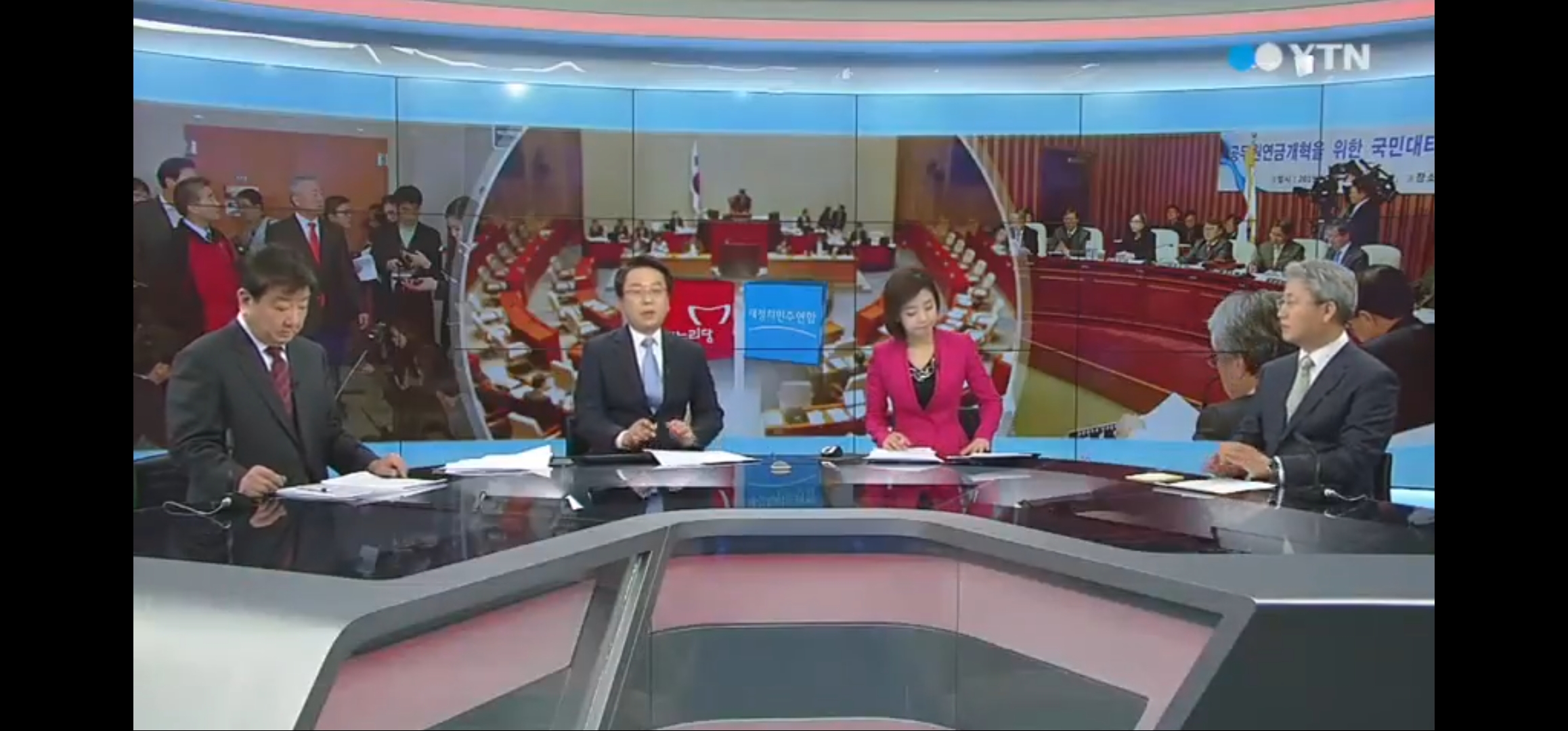
[Anchor]
As the Government Employees Pension deficit snowballs in an aging era, the government and the ruling and opposition parties have set out to reform the Government Employees Pension, but it is not easy, is it? The government employees’ unions support none of the plans.
The National Grand Compromise Body for Government Employees Pension Reform ended its activities without producing a compromise. It was decided to set up a working-level consultative body and try again to reach a final agreement. Let us look at what the points of contention are and how far the ruling and opposition parties have agreed.
Yun Suk-myung, Research Fellow at the Korea Institute for Health and Social Affairs (KIHASA),
and Professor Kim Jin-soo of the Department of Social Welfare at Yonsei University are with us.
Hello.
[Interview]
Hello.
[Anchor]
We had expected the National Grand Compromise Body to produce something, but when the lid came off, it had reached almost no agreement. How do you assess it?
[Interview]
Although it failed to agree on a concrete plan, it seems positive that it at least reached some agreement on the direction in which we should move forward. More important, the Government Employees Pension has harbored a great many problems, and whereas every past reform debate was conducted behind very closed doors, this time many people took part through the National Assembly, and the problems inherent in the Government Employees Pension were discussed more transparently than in the past, so that many people came to share an awareness of what problems it has. That, for now, can be seen as the biggest outcome.
[Anchor]
For now, the broad framework of paying more and receiving less seems to have been agreed. But when you get into the details, there are differences between the ruling and opposition parties, and various other differences too. I think we should go through them one by one.
[Interview]
Broadly speaking, when you carry out pension reform, the idea that people must pay more, or be paid less, or be paid later is really the basic premise. That is not something to be agreed on. It is the starting point.
Yet to say that after 90 days of talks they agreed to make people pay more and give them less means progress has been very slow. Anyone looking at it could think, “What? That country called Korea spent 90 days of discussion to do that?”
[Anchor]
Let me explain how far the discussion has gone while we look at a graphic. Let us compare the Government Employees Pension reform plans. There is the contribution rate, the pension accrual rate, and the fiscal savings effect. It is quite difficult. First, let us look at the last item.
The New Politics Democratic Union plan is said to save more than 266 trillion won, and the Saenuri Party plan to save 429 trillion won.
[Anchor]
We hear about the New Politics plan and the Kim Tae-il plan, but viewers may find it hard to understand from the chart alone. First, the New Politics Democratic Union plan, and then the Saenuri Party prepared a compromise plan, did it not? Please explain specifically what the differences are.
[Interview]
When the discussion first began, the ruling party’s plan—the current Government Employees Pension accrual rate is complicated, but I think I have to use the term. The benefit rate received per year of service as a civil servant is called the accrual rate, and it is currently 1.9.
The ruling party’s original plan was to lower it to 1.35 for current employees and then gradually go down to 1.25, and to start new civil servants at 1 from the outset. This time, the New Politics Democratic Union’s plan said that going down from 1.9 to 1.35 or 1.1 is too steep, so let us go only to 1.7.
Because the gap between the ruling and opposition parties’ plans was so large, the so-called Kim Yong-ha plan raises the 1.25 or 1 previously advocated to 1.65.
So in terms of the accrual rate, the cut is considerably smaller than in the earlier positions.
[Interview]
To put it simply, the ruling party’s earlier plan distinguished between current and future civil servants. That is, for current civil servants the existing system would be amended, and new civil servants would be treated exactly like the National Pension and paid less. But as the discussion went on, it was decided that this would not do, and that they would be treated the same as current civil servants.
On this issue, at least one thing has improved: the problem of treating future civil servants too unfavorably will no longer go that far, so it can be seen as a slight improvement.
[Anchor]
From viewers’ standpoint, whether it is the National Pension or Government Employees Pension reform, how high the income replacement rate is after retirement is quite important, is it not?
Currently, if, for example, someone’s average earnings were 1 million won, then after retirement the National Pension pays about 40%, around 400,000 won, whereas in the case of the Government Employees Pension, with average earnings of 1 million won, they would receive about 700,000 won, would they not? Is that the right way to understand it?
[Interview]
It varies with the contribution period, but to put it simply, on 1 million won the Government Employees Pension goes up to about 760,000 won. That is with 40 years completed; with 33 years completed it comes to about 627,000 won.
National Pension members get around 400,000 won, so the difference is very large. When we discuss the Government Employees Pension and the National Pension, we compare them by the so-called benefit-to-contribution ratio—how much one receives relative to what one paid in—but there is a big trap here.
For the benefit-to-contribution ratio to provide fair data, the denominators being compared must be the same, but the denominators are different.
For example, when one denominator is 1 and the other is 3, even if the benefit-to-contribution ratio is 3, one becomes 3 and the other 9, do they not? There is a difference of 6, but because people never mention it and always say the benefit-to-contribution ratios are similar, National Pension members seem to be quite dissatisfied.
[Anchor]
I think we need to look at the actual difference in what one receives at a given average monthly salary. Please show the graphic.
[Anchor]
This is the example of a civil servant earning an average monthly salary of 3 million won who has served for 30 years.
[Anchor]
If the person currently receives 1.71 million won, applying the compromise plan—the Kim Yong-ha plan—gives 1.49 million won. The Saenuri Party’s original plan, the Kim Tae-il plan, gives even less: 900,000 to 1.13 million won.
And the plan reportedly reviewed internally by the New Politics Democratic Union—applying that plan gives about 1.53 million to 1.71 million won.
[Anchor]
If that plan were applied as it is to the National Pension, at the National Pension’s level one would receive about 1 million to 1.2 million won. It is true that the Government Employees Pension has paid somewhat more.
But civil servants’ position all along has been that they worked hard for the country and lived their lives knowing they would receive this pension, so it seems natural that they would push back when told it will suddenly be cut.
The government employees’ unions oppose all the remaining plans—the ruling party’s, the government’s, and the opposition’s—do they not?
[Interview]
That seems to be the situation. But as I see it, the situation is very frustrating: there is now a new plan on the table, and even that plan is woefully inadequate—a weak plan—for actually achieving fiscal stability.
And whenever the special features of our civil servants are cited, the claim keeps coming up that the Government Employees Pension is being cut too much, but in nearby Japan, from this October, the same pension system as for ordinary citizens is being applied.
Also, the German civil servants’ pension, the most generously paid in the world, comes to 1.79-something in our complicated terminology, and that includes severance pay.
Yet the New Politics Democratic Union’s plan is 1.7, is it not? Our retirement allowance is paid on top of that, at 39%. The civil service also needs to understand that the plan now on the table pays more even than Germany, whose level is the most generous in the world.
[Interview]
I think we need to look at this. As for the National Pension we are talking about, was there no shock? In fact, there was. Our National Pension was at first 1.8-something, and then a little later 1.2...
[Anchor]
The National Pension has kept shrinking too.
[Interview]
And at a very fast pace. I do not mean that this is a good thing, but when we keep talking about equity and say we have been treated unfairly, it is true that the pace and intensity of our reforms were rather severe.
And even so, the reason the Government Employees Pension has come to this is that, although people kept saying it was a problem and promised to reform it, all three attempts, at five-year intervals, failed.
[Anchor]
Right. Past governments kept pushing for it too, but in the end they failed.
[Interview]
So as it accumulates, anything short of an ever stronger reform becomes difficult.
[Anchor]
How dangerous is the situation?
[Interview]
The civil service says that we carried out a reform in 2009 and endured a great deal of pain, does it not? If you look at what the reform contains, most of it applies to those who joined from 2010 onward, and those who had served ten years or more as of 2009 are not cut at all. It was a reform under which about 68% of all Government Employees Pension members saw no cut whatsoever in their pensions.
As Professor Kim Jin-soo said, we have carried out reforms several times, but their effect has not been large. So the ruling party’s plan, too, is retreating from its original version, and even if the Government Employees Pension reform bill passed in its original form, an annual deficit subsidy of 12.9 trillion won—13 trillion won—would keep going in as deficits for 65 years from 2016 to 2080; and now plans that retreat even from that have emerged.
[Anchor]
The Kim Yong-ha plan now sets the income replacement rate lowest; at what level should it be set?
[Interview]
The ruling party’s first plan was one in which the burden rate—10% from civil servants themselves and 10% from the government, 20% in total—matched an accrual rate of 1.25. But the ruling party’s current plan also charges contributions of 10%, 20%, while the rate goes up by 0.4, so the sources of fiscal instability are bound to grow by that much.
[Anchor]
The New Politics Democratic Union’s basic position is that the National Pension’s income replacement rate, now 40%, must be raised to 50%, and that the Government Employees Pension’s income replacement rate must also be at least 50%, while the government and the ruling party seem to think it should be from 45% to a little under 50%. That is now converging, is it not? Would this level be enough? What do you think?
[Interview]
We need to look at it from a somewhat different angle: people keep talking as if this were all there is, but we also have the retirement allowance. Why is that not counted? There is something else paid as a lump sum on retirement, which is called an old-age security payment. If we instead propose cutting the retirement allowance and turning it into a pension, there would probably be much more to discuss.
It is wrong to say, “Since I am retiring, I receive the lump sum separately, and then the pension is this, and the pension is low.” We need to broaden the scope of the discussion somewhat. That is, the income replacement rate should be discussed while removing the irrational elements; keeping this in a separate pocket and talking only about that is dangerous.
[Anchor]
From civil servants’ standpoint, the winds of reform mean their pensions after retirement shrink too abruptly—is there no plan to do it in stages?
[Interview]
Our society is very worried about this, but none of the plans that anyone is preparing or presenting actually cuts pensions abruptly. The figures quoted for the income replacement rate apply to 2016—if the bill passes this year and takes effect from 2016, they apply to those who join from 2016 onward; current employees already hold all their vested rights, so their pensions are not cut that much. I do not really understand why these facts are not properly communicated.
Next, another important point: people say the income replacement rate of 50% must be maintained in the name of strengthening public pensions, but this too is badly misunderstood.
For the National Pension, the income replacement rate is 40% based on 40 years of contributions.
For the Government Employees Pension, it is based on 30 years. If this is aligned with the National Pension, the opposition’s plan gives an income replacement rate of 68% and the ruling party’s plan 66%. We should discuss these points while properly informing the public and the civil service.
[Interview]
To put simply what Dr. Yun said: suppose that next year I work one more year from 2016 and then retire. Then only that one year is affected by the reform. Everything before that stays as it was. Moreover, the opposition’s plan says it will not touch those currently receiving pensions at all. Then ordinary citizens would probably say this:
Then why did the deficits arise all this time? Because those currently receiving pensions receive a lot. Moreover, many are applying for voluntary early retirement, yet if they are left untouched and the changes apply only to serving or newly hired employees, would it not be hard to say, “Is that really right? Is that fair?” We need to consider these weaknesses.
[Anchor]
You mentioned the retirement allowance earlier. If this part is discussed comprehensively, do you think it will be easier to find a compromise?
[Interview]
It could become easier, but there is another problem there. The retirement allowance is not, as Professor Kim just said, entirely unpaid; civil servants are also paid 39%—39% of the private-sector level.
But the biggest problem here is that there may be considerable disagreement over how much the 39% paid as a retirement allowance would amount to if converted into a pension.
The civil service, saying that it includes severance pay and so is not much, will try to raise that ratio, and the experts in general will try to lower it...
[Interview]
We should think about this with common sense: why must old-age security be provided? In the past, a lump sum was fine, because life spans were short. The point of paying it as a pension is to provide old-age security properly. That is why we are also proposing to move ordinary workers today to the retirement pension system.
The National Pension must be paired with a retirement pension. But this is not our debate; it is common sense...
[Anchor]
But it was the same in Japan and in Europe: reform is unavoidable in any case. When other countries faced such clashes in the past, how did they resolve the conflict?
[Interview]
Some countries took a long time and others a short time, but those that handled it best disclosed information transparently. Yet in our Government Employees Pension reform debate, key information—bonuses, for instance—is still not being properly conveyed. Just look at the income replacement rate...
Countries that properly explained why pension reform was unavoidable—the changes in the social and economic environment—and clearly communicated what problems the system had went through pain but reformed in the right direction, whereas in countries that reformed while communicating only halfway, every reform turned into a deterioration.
A typical example is Italy, which has reformed seven times and still has no solution. It is the champion in the number of reforms, but because what was proclaimed outwardly differs greatly from reality, it has that kind of problem.
[Interview]
It has been 120 to 130 years since social insurance was introduced, and there is a book published in Germany to mark the centenary. It contains a report on civil servants’ pensions, and what happened? In the early days there was a difference between civil servants and workers. But it gradually narrowed. And the countries that held out to the end abolished it.
So the countries Dr. Yun mentioned a moment ago, such as Japan and Austria, have abolished their civil servants’ pensions. Because as they went on they came too close to a cliff and an extreme decision became necessary—we need to take lessons from such things.
[Anchor]
Finally, briefly: a single plan has to be produced, has it not? What should the discussion focus on?
[Interview]
First, at the outset the government and the ruling party pursued a structural reform plan. This becomes controversial every time the Government Employees Pension is discussed, does it not? In the name of transparency, it was proposed to clearly separate the National Pension portion from the severance pay portion, but for now the gathering of opinions is moving toward discussing them together.
Even if it must unavoidably go that way to produce a compromise, internally separating the National Pension-equivalent portion and the severance-pay-equivalent portion of the Government Employees Pension to be paid in the future seems to be the way to make any further discussion very effective.
[Anchor]
Yes, I see. Everyone understands and accepts the proposition that the Government Employees Pension must be reformed. But various conflicts are surfacing in the process. I think it is time to pool our wisdom.
That was Yun Suk-myung, Research Fellow at the Korea Institute for Health and Social Affairs,
and Professor Kim Jin-soo. Thank you for your insights. Thank you.
[Interview]
Thank you.
[Copyright (c) YTN. Unauthorized reproduction, redistribution, and use as AI data prohibited]
https://m.ytn.co.kr/news_view.php?s_mcd=0103&key=201503291221111997&pos=#return


