
(Journalists Association of Korea Briefing) Government Employees Pension Reform “Is Evidence of Problems in the Government’s Fiscal Management” [Briefing on Morning Radio Current Affairs Programs, September 23] (September 23, 2014)
The backlash within the civil service against Government Employees Pension reform is considerable.
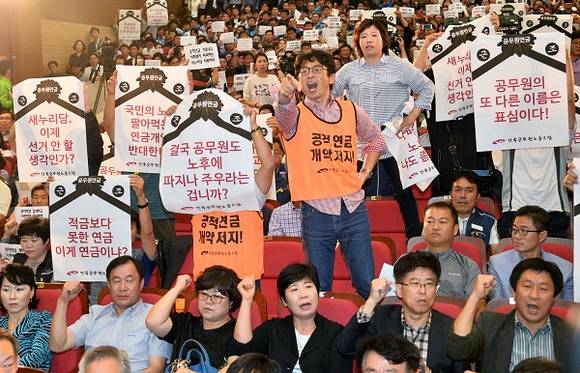
The “Policy Debate for Government Employees Pension Reform,” which the Korean Pension Association had planned to hold at the National Assembly Members’ Office Building on the 22nd, was called off after government employees’ unions blocked it, and the “Joint Struggle Headquarters to Stop the Deterioration of Public Pensions” plans large-scale rallies in Seoul, including a “General Uprising of One Million Civil Servants” on November 1. Even so, the Saenuri Party has decided, together with the government, to finalize its pension reform plan in October, foreshadowing a sharp conflict.
On MBC’s “Shin Dong-ho’s Focus” on the 23rd, Yun Suk-myung, Research Fellow at the Korea Institute for Health and Social Affairs (KIHASA), who agrees that the Government Employees Pension needs reform, and Jung Yong-cheon, spokesperson for the Korean Government Employees’ Union on the union side, appeared and presented their respective arguments on Government Employees Pension reform.

▲ At the “Policy Debate for Government Employees Pension Reform” hosted by the Korean Pension Association at the National Assembly Members’ Office Building in Yeouido, Seoul, on the 22nd, members of the Korean Government Employees’ Union protest, denouncing the government and the ruling party. (Newsis)
Spokesperson Jung Yong-cheon argued that the Pension Association does not take the particular features of the Government Employees Pension into account at all. “Civil servants are not covered by the Labor Standards Act, so even when they work emergency shifts on holidays because of floods, forest fires, heavy snow, and the like, only four hours a day are recognized, and they are paid at their usual rate rather than 1.5 times,” he said. “There are many disadvantageous conditions—they are not even covered by industrial accident insurance or employment insurance—and the compensation for these is reflected in the Government Employees Pension, yet the government does not take these features into account at all.”
He went on, “While the National Pension has only the character of old-age security, the Government Employees Pension combines old-age security with various elements of wage security and reflects compensation for restrictions on rights and the like,” adding, “In particular, it is a problem that the media have recently been simply comparing figures from the Government Employees Pension Act before its amendment with the National Pension.”
Spokesperson Jung also pointed to the nature of the Pension Association. “The Pension Association led the drop in the National Pension’s income replacement rate from 70% to 40%,” he said, adding, “It seems civil servants were outraged when it became known that the Saenuri Party had entrusted the all-important Government Employees Pension to the Pension Association, a body that champions the private insurance market.”
In response to the criticism that the Government Employees Pension’s large deficit is a burden on the national economy, Spokesperson Jung said, “I acknowledge that, but any country that employs civil servants spends a certain amount in one form or another,” and argued, “Among OECD member countries, Korea’s Government Employees Pension expenditure relative to GDP is very low.”
He continued, “If anything, the government’s burden ratio is on the low side, and yet the government keeps talking about fiscal deficits,” pointing out, “This is evidence that the government itself has serious problems in its fiscal management.”
Spokesperson Jung said, “We can never agree with the claim that the nation’s finances are in serious trouble because of pensions,” adding, “Our position is that public pensions must become substantive pensions that secure the people’s old age.”
Research Fellow Yun Suk-myung, on the other hand, rebutted Spokesperson Jung’s arguments and maintained that the Government Employees Pension must be reformed.
“The reason Korea’s Government Employees Pension expenditure relative to GDP is low is that, compared with other countries, very few people receive pensions,” Research Fellow Yun said,
explaining, “In other countries, the Government Employees Pension system was introduced much longer ago, so the share of people receiving pensions exceeds 70% to 80%, whereas in Korea only some 310,000 of 1.07 million receive pensions.”
He went on, “An analysis of the pension system in the early 2000s found that if the system were carried on as it was, the deficit alone would exceed 2% of GDP,”
adding, “Yet the government covers every deficit with taxes, and when the Government Employees Pension Act was amended in 2009, the changes were applied only to those who joined from 2010 onward, so more than 950,000 people enjoy substantial benefits regardless of the reform.”

![(KBS TV. 이슈&뉴스] 공무원 연금, '세금 먹는 하마'?...'사회적 합의' 절실 (2013년 10월 23일)](/_next/image?url=%2Fuploads%2Feditor%2F2026%2F11%2Fcfe4824d207e450c8cad3a7c73e2fb04-Screenshot_20261122_221550_Samsung-Browser.jpg&w=128&q=75)