
(YTN TV) Citizen Panel Chooses “Stronger Income Security” — Which Way for National Pension Reform? (April 28, 2024)
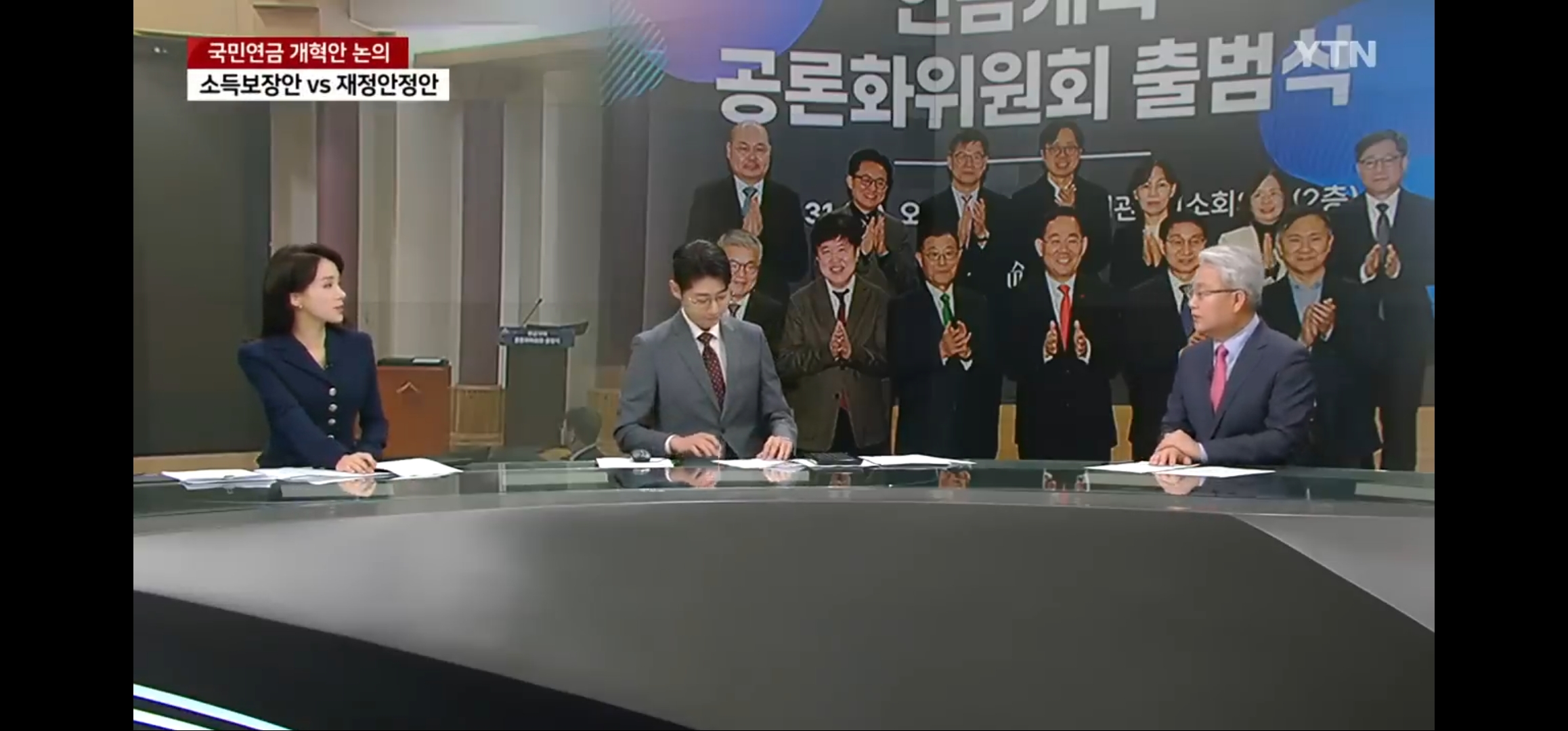
■ Hosts: Anchor Lee Ha-rin, Anchor Jeong Chae-un
■ Guest: Yun Suk-myung, Research Fellow, Korea Institute for Health and Social Affairs
* The text below may differ from the actual broadcast; for the precise content, please check the broadcast. When quoting, please cite [YTN24].
[Anchor]
In the National Assembly’s deliberative debate on National Pension reform, the citizen panel sided with strengthening income security. Now the ball has passed to the National Assembly.
Since the outcome of the citizens’ debate is not binding and the ruling and opposition parties are sharply at odds, attention is on whether the 21st National Assembly can wrap up the reform discussions. We will take a closer look at the direction of National Pension reform and the discussion process with Yun Suk-myung, Research Fellow Emeritus at the Korea Institute for Health and Social Affairs. Welcome.
Let us try to unpack this a little more simply. In a word, the National Pension will run short of money to pay out while the number of people receiving benefits grows—that is the problem, is it not? Please walk us through it in concrete terms.
[Yun Suk-myung]
The National Pension scheme was first introduced in 1988 for workplaces employing 10 or more people. At that time we were in an era of very high growth, and people were also having many children, so the outlook for the future was very optimistic. When the scheme was introduced—there is what we call the pension income replacement rate; the ratio of the pension paid to one’s monthly wage during one’s working years is called the income replacement rate—when it was first introduced, we set it at 70%. We introduced a very high-benefit scheme that paid 70% of the monthly wage. Contributions, on the other hand, were introduced at 3%.
Contributions should have been collected at 20% or more at the very least, even in a high-interest-rate era, but because such low contributions of 3% were collected, many factors of fiscal instability are built into the pension scheme. Yet the factors of fiscal instability built into the pension scheme do not appear right away. Right now many people are simply paying their pension contributions, but once they retire in earnest—as I will also mention later regarding the Government Employees Pension—and the number of beneficiaries grows, spending rises from then on, so in the second half of the pension scheme there is no contribution income, only a great deal going out, is there not? At present, our pension reserves exceed some 1,000 trillion won, an enormous fund large enough to be called one of the world’s three largest pension funds.
Views on this seem to differ greatly. People ask: we hold the third-largest reserves in the world, so why is there talk of fiscal instability? But going forward—as of last year—the fertility rate, which used to be high, with four or five children per household in the past, has fallen to 0.7 and is expected to fall even to 0.6, has it not? That is the situation, and as for life expectancy, as recently as the 1960s it was about 52. Now, for women, it is passing 90.
So there are several factors that cause pension fiscal instability: falling economic growth, a falling fertility rate, and rising life expectancy, which lengthens the period over which pensions are received. These factors have a very bad effect on pension finances, and Korea is a country where the three worst factors for running a pension scheme—not only in the OECD but in the whole world—are converging very rapidly all at once. So, in the sense that failing to prepare in advance could place an enormous burden on the younger generation and on later generations, experts, and the state and the government as well, frequently say that pension reform is urgent.
[Anchor]
With the various complex factors you have described at work, it was argued that pension reform must happen, and the citizen representatives of the Public Deliberation Committee under the Special Committee on Pension Reform held deliberative debates. Some three debate sessions are said to have been held on two main plans. First, what does the income security plan, which won majority support this time, contain?
[Yun Suk-myung]
To be precise, there were four debate sessions—debates by the citizen representatives—and I think the frame itself was wrong. One is called income security and the other fiscal stabilization, so when ordinary people first hear “income security,” they cannot help but prefer it. One side says it will guarantee something, and the other, called fiscal stabilization, emphasizes pain, so I do not think the terminology itself is fair. But first, to explain the plan called income security: the National Pension income replacement rate—earlier I said it was introduced at 70%—has, through two pension reforms, come down to 42% as of this year.
It is scheduled to fall gradually to 40% by 2028. What the income security plan proposes is this: if it falls to 40%, the income replacement rate could become too low, so we should reverse the reform we made earlier and raise it by 10 percentage points, to 50%. Since it promises to pay more, many people cannot help but like it. But on contributions—I left this out earlier—even if the income replacement rate is lowered to 40% in 2028 as scheduled, according to last year’s fifth financial projection, the National Pension Fund looks set to be depleted in 2055. 2055 may seem a long way off, but it is only 30 years away, is it not?
But the problem is that we have not been able to raise contributions by even 1 percentage point from 9% in 26 years, and once the fund is depleted in 2055, paying pensions out of each year’s revenue would require contributions to rise to 35%. That is a very heavy burden. Yet this income security plan raises the income replacement rate by 10 percentage points, to 50%, so the burden would be higher than simply keeping it at 40%, would it not? Even so, it proposes raising contributions by only 4 percentage points, to 13%, so from the standpoint of ordinary citizens, contributions go up only a little while what they receive is quite a lot more, and I think most citizens may prefer this.
[Anchor]
You have just explained Plan 1, the income security plan, in detail. Then please explain the other reform plan, Plan 2, which focuses on fiscal stabilization.
[Yun Suk-myung]
The fiscal stabilization plan, Plan 2—experts cannot help but prefer it. Ordinary citizens and the public are unlikely to like it, are they? It leaves what you receive at 40% and only raises contributions by 3 percentage points, to 12%. So one side says it can pay more, while this side says it will pay the same and only raise contributions, so it seems the citizen representatives gave more votes to the plan to strengthen income security.
[Anchor]
When the debates began, support for Plan 2 was high at first, but as the deliberative debates went on—although you said a moment ago that the wording was problematic—the share siding with the income security plan grew somewhat. How do you see the reasons for that?
[Yun Suk-myung]
First of all, it is being received as quite a shock. It seems to be received as a great shock not only by experts but also by the government and the political sphere. Three surveys were conducted: the first before any learning, the second after reviewing the learning materials for the citizen representatives distributed by the Public Deliberation Committee, and the last a vote on the 21st after the four KBS debates. At first, support for the income security plan was, as I recall, about 36%. And preference for fiscal stabilization was about 43%. But from the second survey it already began to flip, and at that point the tide turned completely.
And then, after the citizen representatives went through four rounds of learning—the government talks of pension reform because fiscal stabilization is needed, does it not? Even so, preference for, support for, the fiscal stabilization plan actually fell compared with the start. The income security plan, by contrast, saw its support rise by a full 19.1%, reaching, as I recall, 56%. Because of that, many questions seem to be raised about this. Shall I say a little more here? On why this result came out, Representative Kim Sung-soo, the opposition-party secretary, says the citizens made a great choice, while Representative Yoo Kyung-joon, the ruling-party secretary, says this was a very populist judgment. What I would say, speaking neutrally as a researcher, is that the citizen representatives learned almost nothing about the negative aspects of the income security plan, and it seems that mainly its optimistic aspects were taught.
There are materials of that kind among those provided to the citizen representatives. To mention just two: the two plans are shown to differ by just one year in the timing of fund depletion. Then, as you yourself would see it, one plan pays 10 percentage points more in income replacement rate—in pension benefit rate—yet the fund depletion dates of the two plans are 2062 for one and 2063 for the other, only one year apart; naturally, people would choose the plan that promises to pay more, would they not? But for the citizen representatives to learn properly, they should have been shown what would happen not in the first half but in the second half of the pension scheme, and that was not shown.
The key point there is this: because the National Pension must assess its own fiscal condition, it conducts a fiscal assessment not over the short term but over 70 years. And at the end of that 70-year assessment, in 2093, Plan 1 adds a deficit of 702 trillion won on top of the National Pension’s fiscal condition, which is already unsustainable. By contrast, the reason experts relatively prefer Plan 2 is that, in 2093, 70 years from now, it reduces the projected deficit by 1,970 trillion won. So the two plans differ by a fiscal saving of 2,700 trillion won, and the citizen representatives were not able to learn about this.
[Anchor]
Since they were not able to learn about it, I would like to ask more about that. The timing of fund depletion is similar, yet the fund depletion—the cumulative deficit—differs, with an increase of 702 trillion versus a decrease of 1,970 trillion. Please explain why there is such a difference, and the basis for estimating those figures.
[Yun Suk-myung]
It is what I mentioned. The reason large reserves build up is that many people pay contributions and few are yet receiving pensions in earnest—that is how these fiscal instability factors arise, is it not? It was the same with the Government Employees Pension. Until the 1990s, there were only many people paying in, so there were no factors of pension fiscal instability, but as Government Employees Pension beneficiaries grew in number in earnest, fiscal instability set in, did it not? Now, what distinguishes a pension scheme like this from the health insurance scheme, which is a matter of controversy these days, is that in health insurance, revenue and expenditure are settled each year on a one-year basis.
The National Pension, on the other hand, has a particular feature: when you are young—by the current standard, until age 63—you only pay contributions. To be precise it is until 59, and even after paying contributions for 10 or 20 years you cannot receive a pension; you can receive it only after 63. Because our pension scheme is relatively very young, it is now at the stage where mainly the insured pay contributions, not at the stage of receiving benefits. But as we head into the second half, with the fertility rate falling, the economically active population will shrink, so the number of contributors will fall and the number of recipients will grow exponentially.
So, with the 50% income replacement rate and the 40% one, until the fund is depleted—before the stage of receiving pensions in earnest—both plans register only contribution income, so the depletion dates do not differ much. But once we enter the stage of paying pensions in earnest, there is that 10-percentage-point difference between 50% and 40%, is there not? As it is reflected in earnest in the fiscal condition, the gap in cumulative deficits between the two plans widens over time.
[Anchor]
Then reactions to the two plans are bound to diverge by generation as well. People in their 40s and 50s are said to have given relatively strong support to the income security plan, whereas, conversely, those now in their teens or younger, or those not yet born, do not know how much they will end up paying. Could this not also grow into conflict between generations?
[Yun Suk-myung]
What those raising objections point to this time is that the 500 citizen representatives were selected in proportion to the population. In other countries doing it this way might not be a big problem, but for us it can be a very big problem, because with the plunge in the fertility rate the share of young people in the total population is shrinking sharply, is it not? Because the citizen representatives were also selected in proportion to the population, there were inevitably many middle-aged and older people, and in that respect, as you say, the number of people who could reflect the younger generation and future generations was limited. What is very significant is that, even so, those in their 30s—I do not know why. Maybe it is because they have just married and had children; those in their 30s probably have various thoughts about the pension—actually sided with fiscal stabilization, while, as you said earlier, those in their 40s and 50s overwhelmingly sided with income security, by almost two to one.
[Anchor]
Is that because the time to receive benefits is approaching?
[Yun Suk-myung]
There may be something to that. To put it in practical terms, because the National Pension spans an extremely long period, there is a criticism that in some respects even people in their 20s can belong to those with vested interests. Because although the fund is said to be depleted in 2055, as things stand people pay until 59 or 60 by the current standard, so whenever the fund is depleted, if these people are told they will get 40% or 50%, and the depletion date is pushed back a few years, the fund will not be depleted during the period they are paying contributions. So even people in their 20s, 30s, and 40s can make the political choice of preferring to be paid more.
[Anchor]
Because the fund will not be depleted before their own retirement.
[Yun Suk-myung]
Right, it will not. After that, the idea is that the state can collect taxes and pay. But one thing that must be pointed out here is that, compared with other generations, those in their 20s and younger sided with income security. I think this is very problematic—in how the Public Deliberation Committee was run. Because if they had understood properly, the future of the National Pension is bleak, so the younger they are, the stronger the fiscal stabilization measures they would need in order to be sure of receiving their pensions, would they not? Even so, those in their 20s and younger, aged 18 to 29, chose paying more over the fiscal stabilization plan. I think this is a point that shows there were problems with the citizens’ learning materials and learning process in the Public Deliberation Committee this time.
[Anchor]
For now the ball has passed to the National Assembly, but the 21st National Assembly has only a month left. Is it becoming more likely that the 21st National Assembly will fail to reach a conclusion? What is your outlook?
[Yun Suk-myung]
Since the result came out, the positions of the ruling and opposition parties have split very sharply. As I said earlier, Representative Kim Sung-joo calls it a great choice by the citizens, and the ruling-party secretary, Representative Yoo Kyung-joon, goes so far as to call it the height of populism—the two are in extreme confrontation. Party leader Lee Jae-myung seems to have a very strong will to pass it within the 21st National Assembly, to the point of being willing to put it on the agenda even at the meeting of the ruling and opposition leaders, but only about a month is left, is it not? And while the decision the citizen representatives made deserves great respect, it also has some problems in part. In the sense that time is needed to think about them calmly as well, my view is that reform is very urgent, but since this is a problematic decision, I think time is needed to approach this issue more carefully.
[Anchor]
I see. Finally, since you mentioned the Government Employees Pension a moment ago, I will ask one related question and wrap up. There is talk that the state subsidy to be put into the Government Employees Pension next year will be around 10 trillion won. How much has the deficit widened?
[Yun Suk-myung]
According to the government’s announcement as of last year, it has doubled from 5.1 trillion won in just two years. This is an almost staggering level. The reason the Government Employees Pension deficit is growing so sharply is that when the Government Employees Pension was overhauled in 2015, beneficiaries’ pension benefits were frozen for five years. They were not raised. That is one factor, and the other is that the number of retired civil servants is growing very rapidly in earnest; the two factors combined seem to be widening the deficit greatly. One last thing I would like to say is this: there is a great deal of talk now about reforming the National Pension, but the fiscal instability is relatively far more severe in the government employees’ and military pensions. Yet because people talk about reforming only the National Pension while leaving those alone, the general public is very dissatisfied. So it would be good to discuss reform together—not only of the National Pension but also of other pension schemes, including the Government Employees Pension—at a level where the stakeholders can accept it within the bounds of common sense.
[Anchor]
I see. We have covered everything up to the Government Employees Pension reform plan. We have been talking with Yun Suk-myung, Research Fellow Emeritus at the Korea Institute for Health and Social Affairs. Thank you for your time today.
※ “Your tip becomes the news”
[KakaoTalk] Search for YTN and add the channel
[Phone] 02-398-8585
[Email] [email protected]
[Copyright (c) YTN. Unauthorized reproduction, redistribution, and use as AI data prohibited.]
https://m.ytn.co.kr/news_view.php?s_mcd=0103&key=202404281319471315&pos=#return


