
(KBS 1TV, Sunday Diagnosis) [Sunday Diagnosis Live] A Rapidly Aging Korea — What Are the Solutions on “Retirement Age and Pensions”? (December 19, 2021)
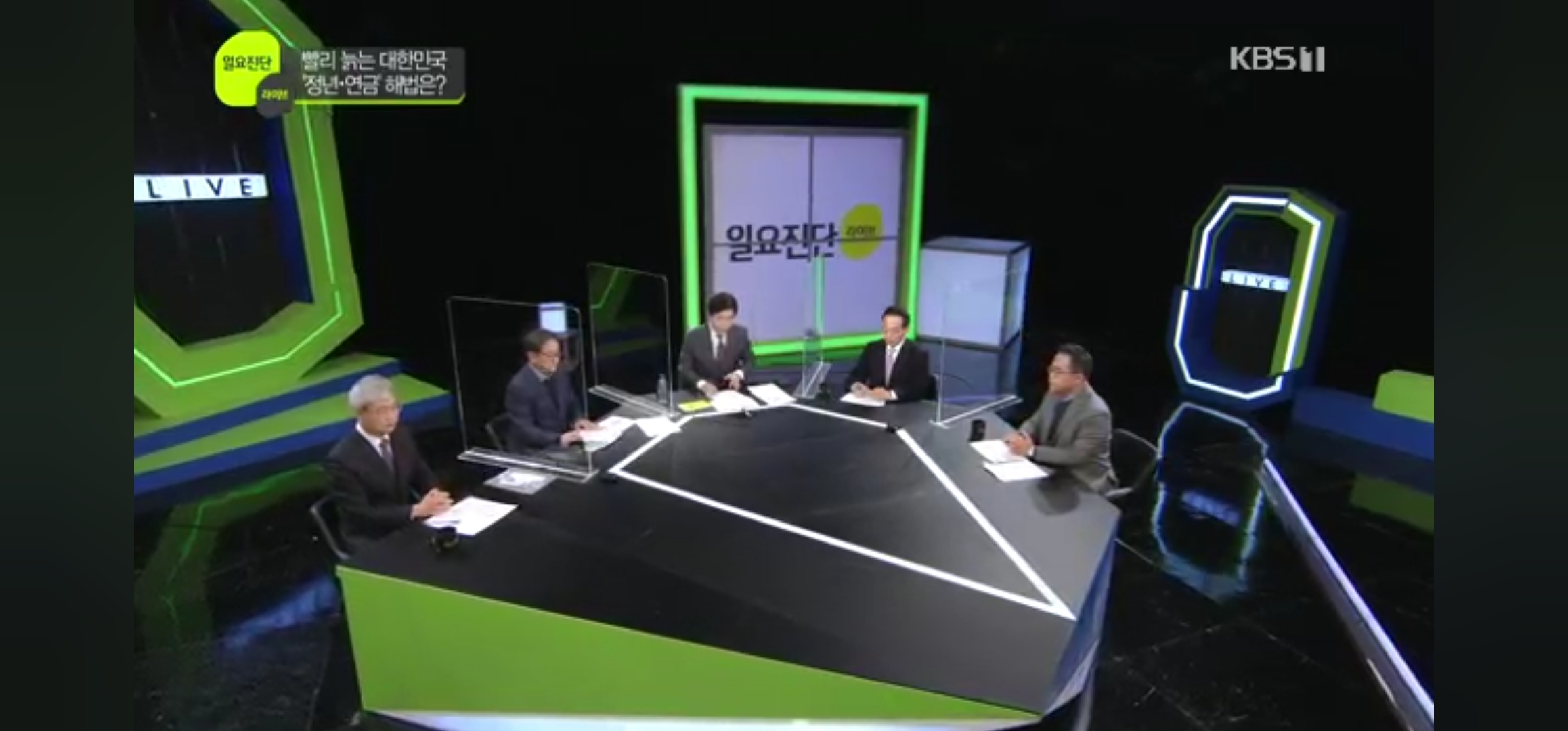
Host: Park Tae-seo
■ Panel:
Kim Seong-hee, Professor, Graduate School of Labor Studies, Korea University;
Kim Tae-ki, Professor Emeritus of Economics, Dankook University;
Yun Suk-myung, President of the Korean Pension Association;
Lee Sang-lim, Research Fellow, Korea Institute for Health and Social Affairs
Park Tae-seo: Good morning, everyone. Today’s topic on Sunday Diagnosis Live is extending the retirement age and pension reform. Korea’s low fertility and population aging are said to be proceeding at the fastest pace in the world. Amid all this, it is said that if we keep turning away from discussing the extension of the retirement age and pension reform, national misfortune will be unavoidable. In fact, everyone knows just how urgent a task this is for our entire community. And yet open debate is not easy. Some even call it belling the cat. So today Sunday Diagnosis Live has made up its mind and prepared this program. First, let us watch together a video summarizing how serious the population cliff is—the problem directly tied to extending the retirement age and to pension reform.
(VCR plays)
Park Tae-seo: To discuss the extension of the retirement age and pension reform on Sunday Diagnosis Live today, four guests have joined us. First, Professor Kim Seong-hee of the Labor Research Institute at Korea University. Welcome.
Kim Seong-hee: Hello.
Park Tae-seo: From the Department of Economics at Dankook University, Professor Emeritus Kim Tae-ki has joined us. Thank you.
Kim Tae-ki: Hello.
Park Tae-seo: Next, Dr. Yun Suk-myung, President of the Korean Pension Association, is with us.
Yun Suk-myung: Hello.
Park Tae-seo: Good to see you. Lastly, from a government-funded research institute—the Korea Institute for Health and Social Affairs—Research Fellow Lee Sang-lim, who monitors population policy, has taken a seat. Thank you.
Lee Sang-lim: Hello.
Park Tae-seo: Extending the retirement age and pension reform are extremely sensitive topics, ones we all find burdensome, and by the same token they cannot help but be issues that concern every generation. First, we will show and explain the data on population, which can be called the root cause of this problem. Could you put it up, please? This is the trend in the fertility rate and in births. As you can see, look at last year, on the far right. The figures 0.84 and 27.2. Last year the number of births was 272,000, and it is said that last year was the first time since statistics began that the number of births in Korea fell below 300,000. And the fertility rate is shown as 0.84, right? That means married women are not having even one child each. Dr. Lee Sang-lim, as a population policy expert—even from these figures alone the situation looks quite serious. Just how bad is our situation, our population situation, right now?
Lee Sang-lim: Many people think Korea’s level of aging is high. In reality, among OECD countries, Korea’s share of older people is at the lowest level. There are only seven countries with a smaller share than ours. They are small European countries such as Ireland and Luxembourg, or countries such as Mexico and Chile that differ from what we think of as advanced countries. The problem, however, is that by around 2045—not the distant future—Korea’s share of older people will overtake Japan’s, and Korea will become the oldest country in the world. Only 25 years remain. This speed—the problem is not the level but the speed—means that in fact every system in our society will inevitably be sucked in. Problems will arise in many places, and there will be conflict. If we do not prepare starting now, we will be in real trouble.
Park Tae-seo: So what you are saying is that by 2045 Korea will overtake Japan and become the oldest country in the world. We have also prepared data on just how steep the increase in the older population is toward 2045. This is the trend in the share of the elderly population—shall we look at this too? The population aged 65 and over as a share of the total population; you can see the threshold for entering a super-aged society in the middle, right? The mark in black. A society is called super-aged when 20% of the total population is aged 65 or over, and Korea will enter that stage in 2025. By 2060 the population aged 65 and over will be 43.9% of the total population—approaching nearly half. So, as some media have recently reported, as the older population keeps growing, there will be fewer people to work, and in light of how serious this is, the working-age population cannot help but decline rapidly. I think Professor Kim Seong-hee should explain just how serious this is.
Kim Seong-hee: Along with population decline, and especially because the birth rate is low, the youth population shrinks and the older population grows, so the working-age population in between, those aged 15 to 64, keeps declining. On average in the 2020s it declines by 360,000 every year. Over ten years that is a decline of 3.6 million. Then in the 2030s it is 530,000 a year, so by 2040 there will be an additional decline of 5.3 million. So by 2070 there will be only about 17 million, 46.5% of today’s working-age population.
Park Tae-seo: We have prepared data on that. Is the graph ready? It is labeled the trend in the working-age population; if you have the graphic, could you put it up? What Professor Kim Seong-hee just explained is this—the one labeled working-age population. Could you put up the graphic, please? The working-age population, aged 15 to 64, which now stands at 37.65 million, will shrink to exactly half that level by 2067. That is what you are saying, right?
Kim Seong-hee: Yes. So the particular problem is the dependency ratio. It is the youth population and the older population combined, relative to the working-age population. The ratio that those diligently engaged in economic activity must support: today 100 working-age people support 38.7, but by 2070 this will be 116.8. In other words, a ratio at which one person must support more than one person. That is on the premise that current population trends continue. The point is that we have a bit of room until 2030, so on the premise that we have ten years to prepare, these figures can change if our response changes; but if nothing changes from the current state, this is the situation that can be said to unfold.
Park Tae-seo: Opinions are being put forward that the working-age population—the population able to work—which is currently defined as up to age 64, should therefore be extended to age 69. Is this not also eating into our growth rate right now? I think this part needs explaining.
Kim Tae-ki: First of all, the working-age population means this. People who can work—when the number of people who can work falls, the growth rate naturally falls. That is what we calculate as the potential growth rate. And when we calculated the potential growth rate, something truly astonishing happened. In about 20 years, our potential growth rate fell by exactly half. No other country has seen its potential growth rate fall so rapidly. Even Japan was not as bad as us. And what about the next 20 years? The economic growth rate will turn negative. To put it simply, we are earning nothing now and, from now on, we are only eating into what we have. In fact, the population issue came up earlier, but on population, has Korea not already been designated the number-one country at risk of national extinction because of population decline? Then we have to see this as saying that the very foundation of the economy is collapsing.
Park Tae-seo: So, on whether we need to extend the retirement age, which we are about to discuss, and whether to do it at this point—since the working-age population has come up, let me put a question a little further on that to the pension expert who has joined us, Dr. Yun Suk-myung. If the working-age population, now defined as up to 64, is raised to 69—that is, to nearly 70—this would be directly tied to the pension problem as well, right?
Yun Suk-myung: I think it is connected in many respects. On the pension side, what was raised a great deal as a problem under the current Moon Jae-in administration was that the income replacement rate of our National Pension falls to 40% in 2028, while the average contribution period of those enrolled in the National Pension will still be under 30 years even 50 years from now, so is the income replacement rate, the benefit rate, not too low? So the past four or five years were wasted heading toward raising the pension benefit rate. The key point here is this: we say we live in the age of the 100-year life. But as I just said, if the average contribution period is still only about 27 years even 50 years from now, then the state cannot be sustained—it is not a pension problem, the state itself cannot be sustained, can it? If people live to 100, contribute to the National Pension for fewer than 30 years, and expect to receive a pension for the rest, then this cannot be sustained, can it?
Park Tae-seo: So increasing the working-age population can be linked to extending the retirement age.
Yun Suk-myung: This is not a choice but a road we must take, yet because it is politically very burdensome, this too has been left completely untouched. So the biggest obstacle to extending the retirement age is that young people are unable to find jobs, and
Park Tae-seo: Let us talk about that in detail later.
Yun Suk-myung: So extending the retirement age is not a matter of choice for us—it must be done; the problem is how to do it.
Park Tae-seo: I see. President Yun has gone straight to the main topic of extending the retirement age, so let us condense the discussion and go straight into extending the retirement age. In fact, the reason we mentioned the population problem earlier—the fertility rate and even the working-age population—is that extending the retirement age is today’s hot topic. We are explaining it because some prior understanding of it seemed necessary, and in that connection, two years ago Deputy Prime Minister for the Economy Hong Nam-ki came here and mentioned extending the retirement age. Shall we listen to that briefly?
(VCR plays)
Park Tae-seo: He said, “I think it is time for it to be discussed in society,” and the next day it made fairly big news in the press. From the day after that, the discussion stopped dead. Nobody talked about it. This shows starkly how socially sensitive the issue of extending the retirement age is and what sharp confrontation exists among the stakeholders; I have never heard of any further discussion even within the government after the deputy prime minister’s remarks. Well then, since four experts have joined us, let me ask about extending the retirement age directly. First, those who disagree that it must be done. Is there anyone who thinks the retirement age should not be extended now?
Kim Seong-hee: I do.
Park Tae-seo: Professor Kim Seong-hee.
Kim Seong-hee: I think a great deal about labor issues, so I also see the need to extend the retirement age, but Korea’s elderly poverty rate is high, so we are in a situation where people have to keep working into old age to supplement their livelihood, even through short-hour jobs such as public works programs. So there are limits to substituting for this by raising market wages, and it can be said that it is by no means desirable either. And who will the benefits of extending the retirement age actually go to? They do not go to the people who really need them—the insecure people who could fall into elderly poverty, those in precarious employment, non-regular workers, people whose old age looks bleak—but mainly to people whose incomes are now high. So the gaps in years of service by company size and by type of employment are quite large. More than twofold. Even so, years of service are well below the OECD average. The share of people who stay long at one company is low, and those who can stay long work at large companies, are regular employees, and are in high-wage occupations. Because the benefits of extending the retirement age may go only to them and not to those who really need it,
Park Tae-seo: So we should be cautious?
Kim Seong-hee: The youth unemployment problem is also serious right now, so rather than doing it immediately, we have ten years to prepare for a soft landing, so it is right to do it slowly and in stages in the meantime, and I think the retirement age should be extended in a way that changes the structure in which, if it is done right now, the benefits go to people who can already manage.
Park Tae-seo: So what Professor Kim Seong-hee is saying is that extending the retirement age is premature at present? Youth unemployment is serious right now, and in a structure where, if it is done now, only large companies, civil servants, and high-wage workers benefit, extending the retirement age could produce the wrong victims, so we must be cautious for now—that is your point. Professor Kim Tae-ki.
Kim Tae-ki: First, there are points about extending the retirement age that we need to think about a little. The question is whether we extend the retirement age by law or whether labor and management extend it as a matter of practice. As for extending the retirement age by law now, as I see it, just as Professor Kim said, it will in fact turn into a special privilege for really just 10%—union members at large companies and in the public sector in Korea—and for the rest, as I see it, it is pie in the sky. Why? Already, Korean workers—the average worker—leave their jobs once they reach 50.
Park Tae-seo: Right.
Kim Tae-ki: That is not, in fact, the retirement age—it is early retirement. But they work until 70 now. The age of retirement from the labor market is 70. In fact, Korea’s retirement age of 60 has already become meaningless. Because the statutory retirement age only gives a special privilege to a small number of people, as I see it, the government extending the statutory retirement age is, as I see it, not something to rush right now, and
Park Tae-seo: Oh, really?
Kim Tae-ki: That is what I think. Rather, like other countries, there is such a discussion in Korea too. It is that there should be no discrimination based on age. If so, then the direction we should ultimately head in is that the retirement age itself—the statutory retirement age itself—should be abolished. Why? Basically, we are short of labor, and making it possible for people who are healthy and able to work, even as they grow older, to keep working is in fact the way we overcome the problems of low fertility and aging. So seen from that angle, on the retirement-age issue it is in fact time for a paradigm shift, and also, rather than necessarily a statutory retirement age—some people are healthy and fully able to work. What matters, I think, is allowing these people to keep working regardless of the retirement age.
Park Tae-seo: So rather than opposing extension of the retirement age, you are saying it should be approached as the concept of abolishing the retirement age rather than applying it uniformly.
Kim Tae-ki: That is the situation. And if I may continue a little from earlier,
Park Tae-seo: Just a moment.
Kim Tae-ki: Shall I do it a little later?
Park Tae-seo: For the pace of the discussion. You are an expert on the population policy side, in any case—how do you see this? Dr. Lee Sang-lim.
Lee Sang-lim: From the standpoint of population, our society is changing. The current design was for an era when life expectancy was in the 60s and 70s and when people stayed at one company, and now the period after retirement is becoming very long. Also, support can no longer be provided through the family as in the past. Because society as a whole is changing, society must be redesigned to fit, and one part of that is the question of jobs and employment. That is why, of course, preparation must begin now before we go in; then, how will the population change in the future? And how must our industries and technologies change? These must be considered together as we proceed at the level of redesigning society. Then we must prepare from now, and as was said earlier—I think the two speakers said the same thing—we should not start unilaterally through legislation but go in while drawing up a blueprint for how to redesign society. The key point—I think the current discussion is somewhat distorted—is that many people think the current extension of the retirement age is a sudden, uniform expansion for today’s people in their 50s, but that is not it; there is a great deal to prepare. Companies, too, must design how to handle jobs and how to handle ranks, and how the labor market will change in 10 or 20 years, as they go. To that end—I will say more about this a little later—that preparatory process must begin, and with a completion point of perhaps about ten years out, we must prepare from now, draw up the blueprint, and begin discussing what companies should prepare, what social institutions should prepare, and what should be done about pensions.
Park Tae-seo: But right now there is no discussion at all.
Lee Sang-lim: Right. In fact, we are very late. It must be implemented across the board.
Park Tae-seo: I see.
Kim Seong-hee: For reference, a law is already in force. The Act on the Prohibition of Age Discrimination in Employment and Elderly Employment Promotion is in force, making it mandatory to set the retirement age at 60 or above. And there is even a legal interpretation that if the retirement age is set below 60, it is deemed to be 60. So it is not as if nothing has been done—measures to extend the retirement age are already being carried out. As for older workers, the target of labor market policy is defined as those aged 55 and over. So a law that gives benefits to people aged 55 and over is in force.
Park Tae-seo: I see. President Yun, as you said earlier, Professor Kim Seong-hee and Professor Kim Tae-ki argue for caution. And on the approach to the very concept of the discussion, Professor Kim Tae-ki said it should be approached in terms of abolishing the retirement age, and Dr. Lee Sang-lim, from the perspective of a population policy expert, said a comprehensive grand plan is needed and that the discussion must be hurried along even now; but at the outset you said the retirement age must be extended right away. Please explain.
Yun Suk-myung: Viewers may misunderstand, but when I say we should extend the retirement age right away, I do not mean extending it in its current form. For example, when the retirement age was extended from 55 to 60, there was no preparation at all, and then, through some political process, the retirement age was extended in less than a year. As a result, as the three others said earlier, with the extension of the retirement age the benefits have gone mainly to those working at public institutions and large companies, while for the rest it has become pie in the sky.
Park Tae-seo: That is how it is now.
Yun Suk-myung: That is how it is now. And if we just leave it as it is now, it means that at some point—who knows whether in 5 years or 10—the retirement age could again suddenly be extended in that way. The extension of the retirement age I am talking about is one I propose as a solution that finds the greatest common denominator—not something everyone is satisfied with, but something that, in our current situation, the younger generation can accept, employers can accept, and workers can accept. If we extend the retirement age to, say, 64 or 65, that extension would not be the current concept; rather, from about age 55 we would abolish our seniority-based wage system and gradually apply the wage peak system, and in particular from 60 to 64 or 65, for the time being, in the form of re-employment after retirement, I propose that people receive about 30% to 40% of the wages they received up to 60, and if they do not like that, they can simply retire at 60 and leave. Instead, the role of the state here is this: even if wages are cut sharply, if employment is extended from about 60 to 64 or 65, the burden on employers would become very large, would it not? On that point—because people cannot work long, the welfare system is not properly in place, the pension system is not in place, and so at every election there are calls to raise pensions, placing an enormous burden on later generations, are there not? If, instead, the state were to use those resources as effective subsidies for businesses, as social insurance subsidies, I think this could actually make for an easy soft landing. In other words, if people stay on past the retirement age not at 100% of the wages they received but at 30% or 40%, the rest could be used to hire young people.
Park Tae-seo: So what President Yun is saying is that it is not, after all, a mechanical extension of the retirement age.
Yun Suk-myung: Yes. A mechanical extension of the retirement age is very difficult in our current reality. Let me add one more point: in 2018 or 2019, OECD Secretary-General Ángel Gurría paid a courtesy call on the presidential office and delivered a report to President Moon Jae-in. That report is called Working Better with Age—that people work better as they age. But people who work in welfare usually say that Korea’s older people work until about age 72. Because the welfare system is so inadequate, they say, people are forced to work even in old age. They view it critically, but the meaning of what Secretary-General Ángel Gurría conveyed to the President was this: that Korean older people working until late in life is something like a treasure that all OECD member countries should emulate. The problem, however, is that although these people work long, the longer they work, the lower the jobs they hold—they work very hard while their wages gradually fall. So the message he had already conveyed was to find a way, within a legal framework, for them to keep working while youth employment does not shrink, so that both can prosper together.
Park Tae-seo: Just a moment. In connection with that—I am not sure whom to ask about this. One of the sharply contested issues around extending the retirement age is whether it is right to extend the retirement age of older people when youth unemployment is serious. There is also the worry that this could, so to speak, become a detonator that deepens intergenerational conflict, but on the actual youth unemployment problem—Dr. Lee Sang-lim has raised a hand. How do you see it?
Lee Sang-lim: This conflict arises because people think of the current discussion in terms of full implementation. We need to look a little at the population. This year, regional universities—last year and this year there were massive shortfalls in enrollment, and for these young people—the IMF crisis broke out in ’97, and its effect actually showed up in births in 2001 and 2002. Those born in ’97 are the 24- and 25-year-olds now entering the labor market, and at that time the number of births was about 700,000 a year. But the 2002 cohort, the generation behind this regional-university crisis, falls below about 500,000. In just five years, about 200,000 fewer. After that there is a period of ten years in which the working-age population declines again, very gradually. Then the five years in which those young people—those who have just entered university—enter the labor market. Over a period like that, the youth jobs problem will not be as severe as it is now, and
Park Tae-seo: That is exactly my point. What I mean is—you will remember that article. Was it about a year ago? I remember Japanese companies holding some kind of job fair in Busan. Right?
Kim Tae-ki: Not only in Busan—they held them all over.
Park Tae-seo: Right? Is that not what we are talking about now? Because aging is severe in Japan and its population is shrinking, the youth population is declining, and as a result there is also talk that worries about youth jobs may be greatly exaggerated, given the shrinking youth population. So did Korean students not apply to Japanese companies at that youth job fair? That is what you are referring to, right?
Lee Sang-lim: Yes. That is somewhat open to misunderstanding: it is true that as Japan’s working-age population, its youth population—its new entrants—declined, Japanese companies became short of workers. But population does not determine everything. In fact, Japan carried out a great deal of corporate innovation during the past lost 20 years. Then, with the economy improving and the youth population shrinking, full employment came about, and the jobs problem turned instead into a labor shortage problem. There is a possibility of a similar pattern emerging in Korea, too, from five years from now onward. Because the population is clearly shrinking fast. So the point is to prepare now so that we can make a soft landing. Technological innovation by companies, or the adjustment of the industrial structure. Not only that—President Yun mentioned re-employment earlier, but it is not only institutions that are needed. From the company’s standpoint, too, with re-employment: a department head comes back—how will the company use this department head as a non-regular worker? How will promotions work? Will these people be given the same duties they had before? Companies, too, have a great deal to do in terms of personnel management. Failing to begin such preparation now would, in fact, only increase the damage. But what the current government must do is begin not only on these institutional issues but on how to handle personnel management, what preparations companies will make, and, in step with that, what preparations schools will make.
Park Tae-seo: Then shall we look at how companies are doing? Is the simple equation not now being put forward that if companies extend the retirement age, their labor cost burden will increase? Is that right? What do you think? According to what the experts said earlier, it is not a mechanical extension of the retirement age, and if wages are lowered in the form of a wage peak system, say, and things move toward re-employment after retirement, there could be a compromise of sorts. Professor, how do you see the labor cost burden?
Kim Tae-ki: When the retirement age is extended, labor costs rise automatically. That is how our wage system works. To put it simply, wages rise step by step from the year you join the company. It is called the step-based pay system, or seniority-based pay. That being so, it is entirely natural that labor costs rise when the retirement age is extended. In fact, business is truly alarmed. But in fact, last time, when the retirement age was extended from 57 to 60,
Park Tae-seo: In Korea?
Kim Tae-ki: In Korea. When that was done—as President Yun said earlier—at the time, when the retirement age was extended, this was discussed. It had been agreed to introduce the wage peak system at the same time. But at the last minute, the wage peak system was stripped out entirely.
Park Tae-seo: Is it not being done now?
Kim Tae-ki: No. At the time, in fact, as was said earlier, a wage peak system or an overhaul of the wage system was called for in the supplementary provisions, but the problem was that in the National Assembly process that was stripped out entirely, and the retirement age was simply extended from 57 to 60. Business went into shock, and in fact that shock badly worsened jobs for young people. That all shows up in the statistics; KDI analyzed it, and in fact my own estimate is far larger than what KDI put out. Because the places where Korean young people now want to work and the places that benefit from the extension of the retirement age are directly opposed. Why? Where do young people want to go? They want jobs at large companies. Large companies are caught right in the extension of the retirement age, so they simply halted everything, and youth jobs dried up. As I see it, there is no disputing that labor costs rise if the retirement age is extended now. The question of how to reduce that burden is the kind of thing President Yun and Dr. Lee mentioned earlier. For example, companies designing such things—and as I see it, corporate design is not easy—but the part I must take issue with here is this: listening to Deputy Prime Minister Hong earlier, I thought, ah, how leisurely of him.
Park Tae-seo: That was said two minutes ago.
Kim Tae-ki: Right. Two minutes ago, something about how the retirement age will be extended. But the government itself should take the lead in the discussion. It should have said, starting with the government, this is how we will hire—recruitment. And then, starting with the government, this is how we will manage personnel. Why, as I see it, the place where the step-based, seniority-based pay system is most firmly entrenched right now is the government.
Park Tae-seo: Civil servants.
Kim Tae-ki: If the government does not change and tells the private sector to do it, will that work? So, as I see it, I think that is really a big problem.
Park Tae-seo: I see. Professor Kim Seong-hee.
Kim Seong-hee: (3337) Yes. Well... the Korea Economic Research Institute reportedly said it would cost 15 trillion won a year, .
Park Tae-seo: The labor cost burden.
Yes. That is a simple calculation, and well... there are also gains from extending the retirement age. Continuing to use highly skilled workers. Because it is hard to hire people who are not ready... not prepared and put them to work, and then because they have ample physical and mental capacity, there seems to be the advantage of, well, making use of them. So (3404) the returns should, well, be weighed together in comparison, but the problem is that extending the retirement age does not mean everyone works until the retirement age, does it? Hardly anyone actually serves out to the retirement age. So when the retirement age is extended as an institution, it is a different matter depending on how many people the benefits go to and how much, and the important question is who they go to. That is the point. Right now, things like rank-based retirement ages already exist... that is the current situation. And there is one more point open to misunderstanding: with the extension of the retirement age, in most of the public sector it was set up that a wage peak system would be introduced in exchange. That is the practice...
Park Tae-seo: It is meant to be put into practice. Just a moment—while you are on the subject, you teach students at a university, do you not? Have you ever brought this up with your students? If so, how do the students react?
Kim Seong-hee: On this, well... basically, students, young people, feel that the generation that has enjoyed things so far will keep on enjoying them even more. That kind of feeling.
Park Tae-seo: That is too much, something like that...
Kim Tae-ki: That is too much. (Laughter) That is right. That is how it is.
Kim Seong-hee: Good jobs... opening up good jobs is very important.
Kim Tae-ki: They turn cold.
Kim Seong-hee: That is what they think.
Park Tae-seo: What young people think.
Kim Seong-hee: Yes.
Park Tae-seo: Yes. I see. President Yun Suk-myung, go ahead. (3521)
Yun Suk-myung: Well, listening as the four of us debate here this morning, I feel rather frustrated, quite a lot. The most chronic problem in our society seems to be that we mostly discuss the problems we face on the premise that they will never be fixed, and what side effects might arise. Already, life expectancy has risen far beyond the actual average, and the period people actually work is also longer than the actual average, is it not? Then on the issue of extending the retirement age, too, we should be talking not about the concept of retirement-age extension we have had until now but about an extension that can adapt to the changing social environment of a new era; yet because each of us approaches it with the fixed concept of the retirement age we already hold, there is no solution. In Japan alone, already, in the form of re-employment after retirement (3607), 80 to 90% of older people are working until 65. That is what the neighboring country is doing, and with life spans about the same, if we keep saying our system cannot extend the retirement age, that it cannot be done now, that we will do it in ten years, how large will the potential costs be over those ten years? So what I am saying now is that those who will work until 60 should work until 60. What I find very frustrating, and frankly pathetic, about the government is that it needs to be able to put options... to put options on the table. It only has to put forward choices that both companies and workers can accept, but without that, by moving uniformly and identically, 50 to 60... 55 to 60, an enormous social cost was incurred in our country, and does conflict not arise between the young and the old? The extension of the retirement age I am talking about—again a lot for some particular group (0358) would go, would it not, then we also need to approach it carefully in the form of a pilot test, and let me say clearly that the move from 55 to 60 happened in one shot without any preparation. The current extension of the retirement age is re-employment after retirement, and what I am saying is that those who accept it must, from 55 to 60, be on either the seniority-based wage system or the wage peak system, and from 60 to 64 or 65 we would bring out the retirement-age extension card on the condition that they receive no more than 30 to 40% of the wages they received.
Park Tae-seo: Ah, yes, yes. There was that.
Yun Suk-myung: Then those who do not like it work until 60 and stop working, and those who want to work can work. But what is being discussed in our society—what young people, too, have misperceived—is that you people, working five more years in the same position with your pay rising the same way by seniority, is that not too, too much? When we cannot even get jobs. What is this? Is one particular generation not enjoying everything? The point is that the only talk is about cases that sow a great deal of misunderstanding in this way.
Park Tae-seo: That is right. I, too, while planning this program,
Kim Tae-ki: First of all, I think I need to say something about that.
Park Tae-seo: When we raised the topic of extending the retirement age, even I, as a non-expert, simply had in mind the concept of retirement-age extension as being able to work more until 62, 63, 64, 65, with the retirement age pushed back by that much. That is all. As you said, I confess now that I myself had no thoughts on the details—re-employment after retirement, or a wage peak system, or choosing and working at 30% of one’s wages. Now, Research Fellow Lee Sang-lim.
Lee Sang-lim: I would like to come back to the point about population structure; as we saw earlier, Korea...
Park Tae-seo: Please keep it brief.
Lee Sang-lim: As we saw, it is heading in a very painful and very—how should I put it—unusual direction. That is why our response must not be slow like this but must proceed quickly now, and it must be accompanied by a great deal of pain. Japan, too, with the retirement age... when the dankai generation reached retirement, in fact the retirement age... it was the dankai generation whose employment rose, and the young people...
Park Tae-seo: The dankai generation. That is the baby-boom generation, right?
Lee Sang-lim: The young people, in the process, saw instead a worsening shift toward non-regular and contract work. Some short-term pain is unavoidable, but what I want to say is that from the start the discussion should not be about whether or not to extend the retirement age, but should begin with taking certain plans and discussing which plan is appropriate.
Park Tae-seo: You mean putting all the various plans on the table together?
Lee Sang-lim: Right. And in that role the government should take a plan and try to persuade... the public and businesses; if it keeps just reading the room, I think the conflict will only keep being pushed back.
Park Tae-seo: Why do you think it is reading the room? Even the presidential candidates are saying nothing at all about the retirement-age issue, right?
Lee Sang-lim: They dislike the spicy stuff.
Kim Tae-ki: I think I should say a word first.
Park Tae-seo: (3938)
Kim Tae-ki: Earlier the question came up of how young people now view extending the retirement age. In fact, as I see it, they are very cold toward it. And as President Yun said earlier, there are various good alternatives, so why do young people turn away? That is not it. What do young people know? Well, it is this. The group that benefits from extending the retirement age in Korea is, to put it simply, one firmly controlled by labor unions. There is no backing down with them.
Park Tae-seo: Large companies?
Kim Tae-ki: Large companies, and especially the public sector.
Park Tae-seo: The public sector.
Kim Tae-ki: So in Korea’s public sector, the unionization rate is over 70%. In which country** (4016) And at Korean large companies with 1,000 or more employees, it comes to about 73%.
Park Tae-seo: Only these people are benefiting from the extension of the retirement age?
Kim Tae-ki: Right. So, to put it simply, they consider things like cutting wages by 30 to 40% while extending the retirement age to be impossible. That is why wages simply go up and their own...
Park Tae-seo: It will not be easy because it will run into the unions’ unyielding resistance?
Kim Tae-ki: That is right. Right now the labor unions are so formidable—their power.
Park Tae-seo: You mean young people view that cynically?
Kim Tae-ki: Very cynically. So, young people—something like this happened last time, did it not? At places like Hyundai Motor, the MZ generation said they would form a separate labor union.
Park Tae-seo: That happened.
Kim Tae-ki: Yes. So what is that now? Well, then, Hyundai’s existing labor union, so-called—earlier, those in their 50s did this, and
Park Tae-seo: The ones called the iron rice bowl.
Kim Tae-ki: Because the iron rice bowl is so firmly entrenched, we in fact should be able to come up with somewhat rational alternatives on various matters, but it is difficult; and then whenever Japan comes up, young people say, what is this? We are different from Japan, are we not? Japan, for example, introduced re-employment and, in a sense, many rather flexible systems—for extending the retirement age. But in fact, in Japan’s case, it drastically changed the seniority-pay part of the wage system itself. But what about us? At large companies,
Park Tae-seo: You mean Japan no longer has the seniority system it had in the past?
Kim Tae-ki: Right. Japan made a great deal of effort on that in its own way, and second, Japanese labor unions are very cooperative. So, to put it simply, they discussed these issues together and made adjustments.
Park Tae-seo: Oh, really? In Japan, the labor unions...
Kim Tae-ki: In Japan, the labor unions—even in overhauling the wage system, the labor unions... in fact Japan’s labor... in changing the seniority-pay parts to a focus on job and performance,
Park Tae-seo: Well, if we are to discuss this in Korea too, then in an overall TF... a grand social compromise... a grand compromise committee, the unions would naturally have to take part?
Kim Tae-ki: Of course they must take part. They must take part.
Kim Seong-hee: At the Economic, Social and Labor Council, that process... discussions are taking place. So is the problem serious where labor unions are organized? People say that in some large manufacturing companies the labor unions, er... wield a lot of power, but in fact, while it is true that most of those who benefit are at places with labor unions, it is non-union members who benefit. That is, it is people at managerial ranks and above who benefit, so linking it to the logic of the labor unions is not necessarily correct.
Park Tae-seo: But, no—not only non-union members; are older production workers, for instance, not also actually benefiting?
Kim Seong-hee: No. That side does benefit, but
Kim Tae-ki: At large companies. Simply put, at those with 1,000 or more employees, about seven in ten are union members. So even managerial staff these days—to the extent that everyone up to section chief joins...
Kim Seong-hee: I find this a bit frustrating, so let me speak.
Yun Suk-myung: Yes. Go ahead.
Park Tae-seo: Just a moment.
Yun Suk-myung: The conversation seems to be going round and round like a squirrel on a wheel.
Park Tae-seo: Please keep it short.
Yun Suk-myung: However powerful the labor unions may be, what I am saying is that we should put forward... put forward a separate system in two or three tracks alongside our existing retirement age of 60. People keep misunderstanding this.
Park Tae-seo: (4310)
Yun Suk-myung: Because those who want to retire at 60 as things stand now retire; unions, well... whether in the KCTU or the Federation of Korean Trade Unions—what I am saying now is that if you want to work until 65, apply the wage peak system from 55 to 60 and receive only 30 to 40% of the wages you received from 60 to 65. If you do not like this, then this... this is, um...
Park Tae-seo: I see.
Yun Suk-myung: What I am saying now is that without even presenting such options, across the board (4336) because we only keep talking, there is no progress at all.
Park Tae-seo: Is it not the case that the government is simply not talking about this at all?
Kim Seong-hee: It is not... no, well, this may be misunderstood: Japan made 65 mandatory and we made 60 mandatory. And as Japan extends it to 70, it presented those options. So while making the form of 60 mandatory, we also talk about a re-employment type and a retirement-age extension type.
Park Tae-seo: You mean Japan also has several tracks.
Kim Seong-hee: Yes. Korea has opened it up that way too, but it is not that we have not done it; rather, one can talk about whether we have created a mechanism through which it can work effectively.
Park Tae-seo: I see. Let us wrap up here. Another hot issue directly tied to extending the retirement age that we must cover today is National Pension reform. This, too, is sensitive: everyone knows the National Pension must be reformed and says it must be reformed, yet no one can deny that it is becoming an issue where, as soon as it is raised, everyone looks the other way. Pension reform—viewers, we will explain just how bad the state of the National Pension is, the National Pension you regard as the safety net for your life in retirement, while looking at the graphic we have prepared. It is titled the outlook for National Pension Fund finances, is it not? What this means is: what balance is now left in the National Pension’s wallet? It is now projected to go from 681 trillion in 2019 to a peak of 1,430 trillion in 2039. After that it starts to shrink steadily, and by 2054 the National Pension Fund turns to deficit and the pension fund is depleted. The figure showing that the National Pension we are now pouring money into will fall below zero won by 2054. You are looking at a grim outlook, and it shows plainly that this is bound to happen if the current trend simply continues. Since we have with us today President Yun Suk-myung, known... known as the foremost pension expert in Korea—if things go on like this, what happens?
Yun Suk-myung: That outlook is far worse than the results of the 4th financial projection of 2028, just three years ago. The 2028 4th National Pension financial projection. That is official material released by the government, and according to it, the fund is depleted in 2057; so this is three years earlier than that. But what I want to say is
Park Tae-seo: ’54 or ’57, well...
Yun Suk-myung: Yes. But the important thing is what comes after; we usually do a 70-year financial assessment. From 2057 to 2088, the cumulative deficit reaches 1 gyeong 7,000 trillion won.
Park Tae-seo: 1 gyeong 7,000 trillion won.
Yun Suk-myung: 7,000 trillion. You have rarely heard the word gyeong, have you?
Park Tae-seo: So it is hard to grasp when you hear it like this.
Yun Suk-myung: Yes. For reference...
Park Tae-seo: Since the unit above jo (trillion) is gyeong.
Yun Suk-myung: I am no pro-Japanese collaborator, but the reason I keep citing Japan as an example today is that Japan’s Employees’ Pension Insurance has enough money to pay pensions until 2120, 100 years from now.
Park Tae-seo: It can hold out?
Yun Suk-myung: It is not holding out; it has the money to pay. And now our National Pension...
Park Tae-seo: You mean Japan can go on for another 100 years?
Yun Suk-myung: Yes. There is no problem at all even 100 years from now. It is not only Japan—so is Germany, so is Sweden, so is Canada. For us, the National Pension’s daily liability... we call it latent liability; collecting less than what has already been promised to be paid... promised—we call that latent liability. Each day, the National Pension’s latent liability (4700) is growing by more than 400 billion won. So, back in 2007, when the National Pension was reformed, there was a phrase used by Minister of Health and Welfare Yoo Si-min at the time. He said that the National Pension’s latent liability was then growing by 80 billion won a day, and that it felt as if a time bomb were ticking over his head.
Park Tae-seo: And you are saying 80 billion has become 400 billion?
Yun Suk-myung: Yes. Even though it has now grown to 400 billion, and even though there are fewer than 100 days left before our presidential election, the presidential candidates of the Democratic Party of Korea and the People Power Party are putting out other populist... kinds of (4733) so many of them, yet they offer not a single word on how they will fix the National Pension—on how they will overhaul it with regard to the difficulties of the younger generation... the fairness concerns of the MZ generation. Instead, Kim Ho-il, President of the Korea Senior Citizens Association, recently said that he would like the next administration to pay the Basic Pension for older people up to 1 million won. To that, Democratic Party of Korea leader Song Young-gil said the Democratic Party would actively consider it as a campaign pledge. Looking at things like this, our society—the current generation... the current generation, well... seems to be showing utterly irresponsible and shameless behavior on important policies that will determine our country’s long-term national competitiveness, its rise and fall.
Park Tae-seo: So President Yun, you seem to be lamenting that, with an election ahead, they promise to raise the Basic Old-Age Pension, which is urgent for votes right now, rather than undertaking National Pension reform—a task that could worsen into, say, a national disaster... Now then, as you said earlier, what happens when the fund is depleted? Does the government not have to borrow?
Yun Suk-myung: Well, that is what has been said all along. So countries like Germany and such—pay-as-... the terminology is complicated now, but under what is called pay-as-you-go, once the fund is depleted there is no money to pay, is there?
Park Tae-seo: Right.
Yun Suk-myung: Then part comes from the income of the people paying pension contributions at the time, and the government collects taxes for the rest—that is what is called operating on a so-called pay-as-you-go basis. So many people in Korea now—the media, experts... some experts, and people in political parties—say that since countries like Germany run on pay-as-you-go, it is only natural for us to move to pay-as-you-go too.
Park Tae-seo: You mean paying in and receiving the way you pay taxes?
Yun Suk-myung: Yes. We (4913) have not been able to raise the contribution rate of 9% by even 1 percentage point in 20 years. It did not appear in the financial outlook earlier, but if we switch to pay-as-you-go in 2054 or 2057, contributions immediately exceed 30%.
Park Tae-seo: What is it now?
Yun Suk-myung: It is 9% now. 9% now... but then...
Park Tae-seo: So 30% of one’s monthly pay. (4933)
Yun Suk-myung: The employer pays half... pays half, but the self-employed have to pay 100% themselves. So the problem I want to raise is this: over the past 20 years we have said that raising it even 1 percentage point is difficult, yet for a system that would raise it to 30% in an instant for later generations, simply because those people are not making the decision now, this kind of (4950) is not being done. And meanwhile, cases like Germany’s, for example, are being badly misused. It is true that Germany runs on pay-as-you-go, but the pay-as-you-go system run in Germany is on a different level from ours. Did I not say earlier that Japan’s Employees’ Pension Insurance has the money to pay pensions 100 years from now?
Park Tae-seo: Yes.
Yun Suk-myung: Yet Japan’s Employees’ Pension Insurance is also described as pay-as-you-go. What we are now badly misusing in policy is other countries’...
Park Tae-seo: Just a moment. Please explain the contribution payment method and pay-as-you-go to the viewers. Simply and easily. Right now we have 4.5% deducted from our monthly pay and paid in, do we not? Right.
Yun Suk-myung: Yes, yes.
Park Tae-seo: 4% on the company side...
Yun Suk-myung: The employer... KBS also pays 4.5%, so 9% is paid in.
Park Tae-seo: I, too, pay 4.5%.
Yun Suk-myung: So the major countries in the past, well... the reason pension systems are so easy to misuse politically at the outset is that, at the outset of a pension system—take our National Pension—you can receive it only after contributing for 10 years and reaching age 62 or 63. So many people are now paying pension contributions but not receiving anything. As a result, more than 900 trillion has piled up; you, our host, will also receive a pension when you retire later, will you not? Right now you are only paying contributions, are you not?
Park Tae-seo: Yes, yes.
Yun Suk-myung: But in reality we should be collecting contributions of over 20%, and we are collecting 9%. So even though we are collecting 11%, 10% too little, because there are few people receiving benefits, the finances appear to be in good shape. And because a presidential term is five years, there is an aspect of badly misusing this, since it will not turn to deficit during my five years. So a funded system is one in which you pay 100% of the pension you will receive during your own working years. Pay-as-you-go is where you pay part and later generations bear all the rest. And among the major countries, we are a country with a very strong pay-as-you-go character. It is complicated, but let me give just one example from Germany.
Park Tae-seo: Just a moment. This is really too complicated. That complicated... if we go any further, I think viewers will not be able to follow.
Kim Seong-hee: We need to consider some other statistics as well.
Park Tae-seo: Yes. Professor Kim Seong-hee.
Kim Seong-hee: Because ours is, well, a funded system, the National Pension (5145) keeps piling up because there are many new contributors and few beneficiaries, does it not? By ’41, close to 1,800 trillion will have accumulated.
Park Tae-seo: It was in the graph earlier.
Kim Seong-hee: Yes. It piles up like that, and if it is ’41, that is the next 20 years. That is ample time to prepare. Then it is rapidly depleted, and by the projected depletion point of ’57, or, well, ’51, a gradual overhaul toward contribution-based pay-as-you-go—that is, not a method where you pay while young and receive later, but one where you pay... pay right away and receive right away... receive for what you have paid—is being discussed; but because there is money piled up in the funded system, it is hard to overhaul the system. Because it is hard to gauge—because it is hard to calculate who bears the burden and who loses more between future generations and the current generation—we cannot change it; but as a preparatory process for transitioning to the method Western countries use, 20 years is ample time. That is what I think.
Park Tae-seo: There is time, you say? Just a moment. President Yun has spoken several times, so I think I should now give the others a chance to speak. Earlier I said the debate over extending the retirement age, for and against, is also quite heated, and with the pension reform issue—as Dr. Lee Sang-lim said earlier—an overhaul of the wage system, the extension of the retirement age, and so on must be discussed comprehensively as a package, and you said the discussion must start right away; should pension reform not be included in this too? How do you see it? Let me put the question to two of you. First, Professor Kim.
Kim Tae-ki: Yes. Well, it is entirely obvious. In fact, extending the retirement age, or whether the retirement age... even if the statutory retirement-age extension is scrapped, the statutory retirement age... well, however it goes, in fact the future of one’s life changes then, does it not? Naturally the pension side must be fixed, and in fact on the pension side the age at which benefits begin must also be pushed back.
Park Tae-seo: Pushed back further.
Kim Tae-ki: Right. Naturally, I think it is right to link the two. Right now, as I see it, we are, well, pensions...
Park Tae-seo: It starts at 60, right?
Kim Tae-ki: Yes. Well, that kind of talk is already coming up. And even—you mentioned the Korea Senior Citizens Association earlier—the Korea Senior Citizens Association is now saying that it could be raised somewhat. So, as I see it, each group there, too, now wants some kind of grand social compromise. So as I see it, since the retirement-age problem is tied up with the pension problem and so on, in fact, as I see it, the government—the political sphere, as was said earlier—is really, in a sense, being leisurely, as if talking about some other people’s... some other country’s affairs, is it not? As I see it, this must now be opened to public deliberation and, in whatever form, draw a consensus from the public.
Park Tae-seo: That is why we are here today—to fire the opening shot of public deliberation.
Kim Tae-ki: Exactly. I think this is a very important occasion. This presidential election is now proceeding with all these grave issues left out, but in fact, through this public deliberation,
Park Tae-seo: One could call it regrettable.
Kim Tae-ki: In any case, as I see it, we must be alert to the fertility problem as well. And then, because of aging, the population now... this must be gotten under control too, and pensions must be gotten under control too, so as I see it, everything must be bundled together—these are problems that cannot be separated even if one tried... even a grand social compromise...
Park Tae-seo: It must be done. Yes. Research Fellow Lee Sang-lim.
Lee Sang-lim: I am not a pension expert, so I cannot speak carelessly. I said at the beginning, did I not? In 20 or 25 years, Korea will become the most aged country in the world. And at that time a great many things will happen. Government finances will contract, and there will be a great deal to spend money on. For example, defense reform must be carried out, central and local government structures reorganized, and delivery systems overhauled again. There will be an enormous amount of things costing money. And I said that 25 years from now will be a time of great crisis... the time of the world’s most advanced aging, and as it happens the pension’s time horizon is 20 years. There is not much time. 20 years, and our country...
Park Tae-seo: When it peaks and comes down.
Lee Sang-lim: Right. And if you look at our population pyramid as it is stacked up now, it is entirely an inverted structure, so that is not a lot of money. There is little time, and preparation...
Park Tae-seo: You mean the pension... pension finances, the fund is a lot (5555) is what you are saying?
Lee Sang-lim: Yes. It looks like a lot has piled up now, but a very thick population will keep entering old age. That is why there is not much time. It is already too late. So on this problem, we must take the perspective of population, and also—earlier future generations and the current generation were mentioned, but do not put it that way; it is a matter of the established generation and the young generation. The candidates and the government must begin that conversation now.
Park Tae-seo: But right now only Sim Sang-jung and Ahn Cheol-soo have mentioned it, briefly, and the problem is that the leading candidates with a real chance of winning are not talking about it at all. President Yun, you told me earlier that you had something more to add.
Yun Suk-myung: Yes. I left something out earlier. We have been talking only about the National Pension.
Park Tae-seo: Nothing too technical, please.
Yun Suk-myung: Yes, yes. The National Pension is, relatively speaking, the pension scheme with the best fiscal soundness in Korea.
Park Tae-seo: Such as it is.
Yun Suk-myung: Compared with other countries it faces a dismal state of fiscal instability, though. But nobody is talking about the Government Employees Pension and the Military Pension: in last year alone, the Government Employees Pension and the Military Pension increased Korea’s national liabilities by more than 100 trillion won. That is absurd.
Park Tae-seo: Last year (5657) you mean, not that the accrued liability totals 100 trillion?
Yun Suk-myung: In one year... in one year... the Government Employees and Military Pensions exceeded 100 trillion won in national liabilities.
Park Tae-seo: Really?
Yun Suk-myung: The overall total is 1,045 trillion won. It seems even you, our host, are hearing this for the first time; there is this aspect, and next, pay-as-you-go, which I could not explain earlier—since it is complicated, let me just give a stark example. Japan collects contributions of 18.3%, twice ours, yet the pension amounts paid are far smaller than ours. Germany bears up to five times as much as we do, and recently still more than twice, yet the average pension amount received is only 1.25 million won. And it does not end there: countries like Germany and Sweden, and Japan likewise—when the fertility rate falls (we are talking now about our falling fertility rate, are we not?) and life expectancy rises, the period of receiving a pension grows longer, does it not? And if the number of pensioners grows, it will have an adverse effect on pension finances, will it not? Then, without asking the politicians and without asking the public, the government automatically cuts pensions, including those of people already receiving them. They have introduced what is called an automatic adjustment mechanism. Yet we are talking about very leisurely things. Let me say this regarding population: what our low fertility means is that, even before it fell to 0.84, more than 8 million people who should have been born were not born. Nevertheless, because we have not been able to raise contributions, the 7.2 million members of the baby-boom generation born between 1955 and 1963 are retiring from the labor market having paid not even half—not even a third—of the contributions they should have paid. The point is that our MZ generation, later generations, the younger generation will have to bear all of it.
Park Tae-seo: Just a moment. Since that has come up... there is not much time left. Professor, since you are teaching students at your university—I asked you about extending the retirement age earlier, did I not? Was it recently? Last week? I recall that when candidate Lee Jae-myung met students at Seoul National University, a question on pension reform came up, and it briefly made the news that he apparently made no particular comment. Are students perhaps very interested in the pension reform issue as well? Professor.
Kim Seong-hee: Yes. They tend to be swept up a great deal by National Pension horror stories...
Park Tae-seo: You mean, well... well... that we only pay in and will never get anything back.
Kim Seong-hee: Like that... there is the idea that we only pay in and will not receive anything, but if a situation arose where people paid into the National Pension and could not receive it, that would be the country collapsing. Such a thing will not happen. The country collapsing and
Park Tae-seo: You said it might happen, though.
Kim Seong-hee: I think it is the same context. So...
Yun Suk-myung: I think I need to say something here.
Park Tae-seo: Please finish up, then.
Kim Seong-hee: So a situation in which the public has paid in and yet, though it is a public pension, nothing at all is guaranteed cannot happen. The concern that the burden could be so heavy as to cause enormous disruption in fiscal management is a possible one.
Park Tae-seo: The students... I see.
Kim Seong-hee: That is the problem we must think about.
Park Tae-seo: Just a moment. To our Professor Kim. About the students’ views on pensions, (5945)
Kim Tae-ki: The students I meet—my own students—are very cynical about the National Pension.
Park Tae-seo: Not only about extending the retirement age?
Kim Tae-ki: About extending the retirement age too. Basically, they feel that in everything their generation is being sacrificed. And that is actually the case. Look at the unemployment rate. Compared with their parents’ generation, their uncles’ generation, it is absurd. And then they took so much private tutoring and studied so hard to get into university, and what is all this? they ask. So in fact, on the retirement-age problem and then on this National Pension problem, and above all, they see the future as very dark now. So what can they do? Self-reliance. That is how they become “Donghak ants,” investing in stocks, investing in crypto—right now... right now it is chaos. But as I see it, I wonder how the presidential candidates can be so unaware of this. You mentioned two candidates earlier. Lee Jae-myung...
Park Tae-seo: Yoon Suk-yeol.
Kim Tae-ki: Yoon Suk-yeol—they say the two of them are the front-runners, and if these two want to win, they have to win the votes of the MZ generation. If they want to win the MZ generation’s votes, they have to talk about this issue.
Park Tae-seo: I see.
Kim Tae-ki: So they think they will be elected without talking about it? As I see it, in fact, if you ask how I see this, I think the MZ generation will swing en masse at the last minute. So basically, unless a reform that follows the right path is carried out on this issue, then, in a sense, even though they say they will be president, from young people’s standpoint they will be very cynical.
Park Tae-seo: I see.
Kim Tae-ki: “What are you talking about?”
Park Tae-seo: I trust the leading candidates’ camps are certainly watching this program. At the very beginning I mentioned belling the cat. Today our KBS Sunday Diagnosis Live summoned up its courage and put forward the topic of the extension of the retirement age and pension reform; I wonder how viewers saw it, and in the hope that today will serve as the opening shot for this issue to be discussed in earnest in our society, I myself am curious about what comes next. Once again, thank you to the four of you for coming out so early in the morning through heavy snow and cold. That concludes today’s Sunday Diagnosis Live. I will see you again next week. Thank you for watching.
Attachments
- Screenshot_20261116_021545_Samsung Browser.jpg(458.4 KB)ViewDownload
- Screenshot_20261116_021600_Samsung Browser.jpg(462.8 KB)ViewDownload
- Screenshot_20261116_021706_Samsung Browser.jpg(494.3 KB)ViewDownload
- Screenshot_20261116_021711_Samsung Browser.jpg(540.9 KB)ViewDownload
- Screenshot_20261116_021716_Samsung Browser.jpg(736.7 KB)ViewDownload
- Screenshot_20261116_021836_Samsung Browser.jpg(817.6 KB)ViewDownload

