(Shin Dong-A) Korean Pension Association President Yun Suk-myung: “The Golden Opportunity for Pension Reform Has Already Passed” (February 21, 2021)
National Pension deficit of 17,780 trillion won by 2088
Korea’s pension contributions among the lowest in the world
Moon administration’s reform plans have zero chance of being realized
Public pensions as a whole are seriously unsound
Without merging the four public pensions, the burden on the public will grow
Contribution rate must rise to 20% to make a 40% income replacement rate possible
The Basic Pension should also be abolished in the long run
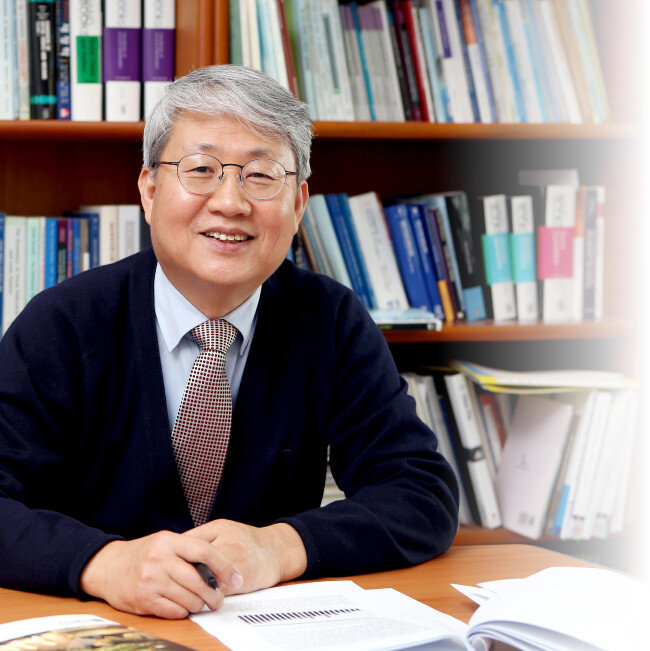
Yun Suk-myung, President of the Korean Pension Association, has focused his research mainly on pensions as a Research Fellow at the Korea Institute for Health and Social Affairs. [Dong-A DB]
“If pensions are left as they are, the country could collapse.”
The content was shocking, but the tone of Korean Pension Association President Yun Suk-myung, heard over the phone, was calm. President Yun is a pension expert recognized as such by himself and others alike. From 2002 to 2018 he served four times as a member of the National Pension Financial Estimation Committee. The National Pension financial projection is conducted once every five years. In other words, he has taken part in every National Pension financial projection since 2002 without missing a single one. He has also lent his expertise to the financial projections of the Government Employees Pension and the Private School Teachers Pension.
Ever since he took part in the 2018 National Pension Financial Estimation Committee (hereafter, the 4th financial projection), he has consistently argued that the National Pension must be reformed into “a structure in which people receive less and pay more than now.” This is because, with low fertility and population aging, the number of people paying pension contributions is falling while the number of pension beneficiaries is rising.
The current National Pension contribution rate is 9%, and the income replacement rate is 44% (40% for those insured from 2028). Paying 9% of monthly income for 40 years entitles one to receive, from age 65, 44% of one’s average income over the contribution period. In 2018 he argued that “the National Pension contribution rate should be raised gradually while the income replacement rate is lowered to 40%.”
The government, by contrast, put forward four pension reform options based on the 4th financial projection. Option 1 maintains the status quo; Option 2 maintains the current system but raises the Basic Pension from 250,000 won to 400,000 won. The Basic Pension is a kind of social security pension paid to the bottom 70% by income of the population aged 65 and over. Options 3 and 4 raise contributions and the income replacement rate at the same time. Option 3 raises the income replacement rate to 45% and the contribution rate to 12%, and Option 4 raises the income replacement rate to 50% and the contribution rate to 13%.
Government announcements that cannot be trusted
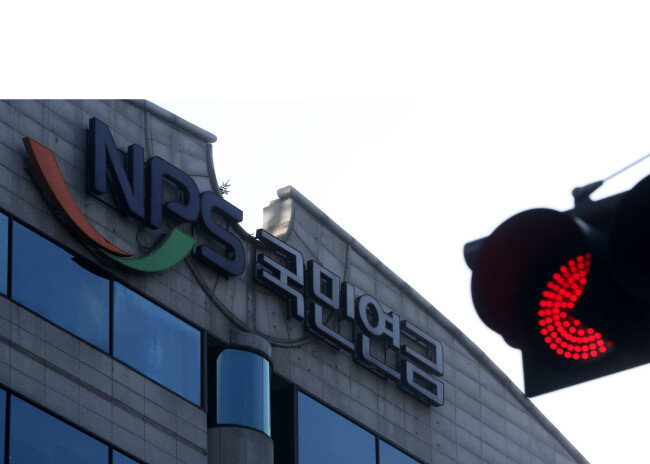
The National Pension Service Seoul Southern Regional Headquarters in Gangnam-gu, Seoul. [Dong-A DB]
- Do the government’s pension reform plans have no chance of being realized?
“None. Options 1 and 2 are effectively the status quo and cannot be regarded as reform plans. Options 3 and 4 would require raising contributions far more than originally planned.”
- The government explained that contributions would not rise.
“That is because it did not think about what happens after the fund is depleted.”
According to the 4th financial projection, the National Pension turns to deficit from 2043. In 2057 the reserves are completely exhausted. After that, the contribution rate will rise sharply. The government knew this but did not include it in the published results of the 4th financial projection.
- By exactly how much will it rise?
“In the case of Option 3, once the reserves are exhausted, the contribution rate must be raised to 36.6% to maintain a 45% income replacement rate. Under Option 4, the contribution rate must be raised to as much as 40.7%.”
- You said the country could collapse if pensions are not fixed quickly.
“The National Pension is structured so that, once deficits begin to arise, they grow exponentially. This can be seen simply from how quickly the reserves are consumed in the 4th financial projection. According to the projection, National Pension reserves reach an all-time high of 1,774 trillion won in 2042, and deficits begin in 2043. Thereafter, pensions are paid by drawing down the reserves. By 2057, the year of depletion, the reserves have been completely consumed.”
Once the reserves are depleted, the nightmare begins
- Does 1,774 trillion won over 15 years mean that more than 100 trillion won a year goes just into keeping the pension going?
“The 1,774 trillion won is the reserves. The National Pension also has contributions and investment returns. Only by adding about 30 trillion won in contributions each year plus investment returns do you arrive at the money spent on keeping the pension going. Over 15 years (2043–2057), running the National Pension alone looks set to cost about 3,000 trillion won.”
- From the point at which the reserves are depleted, it is uncharted territory. As the older population grows, it seems the deficits will gradually grow larger.
“That is right. According to government projections, the cumulative deficit will exceed 17,000 trillion won in 2088. It is just that this has not become known because the financial projection does not deal with such a distant future. If the pension system is not fixed now, it will deal a heavy blow to national finances.”
- Why does the financial projection not deal with the distant future?
“Nominally, I understand it is to improve the accuracy of the projection. From a researcher’s point of view, however, I think it is a way of keeping the reality of the pension system hidden from view. Japan projects 100 years into the future when it conducts its pension financial projection, and Canada 150 years. As people live longer, I think it is reasonable to include such a distant future in the projection in order to see changes in the population structure.”
Korea’s pension, the most stubborn in the world
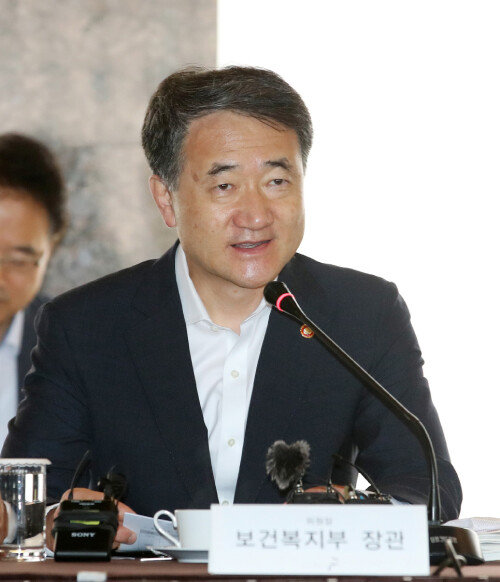
Former Minister of Health and Welfare Park Neung-hoo, who effectively signaled that he was giving up on National Pension reform. [News1]
- Since 1998, Korea has been unable to raise the pension contribution rate from 9%.
“The governing generation that drafts policy was irresponsible. If only for the sake of future generations, it should have explained to the public the need to raise the contribution rate.”
The government has now effectively given up on National Pension reform. In June 2020, then Minister of Health and Welfare Park Neung-hoo said that “the government has no further proposals to put forward (on National Pension reform).”
- Are contribution rates this low in other countries too?
“No. Most countries that operate pension systems have higher contribution rates than Korea’s National Pension. Finland’s national pension contribution rate is 24.4%, and Japan’s is 18.3%. China’s is 16%.”
- And the income replacement rate?
“Generally in the 40% range, similar to Korea. To maintain a stable income replacement rate like this, the contribution rate of a pension system must be adjusted continuously. Germany sets its contribution rate every year according to changes in △ the fertility rate △ life expectancy △ the economic growth rate. Sweden, Norway, and Finland also adjust their contribution rates in similar ways. Japan reviews and revises its pension system as a whole once every five years.”
President Yun said with a laugh, “In mid-December 2020 I had a video call with a Japanese pension expert, and the other side asked, ‘How can Korea’s pension collect so little and pay out so much money?’ Perhaps he asked because he was genuinely curious, but it sounded as if he were mocking Korea’s irrational pension system.”
- If Korea raises its contribution rate regularly from now on, will the National Pension become a sustainable system?
“Unfortunately, the golden opportunity for National Pension reform has passed. As recently as seven or eight years ago, continuously adjusting the contribution rate alone could have secured the soundness of the pension. Today’s Korea has aged further, so it must raise the contribution rate sharply in one go while also reducing the income replacement rate.”
Beyond the National Pension, public pensions are also unsound
- Since aging is a global phenomenon, are other countries also reducing their income replacement rates?
“The global trend is to raise the income replacement rate and the contribution rate together. Having raised contributions sufficiently, these countries can raise the income replacement rate. But Korea’s situation is different. First of all, the contribution rate is too low. Nothing has been decided about how the pension will be run after the fund is depleted, either. Raising the income replacement rate rashly could accelerate the depletion of the National Pension’s reserves.”
- Many people see the pension contributions collected each month as a tax, so the backlash seems likely to be strong.
“Since the money paid in increases and the money received decreases, I doubt many people will welcome it. To reduce the backlash, one approach is to merge it with the Government Employees Pension, the Military Pension, and the Private School Teachers Pension while raising only contributions first.”
- Are other public pensions, such as the Government Employees, Military, and Private School Teachers pensions, in better shape than the National Pension?
“No. The Government Employees Pension and the Military Pension are already in deficit. Unlike the National Pension, these two have their income replacement rates guaranteed by law. That means that when a deficit arises, the national treasury is opened to fill it. Because it is money the state must pay, it is called the ‘accrued pension liability.’ In 2019 alone, the accrued liabilities of the two pensions amounted to 944.2 trillion won. The Private School Teachers Pension’s fund is not yet depleted, but it is highly likely to be depleted earlier than the National Pension’s.”
According to the “Long-Term Fiscal Outlook” report released by the Ministry of Economy and Finance in September 2020, the Private School Teachers Pension will turn to deficit in 2029. In 2049 its fund will be depleted. In the report, the Ministry of Economy and Finance argued that “reform of the social pension and insurance sectors is needed.”
- Is there a reason the public pensions also need to be fixed?
“The unsoundness of public pensions burdens national finances in the long run. It is better to fix them together with the National Pension overhaul.”
Pension contribution rate must rise to 20%
- Must it really be merged with public pensions that are in deficit?
“It does not mean mixing the funds of the four pensions and managing them in an integrated way. It means that each pension manages its fund separately but the contribution rate and the income replacement rate are unified. Apart from the National Pension, the other public pensions have income replacement rates of 50% or more. In return, their contribution rates, at around 18–15%, are also higher than the National Pension’s. On this basis, the income replacement rate and the contribution rate of each pension are adjusted: the National Pension’s contributions are raised to the level of the public pensions, and the public pensions’ income replacement rates are lowered to match the National Pension’s.”
- National Pension contributors get back what they paid in once they pass 65, but public pension contributors would see their benefits cut sharply, so they seem unlikely to welcome this.
“Only for civil servants, soldiers, and private school faculty and staff who were already paying contributions before the pension overhaul, part of the loss in income replacement can be compensated. Assuming the Government Employees Pension’s income replacement rate is 50%, 44% can be paid exactly as under the National Pension and the remaining 6% returned on a defined contribution basis. Since the defined contribution approach also reflects inflation and the economic growth rate, its returns will be higher than those of financial companies’ pension products.”
- Is raising the National Pension contribution rate to 15% enough?
“Among the member countries of the Organisation for Economic Co-operation and Development (OECD), the average contribution rate in countries with pension systems is about 20% of income. Considering that most countries have income replacement rates in the 40% range, Korea too must raise its contribution rate to as much as 20%. At the same time, I think it is better to lower the income replacement rate to 40%. The contribution rate can then be adjusted later as variables such as changes in the population structure and the economic growth rate become clear.”
The National Pension is a kind of insurance into which people pay and from which they receive money back. There is also a pension, however, that people can receive without paying contributions: the Basic Pension, created in 2014. Anyone aged 65 or over in the bottom 70% by income receives the Basic Pension. The maximum payment is 200,000 won a month.
- Some point out that, because of low fertility and population aging, the Basic Pension will also become a burden. What do you think?
“Korea is a country that does not need a Basic Pension. Pensions and the National Basic Living Security System (NBLSS) alone can help low-income older people. On the contrary, there are cases where, because of the Basic Pension, people fail to receive welfare benefits they ought to get. It would be better to enroll low-income older people in the National Pension and give them jobs.”
- In the 2017 statistics on “elderly poverty rates in major OECD countries,” 44% of all older people were found to be poor (below 50% of median income). Korea ranked first among the major countries. Does that not mean that that many older people are experiencing economic hardship?
“The statistics have a blind spot. The OECD’s elderly poverty rate is calculated on the basis of disposable income. That is, only cash assets are treated as wealth. Assets that are difficult to convert into cash immediately, such as real estate, are left out of the statistics. By this standard, even an older person who lives in an apartment worth 2 billion won near Gangnam in Seoul and receives living expenses from their children could count as poor.”
According to the report “A Study on Calculating Various Elderly Poverty Indicators,” released by the Korea Institute for Health and Social Affairs in March 2018, when comprehensive assets including real estate are considered, only 21 in 100 are poor. Of the older population, 66.3% held more wealth than the average household assets (445.43 million won).
The Basic Pension is an unnecessary system
- The Nordic welfare states have basic pension systems. Does Korea not need one too?
“The countries famous for their basic pension systems are Norway, Sweden, and Finland. Of these, Sweden and Norway have abolished their basic pensions. Finland paid a basic pension to 94% of older people until the 1990s, but since 2005 it has reduced eligibility to 45% of older people. In effect, even welfare states are abolishing basic pensions.”
- Is there no way to fix the Basic Pension system and keep using it?
“The current Basic Pension is a load that only burdens future generations. Because it supports 70% of older people, its income redistribution effect is not large either. If the ultimate purpose of the Basic Pension is to help poor older people, it would be better to pay a livelihood-type benefit only to older people who are poor.”
https://shindonga.donga.com/society/article/all/13/2440081/1