
(Aju Business Daily) [Aju Special Interview] Former Korean Pension Association President Yun Suk-myung: “Must Transition to a Defined Contribution Pension That ‘Pays According to Contributions’” (May 27, 2025)
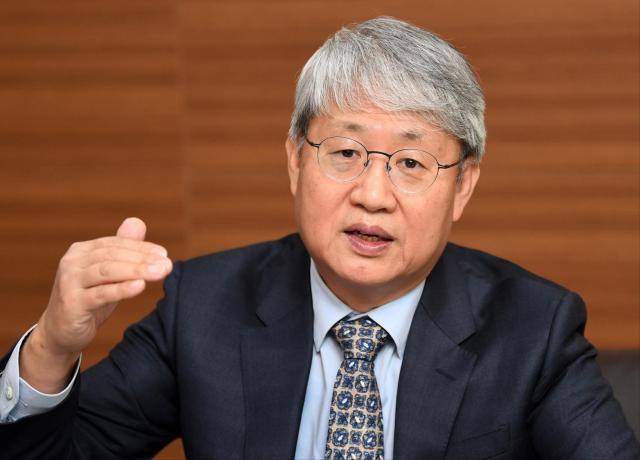
“Separating the old and new pension tiers is the direction that must be pursued over the long term. Once the contribution rate reaches 13% in 2033, the gradual transition to a defined contribution pension that ‘pays according to contributions’ must be accelerated.”
In an interview with the Aju Business Daily, Yun Suk-myung, Research Fellow Emeritus at the Korea Institute for Health and Social Affairs (KIHASA) and former President of the Korean Pension Association, argued that “completing the first-stage reform is a prerequisite for separating the old and new pension tiers. Given that pension benefits are severely inadequate at the current contribution level of 9%, the National Pension contribution rate must be raised to at least 13% before a system separating the old and new tiers can be introduced.”
Yun explained that “separating the old and new pension tiers means transitioning to a system that ‘pays according to contributions.’ A roadmap is needed: lay the foundation through the first-stage reform, then pursue the separation of the old and new tiers as the second stage,” adding that “as the first stage, starting next year, the Japanese macroeconomic slide concept should be applied immediately to beneficiaries, while a Finnish-style quasi-automatic adjustment mechanism is introduced at the same time for contributors. The burden on beneficiaries and contributors needs to be adjusted automatically.” He went on to say that “until the contribution rate reaches 13% in 2033, the preparatory work for a proper second-stage reform must be done,” adding, “From 2033, the transition to a pension system that ‘pays according to contributions’ must be accelerated. That means a transition to a defined contribution approach is unavoidable.” He also stressed that “at the same time, creative ways of securing revenue are essential, such as introducing an earmarked tax to reduce the unfunded pension liability so that the first and second baby-boom generations share the burden, and overhauling the pension income tax and the inheritance tax,” and that “through this process, the shifting of burdens onto future generations must be prevented and a sustainable pension system must be built.”
The following is the question-and-answer session with Yun.
- What state is the National Pension in? And what about the golden opportunity for pension reform?
“The National Pension is currently in a serious crisis in which it is structurally unsustainable. Since the half-hearted reform attempted under the Roh Moo-hyun administration in 2007, there has been no proper reform for 18 years, and with low fertility and population aging, the burden on future generations is growing exponentially. The golden opportunity for pension reform is assessed to have already passed. This means that immediate and fundamental reform is needed, since the deterioration of National Pension finances accelerates as time goes by.”
- Parametric reform was achieved, if only barely. What is the next task for pension reform?
“The recent overhaul pushed back the date of fund depletion, but the contribution burden that will apply after the fund is depleted has risen even further, so in the end the structure only increases the burden on future generations. The pay-as-you-go contribution rate rises from 36% to 39%, and if the mandatory contribution age is extended by five years, the contribution rate is expected to exceed 40%. That is an unrealistic burden, requiring more than 40% of one’s monthly wage to be paid in contributions, and since contributions cannot simply be raised without limit, the pension accrual rate—that is, the income replacement rate—must be lowered realistically to reduce benefit amounts. The next task is to push ahead quickly with a proper reform that strikes a balance between ‘the amount received’ and ‘the amount paid in.’”
- Why is an automatic adjustment mechanism needed?
“The National Pension faces a surge in the contribution burden because of demographic changes such as the rapid rise in life expectancy and low fertility. The mandatory contribution age, currently 59, should be extended to 64, but that alone pushes the contribution rate above 40%, which is unsustainable. The National Pension’s enormous unfunded liability (projected at more than 120% of GDP in 2050) clearly shows the fiscal risk. Introducing an automatic adjustment mechanism, as OECD countries have, so that pension benefits and contributions are adjusted to circumstances, is essential. The government’s plan to introduce a Japanese-style macroeconomic slide 10 to 30 years from now is nothing more than a blame-avoidance strategy; it should be introduced immediately, together with a Finnish-style quasi-automatic adjustment mechanism, to ease the burden on the younger generation.”
- Is there no way to increase the average monthly National Pension benefit?
“The most effective ways to increase National Pension benefits are labor market reform and extending the contribution period. OECD countries such as Norway and Sweden have extended the contribution age to 65 or older, even to 75, and adjust contribution periods and benefit amounts naturally through automatic adjustment mechanisms. In Korea too, extending the mandatory contribution age by five years to 64 would raise the income replacement rate substantially and also ease the decline in the number of National Pension contributors. Another approach is to convert the National Pension into a 100% earnings-related scheme and raise the ceiling on pensionable earnings so as to increase the pension amounts of high earners. For low earners, social equity can be maintained by expanding the Basic Pension. Through such institutional reforms, it is possible to increase National Pension benefits in real terms.”
- What measures are needed to stabilize National Pension finances? How should it be reformed?
“The foremost principle for stabilizing National Pension finances is that the cumulative deficit and the unfunded liability must not increase any further. A transition to a defined contribution scheme that ‘pays according to contributions’ is now unavoidable, and as a step before that, a Finnish-style quasi-automatic adjustment mechanism combining defined benefit and defined contribution elements needs to be introduced. Given the reality that the cumulative deficit increases by about 1,000 trillion won each time National Pension contributors stay insured for one more year on average, extending the mandatory contribution age could cause more than 5,000 trillion won in additional deficits. The March amendment did not properly reflect this reality. Therefore, realistic assumptions must be reflected in National Pension financial projections and policy decisions, and comprehensive reform—extending contribution periods, making contributions realistic, adjusting the accrual rate, and so on—must be implemented swiftly.”
- In what direction should the pension reform debate proceed from here?
“From now on, the pension reform debate must proceed on the basis of complete transparency and openness. At present, the financial projections and key assumptions are managed exclusively by the government and the political sphere, making it hard for the public and the media to obtain proper information. Therefore, all meetings related to pension reform should be livestreamed on YouTube so that any citizen can take part or watch, and minutes recording in detail what was said, with the real names of all participants, should be produced and disclosed immediately. If an approach were adopted like that of Japan’s Ministry of Health, Labour and Welfare, which posts minutes on the government website for anyone to see, public trust would be restored and a rational reform debate would become possible.”
- What would you ask of the government and the National Assembly?
“The National Pension issue must no longer be used as a tool for winning votes. It is urgent to exclude partisan logic from the pension reform debate and to formally declare its depoliticization. Members of the National Assembly of the Republic of Korea in particular must give up their privileges and show a responsible attitude toward the public. The biggest problem is the irresponsible conduct of the political sphere, which has created an environment in which public officials find it hard to act on their convictions and to communicate the seriousness of the pension problem transparently; the government, too, must not hide or distort the situation but must candidly explain the reality of the pension crisis to the public and seek its understanding. The pension reform experiences of advanced countries and objective data must be communicated transparently to the public, and the practice of ‘packaging deterioration as reform’ must stop.”


