(Weekly Kyunghyang) Interview with Yun Suk-myung, Research Fellow at the Korea Institute for Health and Social Affairs: “Partisan Logic Must Not Intrude on the Pension Issue” (February 9, 2022, 08)
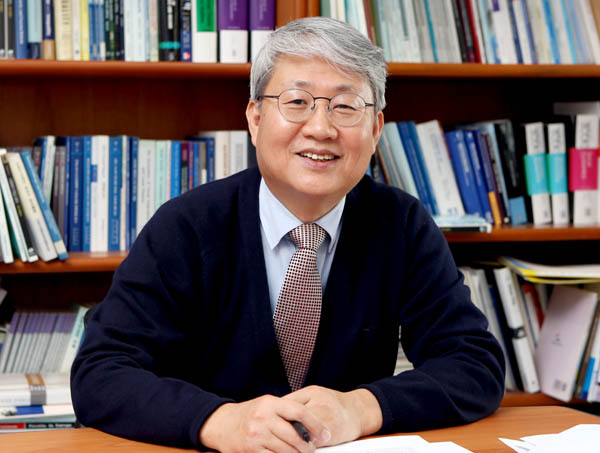
Photo courtesy of Research Fellow Yun Suk-myung
“I hope National Pension reform is done properly, regardless of political camp or ideology.”
This was the answer that came back when Yun Suk-myung, Research Fellow at the Korea Institute for Health and Social Affairs (KIHASA), was asked about the future of the National Pension. He is a National Pension expert who served as a member of the National Pension Financial Estimation Committee for the first through fourth rounds (2002–2018) of the National Pension financial projection, which is conducted every five years. As he also serves as President of the Korean Pension Association, late last year he urged the ruling and opposition presidential candidates to prepare National Pension pledges. He is regarded as an expert who places great weight on the fiscal stabilization of pensions.
The 35-year-old National Pension stands at a critical crossroads. In 20 years the National Pension will turn to deficit. With the fertility rate falling so steeply, that point is likely to come even sooner. After that, it will have to travel “a road never traveled before.” Ahead of the presidential election and of the fifth financial projection, discussion of which begins this year, we asked Research Fellow Yun for an interview to examine “the road the National Pension must take.” We met him by Zoom videoconference on the afternoon of January 26. He stressed that “swift pension reform is needed to reduce the burden on the next generation even a little, and to persuade the public, the government must convey accurate information.” He also advised that the next administration should set the direction of pension reform around politically neutral experts.
- In the span of a month, the National Pension issue has come up a great deal. A press release stating that “those born in 1990 or later will not receive the National Pension” also drew attention.
“The MZ generation should pay close attention. The pension problem had been beneath the surface, but as a consensus has formed recently, there has been quite a bit of discussion since December last year. The Korean Pension Association held a debate on the presidential candidates’ pension pledges, and awareness of the problem was just then erupting in the media, progressive and conservative alike.”
- What state is the National Pension in?
“The most important thing in pensions is the demographic variable. It is linked to how long people receive pensions (life expectancy) and to who will support them (the total fertility rate—the average number of children one woman of childbearing age, 15 to 49, is expected to bear over her lifetime). Along with life expectancy, Korea’s older population is growing at the fastest pace among the countries of the Organisation for Economic Co-operation and Development (OECD). Its fertility rate is the lowest not only in the OECD but in the entire world (United Nations Population Fund, 2020). Pension finances are deteriorating enormously.”
- Some take the view that the finances can be covered by the money set aside, the reserves. The argument is that with about 920 trillion won (2021) on hand, worries about depletion are overblown. It is also said that no country has accumulated as much in reserves as Korea.
“Because the National Pension is a defined benefit scheme—that is, one that has promised to pay a precise amount—the sum already promised to the public in this way exceeded 2,500 trillion won as of September 2021. Even with 920 trillion won actually set aside, it is more than 1,500 trillion won short. One must not point to that and say that, because there is 920 trillion won, the scheme is in better financial shape than other countries. Politicians are misusing the facts about these reserves, and that has made the National Pension debate extremely difficult. When 2,500 trillion won is needed and only 920 trillion won is on hand, can one say it is enough? Countries such as Germany and Sweden have pension histories of around 100 years and are at the mature stage. They have accumulated the experience of paying and receiving pensions since their great-great-grandparents’ day. Korea’s National Pension is only 35 years old. Not all of the baby-boom generation (narrowly defined, those born 1955–1963, about 7.3 million people) have yet begun to draw pensions, so pension payments are not large. Around 2030, when they begin to draw benefits in earnest, the problems that have been festering will burst. By then, so much debt will already have been incurred that the situation will be beyond remedy.”
- So you are saying pension reform is urgent?
“Yes. Years that pass without reform cannot be brought back, like river water that has flowed away. That is because no further contributions can be collected from people who have already left the labor market. Reforming pensions quickly means collecting more from those now in the labor market while they can still pay contributions, before they become pension beneficiaries. Had contributions been raised 20 years ago, that much more could have been collected, but a great deal of time has slipped away amid talk that ‘we can just collect taxes later and pay the benefits’ and ‘there is no problem because there are reserves.’”
- According to the fourth financial projection the government released in 2018, the National Pension “turns to deficit” in 2042 and is “depleted” in 2057. What exactly will happen?
“The reserves will in effect vanish within 15 to 16 years. What matters here is that what disappears then is not merely the 1,788 trillion won (accumulated up to that point) but also the investment returns generated by that fund and the contributions paid each year by the insured (as beneficiaries come to outnumber contributors). Taking this into account, I ran the numbers: roughly 2,500 trillion won or more disappears within a mere 15 to 16 years.”
- How do you view the argument that once the fund is used up, pensions can be paid from the contributions collected as they come in, plus taxes?
“The National Pension is not the only thing that must be plugged with taxes. The Government Employees Pension and the Military Pension, which are already generating national liabilities, and the deficits of the National Health Insurance must also be covered with taxes. Who on earth will pay all those taxes? About 40% of Korea’s economically active population pays no income tax. According to 2019 data from the National Assembly Budget Office, the contribution rate after the National Pension fund is depleted (which later generations would have to pay to keep the National Pension going) rises to 34% of income by 2080 (it is currently 9%). Would young people want to live in a society like this, which tries to collect everything from those who come next?”
- The “baseline scenario” of the fourth financial projection assumed fertility rates of 1.2 in 2017, 1.32 in 2030, and 1.38 in 2060. The “low-fertility alternative,” which assumed that fertility would worsen relative to the baseline, likewise applied 1.14 in 2017, 1.07 in 2030, and 1.12 in 2060. In reality, the rate fell further, to 0.92 in 2019 and 0.84 in 2020.
“What is frustrating is that Japan, in addition to its financial projection every five years, also runs a projection once in between. With the plunge in fertility and COVID-19, the present situation is hardly normal. When there are enormous changes like these, a responsible government at the very least has no reason to wait the full five years. All that is needed is to apply the changed demographic assumptions to the existing calculation, but it is not being done. History can only judge this poorly.”

- It would be reasonable to expect the fifth financial projection, due next year, to show a worse outlook than the fourth.
“We have squandered the entire golden opportunity…. It is exactly like shouting ‘All is well’ when the enemy has already advanced right before our eyes, and then cutting the bridge and running away. Many variables, including the fertility rate, have also become much worse. For a pension system of a social-insurance character that operates by collecting contributions, this means it has entered a more difficult state than five years ago. The fourth financial projection itself reflected an optimistic view, and (for now) there seems to be little that is likely to improve.”
- You keep stressing that the “facts” about the National Pension must be properly communicated.
“The very first thing to do is to tell the facts as they are. Partisan logic must not intrude on the pension issue, nor should it become an ideological sacrifice. Because even pensions have been swept up in partisan logic, the structure is such that the facts do not come out as they are. There must be minutes from the fourth financial projection, surely. Those minutes should be disclosed in full with real names. At present only anonymized summaries are provided, making it impossible to know who on earth said what. Japan posts the full minutes of important meetings on the website of the Employees’ Pension Insurance (the equivalent of Korea’s National Pension). Without disclosure, distortion occurs, and people who said things contrary to the facts later change their story, claiming they never said such things.”
- Korea has kept the contribution rate at 9% for 24 years. Since raising it has been avoided for so long, I wonder whether any future increase would have to be very large.
“Not having raised it for 24 years corresponds, to give a very extreme example, to a period of about 80 years in Western terms. That is because our economy grew in such a compressed way and population aging is also progressing rapidly. When I argued for a contribution increase at the Fiscal Stabilization Committee held in 2003, there was fierce opposition even within the expert group. I asked in return, ‘If we do not raise contributions now because the economy is in bad shape, will we be able to do it later?’ In the end, it was not accepted. Some countries have introduced an automatic adjustment mechanism so that pensions are adjusted automatically when the fertility rate falls and life expectancy rises. They have no need to fight, as we do, over whether to raise contributions a little or cut benefits a little. Only by further intensifying National Pension reform can we hope, just barely, to come anywhere close to such countries.”
- Contributions are money deducted straight away every month, so raising them seems likely to provoke a strong backlash. In fact, the public awareness survey released by the Ministry of Health and Welfare in 2018 showed that while people broadly agreed on the need for pension reform, opposition to paying more was also high. How can this contradiction be overcome?
“Do the government and experts exist for nothing? The Roh Moo-hyun administration’s pension reform of 2007 did not just happen by itself. The government must engage in dialogue with the members of society. It must explain: ‘This was not originally how it was meant to be run, but it became tangled up socially; other countries have already changed it after going through growing pains; and if we simply leave the National Pension alone, all that awaits us is the total collapse of our society.’ The Roh Moo-hyun administration played that role a great deal. Now, surveys and the like are conducted without properly informing the public, so there is no way the answers can come out right. I want to say something pointed to the current administration. The National Pension is a nationally important agenda item. If it lacks the confidence to solve on its own a problem on which the nation’s fate hangs, it should at least put the matter to public deliberation. Is this something to be avoided just because it is burdensome? Is that not why it was handed 180 seats?”
- There was a strong backlash at the time of the Roh Moo-hyun administration’s pension reform as well. The carrot the government held out while cutting the income replacement rate from 60% to 40% was the introduction of the Basic Pension. Currently 300,000 won a month is paid to 70% of older people aged 65 and over. I recall that you expressed a negative view of this Basic Pension.
“Eligibility criteria should broadly take in recipients’ income and assets; there are almost no countries that pay unconditionally just because someone has reached a certain age. The core of Korea’s elderly poverty problem is older people exposed to absolute poverty. Will giving 300,000 won a month to 70% improve their poverty? My argument was that we should give up universality, select the vulnerable as the focus, and spend the money in the optimal way so that they can escape poverty. We should go with an approach that targets the bottom 30% exposed to poverty, ‘guaranteeing those who need it at least enough to escape poverty.’ I did not oppose it unconditionally.”
- Some demand that, to restore trust in the National Pension, a payment guarantee be written into law. How do you see that?
“The pension system became unsustainable because the state ran it poorly. If the payment guarantee is written into law and nailed down, it could completely block any subsequent debate on pension reform or on moving pensions in a different direction. The reaction will inevitably be, ‘Why reform when payment is guaranteed?’ Some claim that Germany has a payment guarantee provision, but that is not true. Neither Germany nor Japan has an explicit provision. (To restore trust,) introducing mechanisms for fiscal stabilization takes priority over writing the payment guarantee into law.”
- How do you assess the current administration’s National Pension policy?
“Other countries have depoliticized their pension systems as far as possible. That is because it is an important matter in which, beyond what shows on the surface (such as the size of the reserves), there are more than one or two underlying problems and many explosive issues are intertwined. As I mentioned, we have already missed the golden opportunity. This administration conducted the debate while hiding the facts. Because a small number of experts whose views are far removed from global trends led the pension overhaul debate, precious time slipped away as years were wasted on proposals that could become a laughingstock in the international community. It is no exaggeration to say that, where the pension issue is concerned, it is the worst of all administrations.”
- What do you see as the role and tasks of the next administration?
“I hope the next administration gathers politically neutral experts and produces a report that, at the very least, shows the situation facing the National Pension objectively and without distortion. On the basis of that report, the political sphere, the media, and civic groups should discuss the direction of the overhaul. It would also be meaningful to put the overall social security arrangements surrounding public pensions to public deliberation and to lay the facts bare to the public without embellishment. Even if pension reform is delayed by a year or two, we must go in that direction. We should first look closely at the paths taken by other countries worth emulating. When it comes to National Pension reform above all, I truly hope it is done properly, regardless of political camp or ideology.”