
(Weekly Chosun) Former Korean Pension Association President Yun Suk-myung: “Even the Slightest Increase in the Income Replacement Rate Would Be Deterioration, Not Reform” (February 14, 2025)
The dying embers of pension reform in the political sphere have flared up again. This follows the People Power Party’s statement, in response to the Democratic Party’s demand for “parametric reform first” in February, that “if the ruling and opposition parties agree to form a special committee, we will accept discussing parametric reform first.” Acting President Choi Sang-mok urged the National Assembly to produce an agreement swiftly, saying that “for the National Pension to be run stably without anyone bearing an excessive burden, a social consensus on ‘paying more and receiving less’ is essential.”
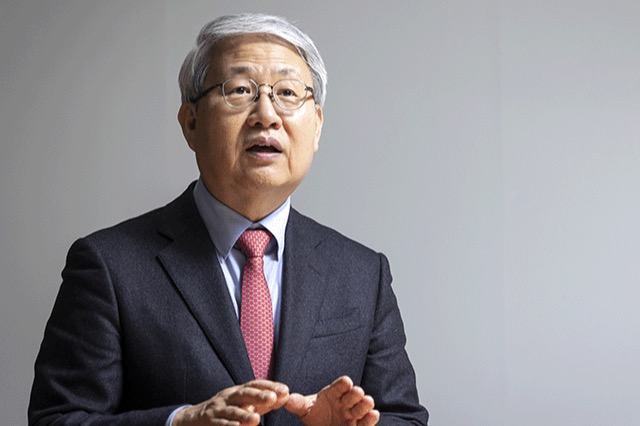
During the 21st National Assembly, the ruling and opposition parties agreed on raising the contribution rate to 13%, but diverged on the income replacement rate: the People Power Party advocated for 43%, while the Democratic Party called for 45%. Accordingly, there was speculation that if parametric reform were to take place this time, it would be negotiated within a range of 43–45% for the income replacement rate. Nevertheless, Yun Suk-myung, Research Fellow Emeritus at the Korea Institute for Health and Social Affairs (KIHASA) and former President of the Korean Pension Association, emphasized that “raising the income replacement rate by even 0.001 percentage points would constitute ‘deterioration,’ not ‘reform,’” and that “what the ruling and opposition parties agreed upon was solely the increase in the contribution rate.”
Yun is a pension expert who took part in every one of the 1st through 5th (2003–2023) National Pension Financial Estimation Committees. Over nearly 30 years of research as a Research Fellow at the Korea Institute for Health and Social Affairs, he has attended the Organisation for Economic Co-operation and Development (OECD) Pension Experts Meeting as Korea’s representative since 2006, and he has served as President of the Korean Pension Association.
The Pension Future Forum, led by Yun, held an emergency press conference at the National Assembly on February 4, and subsequently convened a seminar on February 11 to discuss the desirable direction of pension reform. Yun, a pension specialist who places particular emphasis on the sustainability of the system and on securing intergenerational equity, was interviewed on February 12 in Jung-gu, Seoul.
- People Power Party floor leader Kweon Seong-dong recently said, “We will accept discussing parametric reform first.” Will the income replacement rate be settled somewhere between 43% and 45%? “All that the ruling and opposition parties agreed on was raising the contribution rate to 13%. The contribution rate increase alone should be done in one shot. Handling the contribution rate and the income replacement rate as a package is not ‘reform’ but ‘deterioration.’ The People Power Party did not propose raising the income replacement rate either. The idea is to form a National Assembly Special Committee on Pension Reform, first pass the agreed contribution rate increase in February, and then, as the next top priority, discuss the income replacement rate while also examining the various complex elements of structural reform together to check the coherence of the system. Acting President Choi Sang-mok also stressed that ‘a social consensus on paying more and receiving less is essential.’ This is the key.”
- Last year, the citizen representatives of the Public Deliberation Committee on Pension Reform chose the “pay more, receive more” plan. “Under the plan of a 13% contribution rate and a 50% income replacement rate, the pay-as-you-go cost rate (the contribution rate needed to cover the year’s benefit expenditure with that year’s contribution revenue alone once the National Pension Fund is depleted) reaches 43.2% in 2078. The lifetime contribution burden rates of those born in 2005 (14.8%) and those born in 2035 (36.1%) differ by 21.3 percentage points. This was included in the learning materials for the first round of citizen representatives of the National Assembly’s Public Deliberation Committee, but a few members of the committee agreed to remove it and remade the learning materials. The citizen representatives made their decision without having learned such important information. Who would choose a plan under which nearly half of one’s monthly salary must be paid in National Pension contributions?”
- The pension reform plan the government announced last September included an “automatic adjustment mechanism.” “Seventy percent of OECD member countries have already introduced an automatic adjustment mechanism. I, too, have argued since 1999 that one should be introduced. But the earliest introduction date the government proposed is 2036, when pension expenditure will exceed contribution revenue. The latest introduction date is 30 years from now. Above all, because it touches only the inflation indexation of beneficiaries’ pensions, and considering that pensions are received for 25 years, it will be 55 years from now before the full effect of the automatic adjustment mechanism actually appears. The automatic adjustment mechanism should be introduced right away and applied not only to beneficiaries but also to contributors.”
- How does the automatic adjustment mechanism work? “There are three important factors in running a pension system: the fertility rate, life expectancy, and the economic growth rate. In 2004 Germany introduced a ‘sustainability factor’ into its pension system so that pension amounts are cut if the fertility rate falls, average life expectancy rises, or the economic growth rate declines. Finland’s ‘life expectancy coefficient’ deducts a corresponding amount from the pension paid each year when rising life expectancy lengthens the period over which pensions are paid. In that case, working time is extended in step with the rise in average life expectancy so that pension amounts do not shrink.”
- The People Power Party wants to create a special committee on pension reform at the level of the National Assembly, whereas the Democratic Party wants the discussion held in a special committee under the National Assembly Health and Welfare Committee. “It fell through when the emergency martial law incident occurred in early December last year, but I understand that in mid-November last year the ruling and opposition parties reached an agreement at the working level on forming a special committee on pensions. Currently the Health and Welfare Committee has 14 Democratic Party members and 8 People Power Party members. Including Representative Lee Ju-young of the Reform Party and Representative Kim Sun-min of the Rebuilding Korea Party, opposition members number 16. For proper discussion to take place, a National Assembly Special Committee on Pension Reform must be formed with equal numbers from the ruling and opposition parties.”
- Among young people, there are even calls to abolish the pension. “The National Pension contribution rate is 9%, yet the income replacement rate is 40%. Retirement pensions collect 8.33% of wages, yet their income replacement rate is only about 10%. The National Pension is an advantageous system because the state performs the role of the best financial institution—that is, generating high returns. Young people’s call to abolish the pension ultimately means that we should move to a defined contribution (DC)-type automatic adjustment mechanism. Sweden already runs such a system, under which you receive as a pension the contributions you paid plus a certain amount of interest. Put simply, the money I pay goes into my own account.”
- According to official statistics recently released by the National Pension Service, the total number of National Pension contributors fell by about 573,000 from the end of last year. “The decline in contributors has not yet begun in earnest. Since the National Pension covers those aged 18 and over and people effectively join from around age 25, the impact of falling fertility appears with a lag of about 20 years. Many people think only that falling birth rates reduce new contributors, but once the first and second baby boom generations, which account for a very large share of the entire cohort, exit (as beneficiaries), the number of contributors will fall enormously.”
- There are various structural reform options; what should be done first? “The reason the effective income replacement rate feels low is that contribution periods are short and it is not an earnings-related pension. The National Pension should be converted into an earnings-related pension, and the mandatory contribution age should be extended by five years, from 59 to 64, through post-retirement re-employment. Extending the mandatory contribution age by five years has the same effect as raising the income replacement rate by 5 percentage points. Extending the mandatory contribution age can also ease the decline in the number of National Pension contributors. In addition, the number of Basic Pension recipients, currently older people in the bottom 70% by income, should be reduced, and a higher National Pension accrual rate should be applied to low-income earners.”
- Is there no way to secure old-age income? “In Denmark, the Netherlands, Australia, and elsewhere, retirement pensions account for more than 70% of the income replacement rate. At the OECD Pension Experts Meeting, when I asked Andrew Reilly, a pension analyst, ‘How can our retirement pensions be included in the OECD’s criteria for calculating the income replacement rate?’, the answer came back: ‘If retirement pensions are applied to 80% or more of those eligible, they can be included in Korea’s income replacement rate.’ If the current 53% retirement pension coverage rate is raised to 80% or more through the gradual introduction of mandatory measures, it can be recognized in the OECD’s official income replacement rate. Together with retirement pensions, the actual income replacement rate could rise to 55% or more.”


