(Dong-A Ilbo) [Exclusive] Teenagers: “Why Will No One Listen to Us, Who Will Inherit the National Pension ‘Bomb’?” (May 11, 2024)

Not Once in Two Years of Public Hearings or 24 In-Depth Interviews
Were Young People Invited — Left Out of the Debate
National Pension reform has ultimately fallen through in the 21st National Assembly. What do the future generations who must shoulder the burden think?
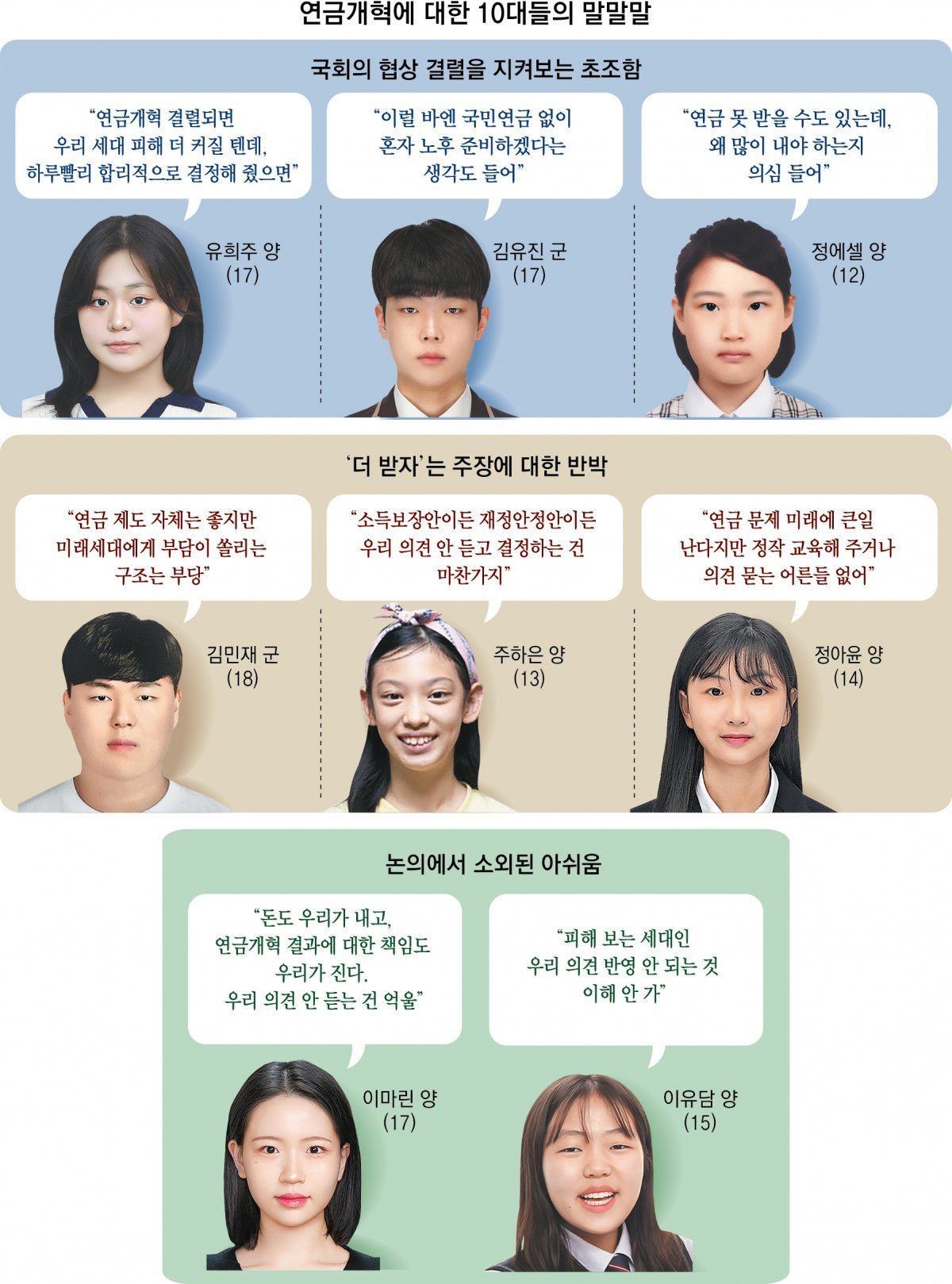
From the 3rd to the 8th, the Dong-A Ilbo interviewed 10 young people aged 12 to 18, including the four members of the presiding board of the Korea Children’s Congress. They protested that “an adult-centered, ‘tilted structure of debate’ has produced an outcome unfavorable to future generations.” Kim Min-jae (18) remarked pointedly, “It is nonsensical to say you are worried about fund depletion and then postpone reform or say ‘we will take more.’ Was it not only the adults who will soon receive pensions who got together and reached a distorted conclusion?” Jung A-yoon (14) said, “The responsibility for explaining what burden we will carry lies with the adults.”
It emerged on the 10th that, while the government and the National Assembly held dozens of public hearings and similar events over the past two years or so, they never once properly heard the views of young people—the very people who will be hit by the “contribution bomb” some 30 years from now.
From August 2022, the Ministry of Health and Welfare conducted a total of 24 “National Pension stakeholder focus group interviews (FGI)” over one year. But all of them targeted adults, such as labor unions, business people, and National Pension Service employees. In the 100 pages of interview material, words such as “children,” “adolescents,” or “kids” were not mentioned even once. The subjects of the Ministry’s public survey (2,000 people) and of the deliberative poll of the National Assembly Special Committee on Pension Reform’s citizen representatives (500 people) were likewise all aged 18 or older.
“Reform Collapsing Is Bewildering and Makes Us Resentful…
We, Who Will Be Hit by the ‘Contribution Bomb,’ Are Citizens Too”
[Saturday Feature]
Listening to the Voices of Young People Left Out of National Pension Reform
Government, in Dozens of Rounds of Opinion Gathering, Excluded the Views of the Future Generations Who Will Bear the Burden
“Adults Who Will Never See Their Pensions Cut Off Decide… Are We Ignored Because We Cannot Vote?” Discontent Grows
Nine in 10 Young People Who Saw the Special Committee’s “Income Security Plan” Oppose It: “Too Great a Burden”
“All Generations Should Share the Fiscal Burden, and Support Such as Job Creation for Older People Is Needed”

《National Pension reform is in danger of falling through in the 21st National Assembly. After much difficulty, the ruling and opposition parties reached a consensus on raising “the money paid in” (the contribution rate) from the current 9% to 13%. But they failed to agree on whether to raise “the money received” (the income replacement rate) from the current 40% to 43% or to 45%. At a press conference on the 9th, President Yoon Suk-yeol said, “Let us pass it on to the 22nd National Assembly and discuss it more thoroughly.”
From the 3rd to the 8th, the Dong-A Ilbo reporting team conducted in-depth interviews with 10 young people aged 12 to 18, including the four members of the presiding board of the “Korea Children’s Congress,” a meeting at which representatives of children and adolescents from across the country gather to voice their views on social problems. They are the very people who will be saddled with a “contribution bomb” amounting to one-third of their monthly pay after 2055, when the fund is depleted. Yet they have been excluded from the debate on overhauling the National Pension. What do future generations think of the older generation’s reform debate and of the National Pension’s future? We showed them materials such as the summary of the financial projection data that the Special Committee on Pension Reform provided to the 500 citizen representatives, and asked for their views.》
“Two percentage points? That does not seem like such a big difference….”
Lee Yu-dam (15), a third-year student at a middle school in Daejeon, said this on the 8th with a hollow laugh. She had just heard the news that pension reform was in danger of running aground because, the day before, the National Assembly Special Committee on Pension Reform had failed to narrow a 2-percentage-point gap over the proposed increase in the income replacement rate. Sighing during the interview, Lee said, “Whatever (the income replacement rate) ends up being, the fund will be depleted in our generation all the same.” Lee added, “Rather than simply forcing the burden onto future generations, I hope they will reflect the views of the youth generation as soon as possible and find a reasonable solution.”
● “Have You Ever Thought About Our Future?”
When pension reform, pursued for the first time in 17 years since 2007, ran aground, young people could not hide their disappointment. According to the Korea Development Institute (KDI), every year that pension reform is delayed is estimated to increase the economic burden on future generations by trillions to tens of trillions of won.
Jung A-yoon (14), who attends a middle school in Hwaseong, Gyeonggi Province, said, “If pension reform fails because the ruling and opposition parties cannot agree, will we children and adolescents not end up bearing that fiscal burden later? The very fact that they put off that responsibility to the next National Assembly is bewildering, and I even resent the choices the adults have made.” She lamented, “I want to ask the adults who cling only to their own opinions, ‘Have you ever thought about our future?’”
The young people raised doubts, asking, “Will pension reform get done just because it is the next National Assembly?” Kim Min-jae (18), a third-year high school student, lamented, “Seeing pension reform fail, when I thought it would finally happen this time, makes me anxious that it may not be resolved even within a few years. Not only pensions but every responsibility for supporting the elderly, including health insurance, will fall on us, and it makes me angry that the adults seem so indifferent.”
They said 2055, when the National Pension fund is scheduled to be depleted, is not such a distant future for them. Yoo Hee-ju (17), who lives in Seoul, sighed, “I have heard that the fund will be depleted before people my age even turn 50. Is this not a problem that must be solved as soon as possible? I do not know when on earth they intend to solve it.”
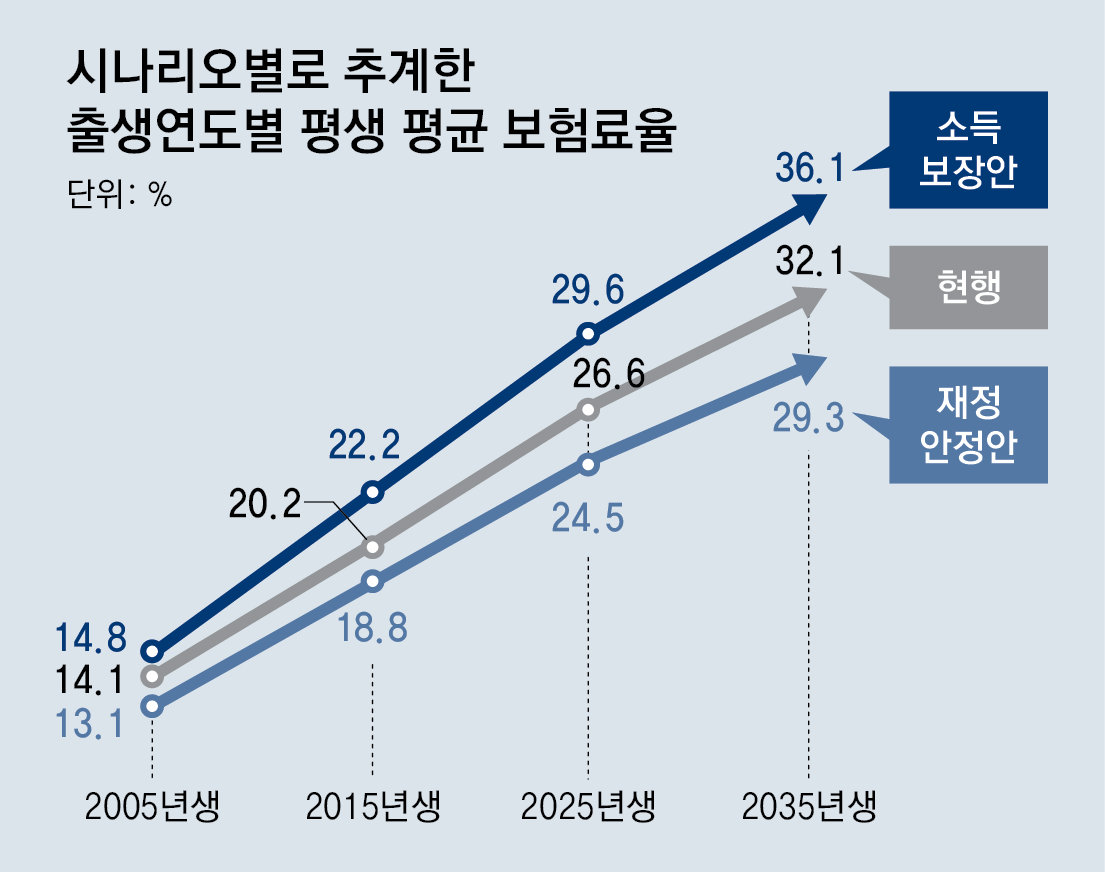
Each time reform is postponed, future generations receive an ever more expensive bill. The contribution rate needed right away to maintain the fund until 70 years after the projection date was 12.72% in 2013, but rose to 16.02% in 2018 and 17.86% in 2023. Since the contribution rate the National Assembly is now discussing is around 13%, the entire difference becomes a burden on future generations.
● Nine in 10: “‘Let Us Receive More’ Makes No Sense”
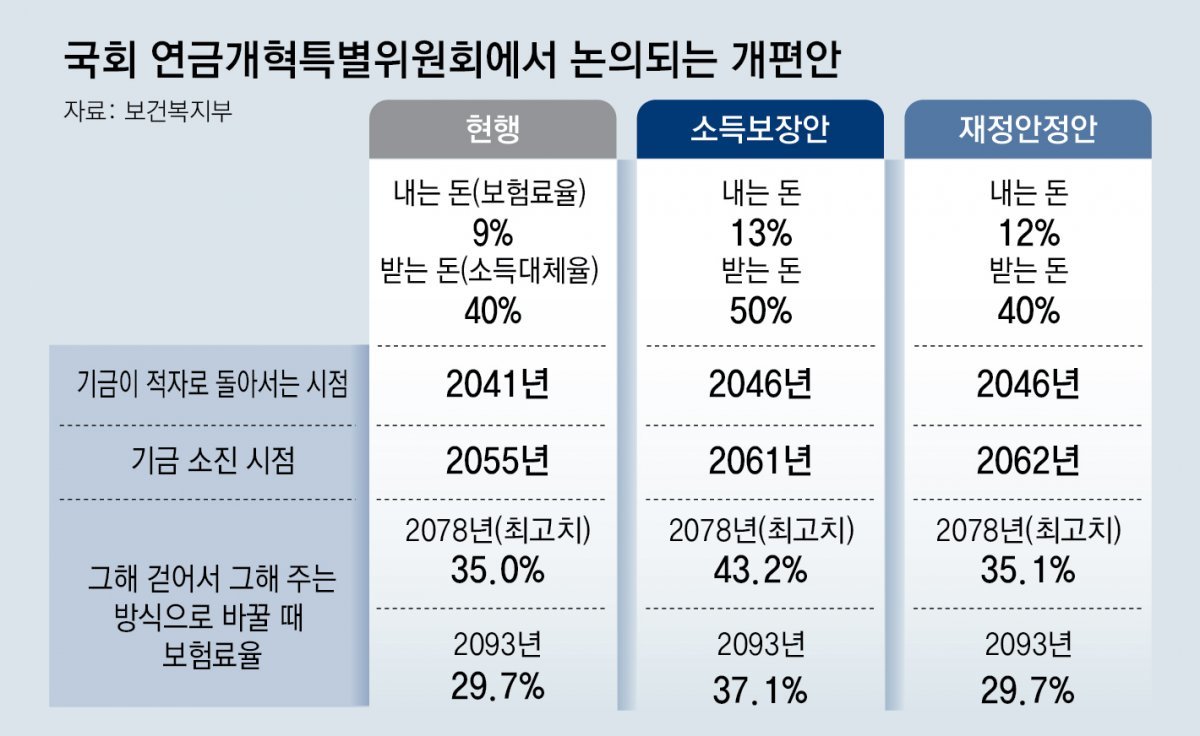
The young respondents agreed that neither of the two reform plans the National Assembly Special Committee on Pension Reform had been discussing could be a fundamental solution. The Special Committee put forward the “income security plan” (contribution rate 13%, income replacement rate 50%) and the “fiscal stabilization plan” (12%, 40%) as the final candidates, but critics point out that both merely push back the fund depletion date by six or seven years, to 2062 and 2061 respectively, which falls far short of easing the burden on future generations.
Kim Yu-jin (17), a second-year student at a high school in Seongnam, Gyeonggi Province, said, “Whether it is the income security plan or the fiscal stabilization plan, it makes little difference to me, since I will retire after the fund is depleted anyway. I think plans that take our generation into account, such as pushing back the pension eligibility age by five years, should be discussed.” Yoon Ji-hwan (18), who attends a high school in North Chungcheong Province, said, “From our standpoint, both plans seem like options in which we unfairly have money taken from us before we even retire.”
In particular, nine in 10 of the young people opposed the income security plan. This is the exact opposite of the Special Committee’s survey, in which 56% of the citizen representatives supported the income security plan. If the income security plan is adopted, future generations will have to pay up to 43.2% of their income in contributions, and many of them were daunted by the burden, saying “I cannot even imagine such a future.” Kim Yu-jin said, “We will already have to pay high contributions in the future, and I cannot agree to a plan that makes that burden even bigger.” Yoon sighed, “My youngest sibling is in a situation where, earning 1 million won, they would have to pay 400,000 won in contributions.”
● “Are We Not ‘Citizens’ Just Because We Cannot Vote?”
Many also expressed great regret that the youth generation, the people who will be most affected by the outcome of pension reform, had been excluded from the debate. They said it is incomprehensible that the government and the National Assembly sidelined young people while gathering public opinion dozens of times.
On this, the young people asked, “Did this result come about because most of the adults leading the debate need not worry about the contribution bomb and the fund will not be depleted within their life expectancy?” Kim Min-jae said, “Was it not only the adults who will soon receive pensions who gathered (in the National Assembly) and reached a conclusion? Just look at how the fiscal stabilization plan, which should have been chosen if future generations had been considered, was pushed to the back.” Kim Yu-jin pointed out, “It seems the problem arose because the policy was pursued for the purpose of winning (adults’) votes, without gathering the views of young people.” Yoon criticized, “Because (young people) have no vote, politicians do not seem to take an interest in our views.”
They also pointed out that “adults, including schools, have not properly told us the reality of the National Pension.” Jung A-yoon raised her voice: “The fund will definitely be depleted, and filling the gap will be our share. Instead of just repeating ‘there will be big trouble in the future,’ the adults should take responsibility and explain it to us.” Lee said, “It is a big problem that schools do not teach about pensions at all.”
● Opinions Split: “Pensions Are Essential” vs. “Better to Abolish Them”
Many respondents agreed on the necessity of the National Pension system itself. Yoo said, “I think the pension is a system needed not only by adults working at their jobs now but also by our generation when we become grandmothers. I hope our generation can enjoy its benefits too.”
But among some respondents, the argument even came up that “should the National Pension not be abolished?” Jung Esel (12), a sixth-grade student at an elementary school in Daejeon, criticized, “As the population keeps shrinking, the guarantee that we will be able to receive the National Pension also disappears. If so, I wish someone would explain what we are paying contributions for.”
Some said, “Is even the promise to ‘pay more later’ not ultimately a story limited to the ‘older generation’?” and “I would rather pay less and take care of my own old age.” Joo Young-min (11), a fifth-grade elementary school student, also said, “If you have a child, it costs much more money, so is it not better to pay less then and keep the money? I do not understand why we have to pay more and receive more.”
● “Listen to Those Affected, and All Generations Should Share the Burden”
They appealed for young people’s voices to be reflected in the debate as well, so that a reform plan that considers future generations can be drawn up. Lee stressed, “(Putting pension finances on a sound footing) is ultimately a responsibility future generations will have to bear. The National Pension is a system for all ‘citizens,’ and young people will carry the greatest responsibility, so I hope we are given a chance to speak too.” She also stressed, “Procedures are needed, such as (the National Assembly and the government) inviting people our age, the generation that will actually bear the burden, and gathering our views.”
The young people also said that not only they but all generations should share the fiscal burden. Yoo said, “We are not asking for pension reform that one-sidedly reflects only the views of young people. We are asking other generations to share, even a little, the burden of the high contributions our generation will have to shoulder.” Kim Yu-jin said, “If we all live together in the big house called the Republic of Korea, it is time to think about ways for everyone to live well together, even if it means a loss for me right now.”
There were also voices saying the problem of population aging should be solved, rather than one-sidedly forcing sacrifice on the young generation. Lee Ma-rin (17) argued, “In a society where the elderly population is steadily growing, the structure that shifts all responsibility onto the young people who work needs to change. Along with pensions, reform should move in a direction that lets the retired generation actively generate income as well, for example through jobs for older people.”
Reporter Kim Su-hyun [email protected]
Reporter Lee Su-yeon [email protected]
Reporter Lee Sang-hwan [email protected]
Reporter Lim Jae-hyuk [email protected]