
(Asia Economy) “Pension Reform That Pays More Is Possible Without Changing the Income Replacement Rate” [Issue Interview] June 11, 2024
Yun Suk-myung, Research Fellow Emeritus at the Korea Institute for Health and Social Affairs Political discord over pension reform continues unabated. The Democratic Party of Korea announced that it would accept the bipartisan compromise proposal (a contribution rate of 13% and an income replacement rate of 44%), while the People Power Party moved to slow the process, insisting that structural reform is necessary. In this context, a proposal by the Korea Development Institute (KDI) to bifurcate the National Pension into a new pension and an old pension has come under discussion.
Yun Suk-myung, Research Fellow Emeritus at the Korea Institute for Health and Social Affairs, stated in an interview with Asia Economy on the 4th that “both proposals have fatal problems,” characterizing them as “passing astronomical debt on to future generations or shifting the pain of pension reform onto them.” Regarding the bipartisan compromise proposal in particular, he criticized it, saying, “The very point of reform is that there are shortcomings to address, yet rather than reducing the mountain of debt, this looks like increasing debt under the banner of reform,” and adding, “Raising the income replacement rate by even 0.1 percentage point makes it not a reform plan but a ‘deterioration’ plan.” He explained, “Instead, fiscal stabilization can be achieved by supporting vulnerable groups through tax funding such as the Basic Pension and by cutting monthly and annual pension payments in line with increases in life expectancy.”
Research Fellow Yun is a pension expert who took part in every one of the 1st through 5th (2003–2023) National Pension Financial Projection Committees. He has been involved in the entire course of pension reform discussions since the National Pension System Improvement Planning Group of 1997. He is regarded as an expert who emphasizes the fiscal stabilization of pensions.

View original Yun Suk-myung, Research Fellow Emeritus at the Korea Institute for Health and Social Affairs, being interviewed by Asia Economy. Photo: Reporter Yoon Dong-ju doso7@
-What state is the National Pension in?
▲Pension finances are deteriorating badly. According to the results of the 5th National Pension financial projection, if the current system (a contribution rate of 9% and an income replacement rate of 40%) is maintained, reserves will grow until 2040, peaking at 1,755 trillion won, and be depleted in 2055. The money that disappears at that point is not just the 1,755 trillion won in reserves. Fund investment returns and newly incoming contributions also vanish. Since the two combined come to about 1,000 trillion won, depletion of the pension means that 2,755 trillion won evaporates.
Even if the income replacement rate is kept at the current 40% and the contribution rate is set at 15%, up 6 percentage points, the finances remain unstable. The fund depletion date is pushed back by about 16 years to 2071, but unfortunately even this figure is more optimistic than reality. The National Pension Financial Projection Expert Committee at the time assumed that the total fertility rate (the number of children a woman is expected to bear over her lifetime) would rebound to 1.21 from 2030–2040. With the total fertility rate now at around 0.6–0.7, is it possible for it to roughly double within a few years?
-Can the reform plans put forward by the National Assembly solve the pension problem?
▲If the contribution rate and the income replacement rate are raised to 13% and 44% respectively, as in the compromise floated by the ruling and opposition parties, implicit liabilities will surge. The contribution rate at the level of long-term fiscal balance, which passes no further debt on to future generations, is called the balancing contribution rate. With an income replacement rate of 44%, the balancing contribution rate is about 22%. That is 9 percentage points higher than the compromise (13%). Put the other way, it is all but certain to hand future generations an additional mountain of contribution debt amounting to 9 percentage points a year. The very point of reform is that there are shortcomings to address, yet rather than reducing the mountain of debt, this looks like increasing debt under the banner of reform. Raising the income replacement rate by even 0.1 percentage point makes it not a reform plan but a “deterioration” plan.
-The average monthly National Pension benefit is in the 600,000 won range. Is there no way to increase “what people receive”?
▲Raise the National Pension’s income ceiling. At present, the cap on the standard monthly income for National Pension contributions (the monthly income the insured report, used to calculate their pension amount) is about 6 million won. This means that even those earning more than 6 million won a month pay contributions based on the cap. This is considerably lower than in other public pensions such as the Government Employees Pension. If the National Pension’s standard monthly income cap were raised to the level of the Government Employees Pension (8.6 million won), people could receive a sizable pension even with a 40% income replacement rate.
-What about low-income people? Some say the income replacement rate should be raised to address old-age poverty.
▲Sweden, which separated pension policy from social policy in 1998, is a good example. Pension policy secured sustainability by letting people receive only as much as they paid in, while social policy guaranteed vulnerable groups a minimum standard of living in old age through tax funding. Korea, too, should respond to old-age poverty through selective programs such as the Basic Pension. That is because the core of old-age poverty is the polarization of income and assets. The wealthy top 10% of older people are the richest in the country, having benefited from high growth, while the bottom 25% are the most miserable group of any age. That is why the National Pension, a universal welfare program, cannot solve the problem of old-age poverty.
Raising the income replacement rate also risks deepening polarization. An analysis of the expected contribution periods of deciles 1 through 10 shows that the poor first decile comes to only 19.3 years, whereas the wealthy tenth decile comes to 33.9 years. Because the National Pension is structured so that benefits rise with the length of the contribution period, the benefits of raising the income replacement rate are likely to go to the wealthy. It must also be understood that raising the income replacement rate does not solve the problem immediately. Even if the income replacement rate is raised today, it takes about 40 years for the effect to take full hold. In other words, poor older people today cannot benefit right away.
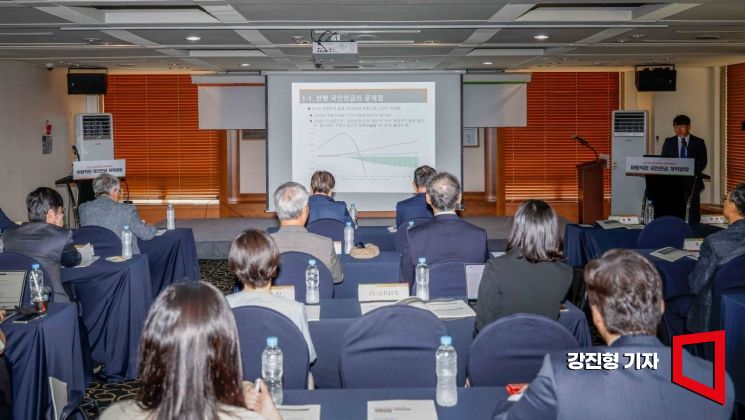
View original Shin Seung-ryong, KDI Associate Research Fellow in the Fiscal and Social Policy Research Division, on the 23rd at the Press Center in Jung-gu, Seoul, attends the “Debate on the Direction of National Pension Reform” hosted by KDI and the Korean Economic Association and presents on the topic “A Plan for Structural Reform Toward a Fully Funded National Pension.” Photo: Reporter Kang Jin-hyung aymsdream@
-How do you view KDI’s proposal to split the National Pension into a new pension and an old pension for fiscal stabilization?
▲It has a fatal problem of intergenerational equity. KDI’s proposal is to accumulate the contributions that come in from the time of reform anew in a new pension account. KDI argues that old-pension contributions paid before the reform should be managed separately, and that when fiscal shortfalls arise in the old pension because of low fertility and population aging, they should be covered with injections from the national treasury. This gives the older generation a free pass. If the state pays off the fiscal burden of the old pension, current beneficiaries and the generation about to start receiving benefits bear none of the pain, so they will say “thank you.” Young people, on the other hand, would have to bear two to three times more on their own for a pension scheme from which they may never receive benefits. Would they welcome that?
-Then how should the National Pension be reformed?
▲The direction of pension reform should be to remove worries about National Pension finances for at least 30 and up to 70 years. Let us adopt a Finnish-style life expectancy coefficient. It is a method under which monthly and annual pension payments automatically decrease as life expectancy increases. However, the total pension amount the National Pension Service pays to each beneficiary over a lifetime stays the same. Applying a life expectancy coefficient lets the older generation share the pain of pension reform while also delivering a large fiscal stabilization effect. That is because rising life expectancy is a major cause of fiscal instability. The National Pension Service expected beneficiaries to receive pensions for about 20 years, but the period of pension receipt has now grown to 25–30 years.
It is also necessary to keep in mind the 1,825 trillion won in implicit liabilities I mentioned earlier. Young people can have hope only if implicit liabilities stop at 1,825 trillion won or, if they grow, grow only a little. The goal should be not to add to the mountain of debt while leaving the income replacement rate as it is.
-Is there anything you would ask of the government and the National Assembly?
▲In a soccer match, besides the first and second halves, there is injury time (extra time allowed at the referee’s discretion after regulation time). Delaying the fund depletion date by five to six years through pension reform is like scoring one or two goals in the first half. The second half still remains, and so does the injury time after it. Since life expectancy has risen far more than expected, pension reform should be approached with serious consideration of how long injury time will run. In doing so, all information related to pensions needs to be shared with the public. The National Pension’s implicit liabilities were disclosed only after long demands and pressure. The minutes of meetings related to pension reform should be posted, and the Government Employees Pension, too, should publish its financial projection results.
Yun Suk-myung, Research Fellow Emeritus at the Korea Institute for Health and Social Affairs, is...
Born in 1961, he graduated from Korea University’s Department of English Language and Literature and received a Ph.D. in economics from Texas A&M University in the United States. He has served as a member of the 1st through 5th National Pension Financial Projection and System Development Committees, a member of the Government Employees Pension Financial Estimation Committee, chair of the Basic Old-Age Pension Financial Projection Committee, and President of the Korean Pension Association, among other posts. He is currently a Research Fellow Emeritus at the Korea Institute for Health and Social Affairs.
Reporter Jeon Young-ju [email protected]
Copyright ⓒ Asia Economy. All rights reserved. Unauthorized reproduction and redistribution prohibited.


