
(Newspim) [Interview] Dr. Yun Suk-myung of KIHASA: “Raising the National Pension’s Income Replacement Rate Is Not Reform but Deterioration.” June 10, 2024, 6:00 a.m.
“Keep the income replacement rate and raise only the contribution rate”
“An income replacement rate of 50% in major advanced countries? The benchmarks themselves are different”
“Include the Basic Pension and Korea’s income replacement rate is far higher”
“National Pension reform should introduce a life expectancy coefficient”
[Sejong=Newspim] Reporter Lee Jung-ah = “Raising the National Pension’s income replacement rate above its current level is not reform but deterioration.”
Yun Suk-myung, Research Fellow Emeritus at the Korea Institute for Health and Social Affairs, made this point about the pension reform plans discussed by the 21st National Assembly’s Special Committee on Pension Reform and the citizen representatives in an interview with Newspim on the 7th.
Research Fellow Yun is a National Pension expert who has taken part in the entire course of National Pension reform discussions since the National Pension System Improvement Planning Group of 1997. In particular, from the 1st Financial Estimation Committee in 2003 to the 5th Financial Estimation Committee last year, he was in charge of the fiscal stabilization measures, the committees’ most central task.
He stressed that the reform plans presented by the Public Deliberation Committee under the 21st National Assembly’s Special Committee on Pension Reform are, on the contrary, a shortcut to deterioration. That is, the parametric reform plans, which adjust the contribution rate and the income replacement rate, would greatly undermine fiscal soundness.

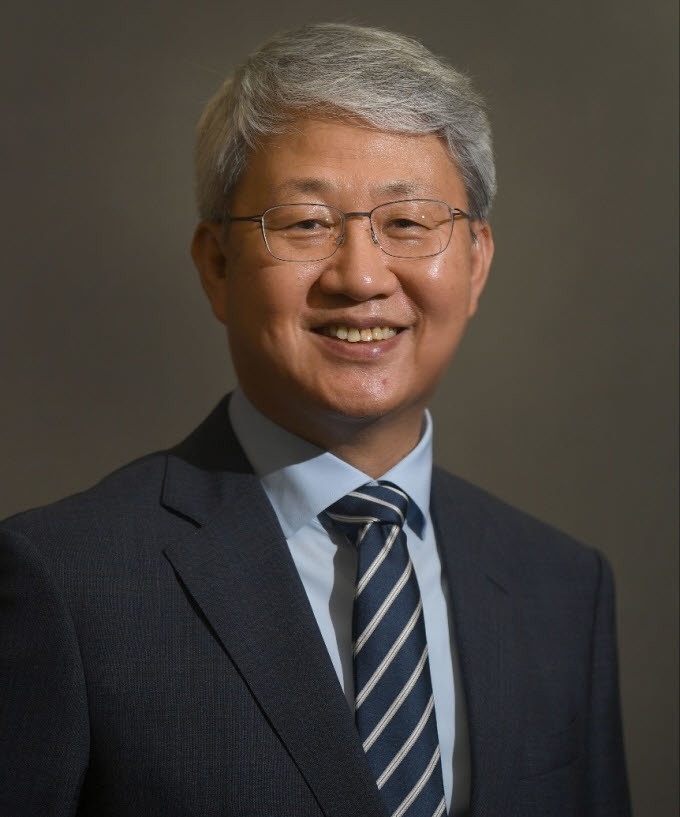
Yun Suk-myung, Research Fellow Emeritus at the Korea Institute for Health and Social Affairs [Photo: Pension Future Forum] June 9, 2024 [email protected]
Research Fellow Yun said sharply, “The core finding of the 5th National Pension Financial Estimation Committee is that even if the income replacement rate is kept at 40% as scheduled and the contribution rate is raised to 15%, 6 percentage points above the current 9%, fiscal stabilization cannot be achieved,” adding, “Ignoring this and pushing to raise the income replacement rate further would bankrupt the system.”
He went on to point out, “Moreover, the 5th financial projection is the result of applying the extremely optimistic assumption that a fertility rate that has plunged into the 0.7 range will rebound to 1.21,” and “no National Pension financial projection results assuming ultra-low fertility have been released.”
Earlier, the Public Deliberation Committee under the National Assembly Special Committee on Pension Reform formed a panel of citizen representatives for social consensus, in order to complete National Pension reform before the end of the 21st National Assembly’s term. The intent was to explain the National Pension scheme to them and to set the direction of pension reform through a survey.
The options the Public Deliberation Committee presented were Plan 1 (a 50% income replacement rate and 13% contributions) and Plan 2 (a 40% income replacement rate and 12% contributions); in the final survey, Plan 1 (56.0%) came out 13.4 percentage points ahead of Plan 2 (42.6%). The representatives chose the “income security” argument of paying more into the National Pension and getting more back (see figure).

On the current pension reform debate drifting into fiscal stabilization versus income security, Research Fellow Yun stressed, “Even ‘a 40% income replacement rate and 15% contributions’ will struggle to achieve fiscal stabilization,” adding, “To avoid passing debt on to future generations, the income replacement rate must be kept at 40% and the balancing contribution rate of 21.8% must be collected.”
The following is the Q&A with Research Fellow Yun.
-What do you consider the essence of a pension system?
▲A pension system is one where money comes in and goes out. That means more than 99% of it depends on actuarial calculation. So the money coming in and the money going out have to be balanced. Yet unlike most member countries of the Organisation for Economic Co-operation and Development (OECD), we have failed to strike an actuarial balance.
-What specific measures do you propose for the fiscal stabilization of the National Pension?
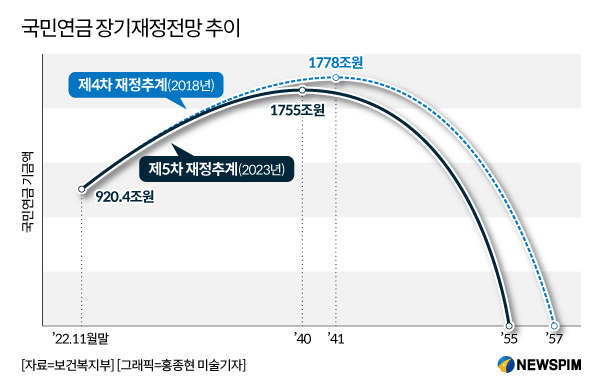
▲For example, if the income replacement rate is lowered to 30% and the contribution rate is set at 15%, the fund is depleted in 2070. By contrast, if the income replacement rate is set at 50% and the contribution rate at 15%, the fund is depleted in 2065. Even though 20 percentage points more in income replacement is paid, the fund depletion date differs by a mere five years.
226 November 1
-Do you mean it is problematic to judge fiscal stabilization by the fund depletion date alone?
▲Exactly. Judging by the fund depletion date alone can create a major optical illusion. The indicator that can assess the health of the National Pension is the cumulative deficit. The recently released cumulative deficit of the National Pension through 2093 reaches 21,656 trillion won. Compared with the 17,000 trillion won at the time of the 4th financial projection in 2018, that is an increase of 4,656 trillion won in five years.
-What other optical illusions are there in the National Pension scheme?
▲First, according to the 5th financial projection, the contribution rate that would not shift debt onto future generations is 19.8%. When the scheme was introduced in 1988 the rate was 3%, and over the past 26 years, too, contributions have been collected at 9%. Because far less has been collected than the pensions to be paid out, debt has piled up like a mountain. According to an estimate by Professor Jeon Young-jun of Hanyang University, a member of the Pension Future Forum, the National Pension’s unfunded pension liability (the amount by which it falls short of the pensions promised) is approaching 1,825 trillion won (80.8% of GDP) as of last year.
-OECD countries have income replacement rates of around 40–50%. Is Korea’s not low by comparison?
▲That is not true. Even within the OECD, the benchmarks themselves differ. Because Korea pays the Basic Pension, including the Basic Pension amount effectively puts old-age income security well above 40%. Also, any comparison with the OECD must be made on matching benchmarks to avoid distortion. For example, most of the OECD countries we usually compare ourselves with have contribution rates of around 15–20%, far higher than Korea’s, and contribution periods of about 40 years. A simple comparison is problematic.
-Why do you argue that the Public Deliberation Committee on pension reform presented biased options?
▲At the time of the 5th financial projection, most committee members supported the combination of “a 40% income replacement rate and a 15% contribution rate.” And in a survey conducted last year by the advisory committee of the National Assembly Special Committee on Pension Reform, 10 of the 15 members chose “a 40% income replacement rate and a 15% contribution rate.” Yet the “40% income replacement rate and 15% contribution rate” plan, which had the overwhelming support of experts, was excluded entirely from the learning materials for the citizen representatives this time. The same was true of the final survey. I want to ask whether a pension reform debate conducted with skewed rule-setting is a proper one.
-In what direction should the pension reform debate proceed from here?
▲While reflecting the views of young people, we must scrutinize whether the overhaul plans discussed so far are truly sound reform plans. Even if pension reform is urgent, going in the wrong direction is worse than doing nothing. Discussion of converting from a defined benefit (DB) arrangement to defined contribution (DC) must also begin. The 22nd National Assembly should continue the pension reform debate carefully, without leaning to one side.
-If there is a pension reform plan that does not shift the burden onto future generations, what is it?
▲I think an earnings-related scheme that pays in proportion to one’s own income is best. The welfare policies embedded in the National Pension should also be separated out. In other words, the National Pension should be designed to be sustainable on its own, and welfare policy should be handled through fiscal policy. For example, Finland introduced a life expectancy coefficient, under which pension amounts automatically decrease as life expectancy rises, for the sake of fiscal stabilization. Proper pension reform can be achieved when the pain of reform is not shifted onto future generations alone but shared by the older generation as well.


