
(Dong-A Ilbo) Government Employees Pension “Patched with Taxes” — Next Year’s Deficit Subsidy at a Record 4 Trillion Won. September 6, 2021
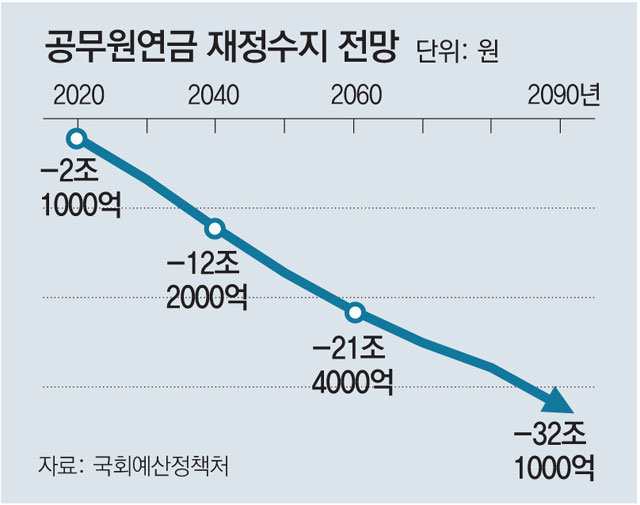
Reserves run dry…
deficits snowballing
Government and politicians
neglect reform

Next year, 4.1 trillion won in taxes will be injected to cover the Government Employees Pension deficit. This is the largest amount since 2001, when the government began covering the pension’s deficit with taxes.
According to the Ministry of Economy and Finance on the 5th, the government has included 4.1 trillion won in next year’s budget proposal to cover the Government Employees Pension deficit. Under the Government Employees Pension Act, the government has been covering the pension’s deficit with taxes since 2001. According to the 2021–2025 National Fiscal Management Plan the government submitted to the National Assembly, the Government Employees Pension is expected to run a fiscal deficit of 3.073 trillion won next year. The pension’s deficit reached 4.7709 trillion won last year and 4.1839 trillion won this year. As the deficit of the pension’s finances grew, the government’s subsidy rose from 59.9 billion won in 2001 to 3 trillion won in 2015. From 2016 through this year, taxes in the 2 trillion won range went in every year.
The reason next year’s subsidy for the Government Employees Pension will grow to a record level is that the number of retiring public servants and pension beneficiaries surged more than expected. Last year’s surge in retiring public servants means an additional 800 billion won will go into the Government Employees Pension. The number of Government Employees Pension beneficiaries next year will also rise by some 40,000, to 606,782, from this year’s 562,342. An official at the Ministry of Economy and Finance said, “As the number of retirees and beneficiaries increased, the government subsidy also surged.”
According to the “Long-Term Fiscal Outlook for the Four Major Public Pensions” released by the National Assembly Budget Office in July last year, Government Employees Pension beneficiaries (retirement pension plus survivors’ pension) will more than double, from 532,000 last year to 1,065,000 in 2060. Accordingly, the Government Employees Pension deficit, even including government subsidies and the like, is expected to worsen from 2.1 trillion won in 2020 to 21.4 trillion won in 2060.
“Expanding the Civil Service While Neglecting Pension Reform… Government and Politicians Shifting the Burden onto Future Generations,” Critics Say
The Government Employees Pension, patched with taxes

Although the Government Employees Pension deficit is ballooning, discussion of pension reform has sunk below the surface since the one reform of 2015. Under the current structure of the Government Employees Pension, public servants pay 9% of their salaries (4.5% for the National Pension) and the government pays another 9% as the employer contribution. In 2015, as the Government Employees Pension deficit problem grew serious, the government carried out a fourth reform, raising the contribution rate from 7% to 9% and lowering the accrual rate from 1.9% to 1.7%.
Despite this reform, however, the Government Employees Pension deficit keeps growing. The National Assembly Budget Office said, “As the Government Employees Pension reserves have been exhausted, fiscal deficits are being covered by (government) subsidies,” adding that “the situation calls for discussion on improving the finances of the Government Employees Pension.”
○ More public servants, pension reform neglected
In this situation, the Moon Jae-in administration is increasing the number of public servants. As of the end of last year, there were 1,131,796 public servants, 99,456 more than under the Park Geun-hye administration. Adding this year’s plans to increase central government staff and next year’s plans for local government staff, the number of public servants is expected to grow by 113,628 under the Moon Jae-in administration alone. Personnel costs for public servants have also risen by 11 trillion won under the Moon Jae-in administration, the largest increase after the Roh Moo-hyun administration (12.2 trillion won).
The other public pensions must also worry about mounting deficits. The Military Pension deficit will grow from 2.7457 trillion won last year and 2.8038 trillion won this year to 2.9077 trillion won next year. The Private School Teachers Pension is expected to turn to a deficit of 866.2 billion won from 2023. Some forecast that the National Pension could be depleted as early as around 2040. Under current law, the public pensions whose deficits the government covers with taxes are the Military Pension and the Government Employees Pension, but critics note that if deficits grow, taxes will inevitably have to be injected into the Private School Teachers Pension and the National Pension as well.
Even so, politicians and the government have effectively neglected pension reform. With next year’s presidential election approaching, there is reluctance to bring up pension reform, which could provoke civil-service voters. Only a few presidential contenders, such as former Representative Yoo Seung-min of the People Power Party and Representative Park Yong-jin of the Democratic Party, are calling for reform of the National Pension and the Government Employees Pension. Professor Kim Tae-ki of the Department of Economics at Dankook University pointed out, “Greatly increasing the number of public servants while not bringing up pension reform places a burden on future generations.”
○ “Reform must make people pay more and receive less”
According to the 2021–2025 National Fiscal Management Plan the government submitted to the National Assembly, the government’s burden for the four major public pensions, the Government Employees Pension along with the National Pension, the Military Pension, and the Private School Teachers Pension, will surge from 7.3902 trillion won last year to 10.4381 trillion won in 2025. Critics say that reforming the public pensions that shift burdens onto future generations requires changing them into a “pay more, receive less” form. According to academic material released in June this year by the Korean Pension Association, the Population Association of Korea, and the Seoul National University Population Policy Research Center, the deficit can be held at its current level only if Government Employees Pension contributions are raised from the current 18% to 30% or more and the accrual rate is lowered to 1.5% or below, close to the National Pension level. Pension Association President Yun Suk-myung said, “That the deficit did not shrink but actually grew despite the earlier Government Employees Pension reform is proof that the level of reform was minimal,” adding, “Pension reform discussions must take place as soon as possible.”
Sejong = Reporter Kim Hyung-min [email protected]

![(KBS TV. 이슈&뉴스] 공무원 연금, '세금 먹는 하마'?...'사회적 합의' 절실 (2013년 10월 23일)](/_next/image?url=%2Fuploads%2Feditor%2F2026%2F11%2Fcfe4824d207e450c8cad3a7c73e2fb04-Screenshot_20261122_221550_Samsung-Browser.jpg&w=128&q=75)