(KBS TV News) The Pension Fund Is Running Out Faster — Reform Is Now “Essential” (Posted March 22, 2022, 7:27 a.m.)
(Pension Future Forum comment:
We point out that the words
spoken by the interviewees in this KBS broadcast —
“pension reform” —
may be the same,
but what they concretely mean
can be the exact opposite.
The Pension Future Forum wishes to stress
that this holds in particular
for the remarks of the people presented as experts
in this broadcast.
In this in-depth KBS TV report,
two experts from the same institution,
the Korea Institute for Health and Social Affairs,
are interviewed side by side — a fact
that supports this claim.
For reference, Dr. Jung Hae-sik of the Korea Institute
for Health and Social Affairs, who appears as an interviewee,
after the Moon Jae-in administration took office,
while arguing that the National Pension’s income replacement rate
should be raised further,
was appointed Director of the Korea Institute
for Health and Social Affairs’s Public Pension
Research Center.)
While time slipped by without reform, both pillars of the pension system, “old-age income security” and “fiscal stability,” have weakened.
That is why people say pension reform can be delayed no longer.
Reporter Park Ye-won looks at the policy tasks for reform. Report
Four years ago, the 2018 projection already foretold a bleak future for the National Pension.
It concluded that the National Pension Fund would go into deficit in 2042 and be completely depleted in 2057, leaving no capacity to pay benefits.
Since the fertility rate has fallen further and life expectancy has risen further than projected at the time, the National Pension may be depleted even sooner.
[Yun Suk-myung / Research Fellow, Korea Institute for Health and Social Affairs:
“We have reached a world in which generations of fewer than 300,000, generations of 250,000 (births), must support a generation born a million strong. If the timing of pension reform is delayed, there will be almost no way left to deal with this.”]
The reform options usually discussed are paying more or receiving less.
First, what people pay in, the contribution rate, is about half the OECD average (18.2%).
What they receive, the income replacement rate, is already low after two rounds of reform.
So the contribution rate is more likely to be raised, in the direction of paying more rather than receiving less.
[Oh Jong-heon / Secretary General, Public Pension Strengthening People’s Action:
“If most citizens are confident that they can have a secure old age, I think they will agree to a reasonable burden.”]
But even if the contribution rate were doubled, the fund in 2088 would hold only enough to pay benefits for a single year.
In other words, it is not a complete solution.
In the end, it is a structure in which state finances will have to step in one way or another.
This is why some are calling for a redesign that links the National Pension with the Basic Pension, which is already being paid out of state finances.
[Jung Hae-sik / Director, Public Pension Research Center, Korea Institute for Health and Social Affairs:
“The Basic Pension, again, becomes a problem that brings some fiscal burden on future generations, so (we need to discuss) how to structure the Basic Pension better and what roles the National Pension and the Basic Pension should play.”]
Proposals to align the National Pension with other pensions, such as the Government Employees Pension and the Private School Teachers Pension, in terms of equity are also being publicly debated in political circles.
These are tasks that are hard to resolve without relying on the political momentum of an administration’s early days.
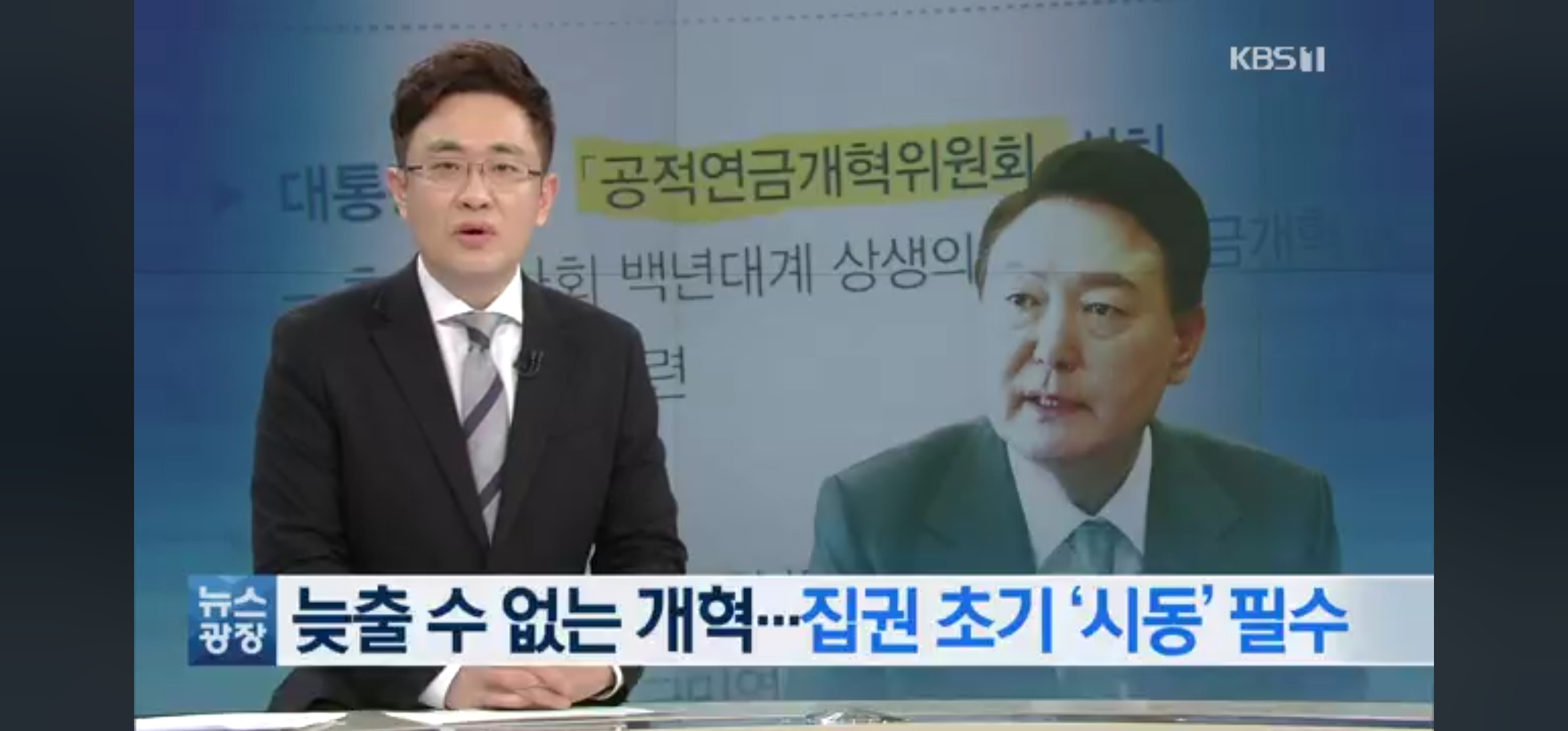
President-elect Yoon Suk-yeol, too, stressed in a TV debate during the campaign that pension reform is not optional and must be done early in the administration.
According to his campaign pledge book, a “Public Pension Reform Committee” is to be set up directly under the President.
This is Park Ye-won, KBS News.
Camera: Lee Kyung-gu / Video editing: Park Joo-yeon / Graphics: Lee Geun-hee